



Name
Classifications and Characteristics
| Plant Growth Form | Palm (Solitary Habit) |
|---|
Biogeography
| Native Distribution | Endemic to island of Ishigaki and Iriomote in the Ryuku archipelago. |
|---|---|
| Native Habitat | Terrestrial |
| Preferred Climate Zone | Tropical |
Description and Ethnobotany
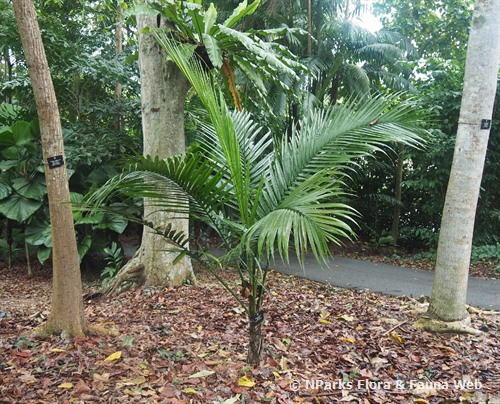
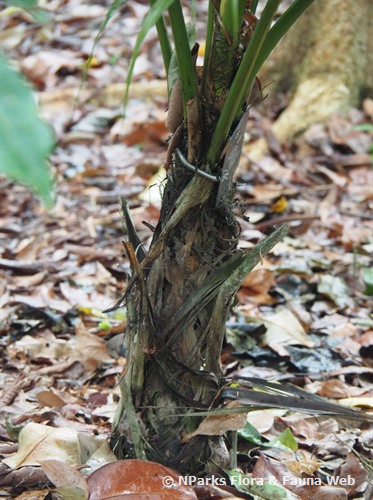
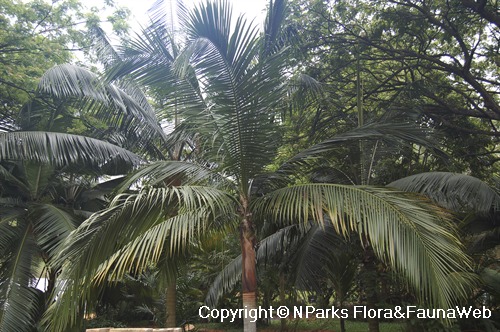
| Growth Form | It grows to 20 m tall, in habitat. It has a solitary trunk which is mostly cylindrical but can be swollen at the base. Adventitious roots may develop at the base. |
|---|---|
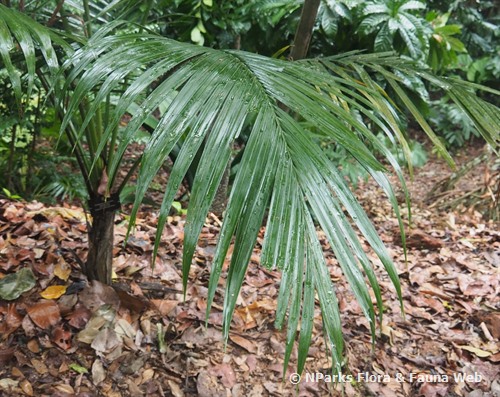
| Foliage | Leaves are pinnate, 2.4 – 3 m long and arching. Petiole is short (about 10 cm ) in adult palm and longer in juvenile palm. |
| Crown Shaft | Crownshaft is reddish green to mahogany green at maturity. |
| Flowers | Inflorescence is monoecious and appears pinkish. It usually forms below the crownshaft, Prophyll are dark green and densely covered in brownish scales. |
| Fruit | Fruits are oblong, 13 mm diameter and turn black when ripe. |
| Habitat | It grows on hills and near sea level in moist forest. |
| Cultivation | Seeds take up to 6 months to germinate. Avoid drying out before sowing. Less ripens seeds are observed to germinate better than fully ripen seeds. |
| Etymology | The genus is a combination of 2 words. The first word is to commemorate Toshihiko Satake (1910-1998), a Japanese industrialist, amateur botanist and lover of palm trees, while the second word, Kentia, is an archaic genus name used in combination to mean any sort of solitary, elegant, pinnate leaf palm. The epithet is latin for ‘of Liukiu” (Ryukyu). |
Plant Care and Propagation
| Light Preference | Full Sun |
|---|---|
| Water Preference | Moderate Water |
| Plant Growth Rate | Moderate |
Foliar
| Mature Foliage Colour(s) | Green |
|---|---|
| Leaf Area Index (LAI) for Green Plot Ratio | 2.5 (Palm - Solitary) |
Non - Foliar and Storage
| Trunk Type (Palm) | Solitary Habit, Aboveground |
|---|
Image Repository
Others
| Master ID | 1393 |
|---|---|
| Species ID | 2686 |
| Flora Disclaimer | The information in this website has been compiled from reliable sources, such as reference works on medicinal plants. It is not a substitute for medical advice or treatment and NParks does not purport to provide any medical advice. Readers should always consult his/her physician before using or consuming a plant for medicinal purposes. |