





Back
Duabanga grandiflora
| Family Name: | Lythraceae |
| Synonyms: | Duabanga sonneratioides |
| Common Name: | Beremban Bukit, Beremban Darat, Pedada Bukit, Pedada Darat, Bermah, Duabanga, 八宝树 |
Name
Classifications and Characteristics
| Plant Growth Form | Tree |
|---|---|
| Mode of Nutrition | Autotrophic |
Biogeography
| Native Distribution | Nepal, Southeast Asia |
|---|---|
| Native Habitat | Terrestrial |
| Preferred Climate Zone | Tropical |
Description and Ethnobotany
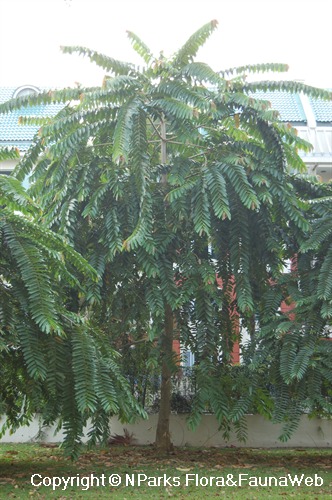
| Growth Form | Large tree, scarcely buttressed, able to grow up to about 18 - 30 m tall, sometimes reaching 40 m in its natural habitat. |
|---|---|
| Crown | Branches tend to spread out horizontally in all directions and drooping from the trunk. |
| Foliage | Large green oblong leaves, opposite arrangement, measuring about 12 - 15 cm long and 5 - 7 cm wide, petiole about 1.2 cm long, young leaves are reddish-pink. |
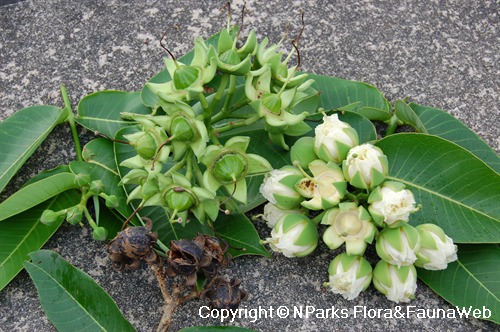
| Flowers | White 6-petaled flowers (3 - 20) borne on a drooping corymb inflorescence from the ends of branches, each flower about 5 - 6 cm wide, unpleasant smell, numerous stamens. |
| Fruit | Fruit is a subglobose capsule about 2 - 4 cm long and 4 cm wide, turns from green to brownish-orange when ripen, contains many small seeds. |
| Habitat | Can be found in lowland forests and along riverbanks. |
| Etymology | Genus Duabanga is from the Bengali name "Duyabanga". Species grandiflora means with large white flowers. |
| Ethnobotanical Uses | Edible Plant Parts : Edible Fruits Medicinal: Pounded leaves are applied as a poultice for stomachache. Timber & Products: The wood is used for making crates and furniture. |
Landscaping Features
| Desirable Plant Features | Ornamental Flowers, Ornamental Fruits |
|---|---|
| Landscape Uses | Parks & Gardens |
Fauna, Pollination and Dispersal
| Pollination Method(s) | Biotic (Fauna) |
|---|
Plant Care and Propagation
| Light Preference | Full Sun |
|---|---|
| Water Preference | Moderate Water |
| Plant Growth Rate | Moderate |
| Rootzone Tolerance | Moist Soils, Well-Drained Soils |
| Propagation Method | Seed |
Foliar
| Mature Foliage Colour(s) | Green |
|---|---|
| Foliar Arrangement Along Stem | Opposite |
| Foliar Attachment to Stem | Petiolate |
| Foliar Apex - Tip | Acuminate |
| Foliar Base | Rounded / Obtuse, Cordate |
Floral (Angiosperm)
| Flower Colour(s) | White |
|---|---|
| Flower Grouping | Cluster / Inflorescence |
Fruit, Seed and Spore
| Mature Fruit Colour(s) | Orange |
|---|
Image Repository
Others
| Master ID | 1571 |
|---|---|
| Species ID | 2864 |
| Flora Disclaimer | The information in this website has been compiled from reliable sources, such as reference works on medicinal plants. It is not a substitute for medical advice or treatment and NParks does not purport to provide any medical advice. Readers should always consult his/her physician before using or consuming a plant for medicinal purposes. |