










Back
Thespesia populnea (L.) Sol. ex Corrêa
| Family Name: | Malvaceae |
| Synonyms: | Hibiscus bacciferus, Hibiscus populneus |
| Common Name: | Bendy Tree, Milo, Bhendi Tree, Portia Tree, Pacific Rosewood, Baru Baru, Baru Laut, Bebaru, 桐棉 |
Name
Classifications and Characteristics
| Plant Division | Angiosperms (Flowering Seed Plants) (Dicotyledon) |
|---|---|
| Plant Growth Form | Tree (Medium (16m-30m), Small (6m-15m)), Shrub |
| Lifespan (in Singapore) | Perennial |
| Mode of Nutrition | Autotrophic |
| Plant Shape | Irregular |
| Maximum Height | 10 m to 20 m |
Biogeography
| Native Distribution | Throughout the tropical regions of the world (including Singapore) |
|---|---|
| Native Habitat | Terrestrial (Coastal Forest), Shoreline (Mangrove Forest, Sandy Beach) |
| Preferred Climate Zone | Tropical |
| Local Conservation Status | Native to Singapore (Least Concern (LC)) |
Description and Ethnobotany
| Growth Form | It is a tree or shrub, with dense crown, and usually grows up to 10 m tall although it has been recorded to be 20 m tall. |
|---|---|
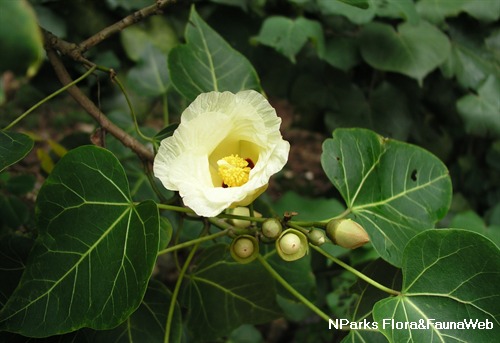
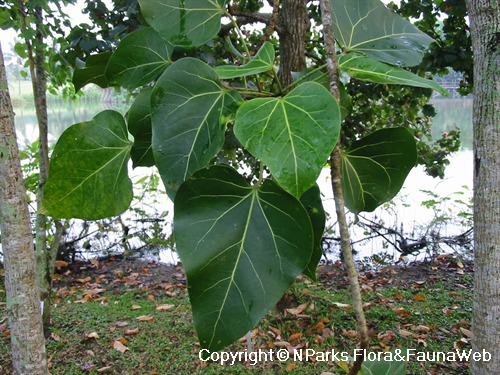
| Foliage | Its spirally arranged, stalked leaves have leathery leaf blades that are light green, triangular heart-shaped, and 7–23 by 5–16 cm, with 7 distinct, yellow veins. |
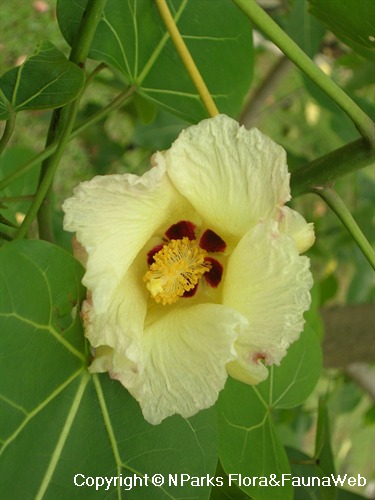
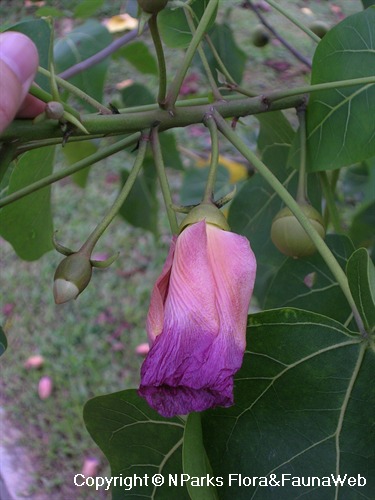
| Flowers | Its bisexual flowers are bell-shaped, 6–7.6 by 7.6 cm, solitary, inserted at leaf axils, and pale yellow with a maroon center. Older flowers will turn pink and will remain on the tree for few days. |
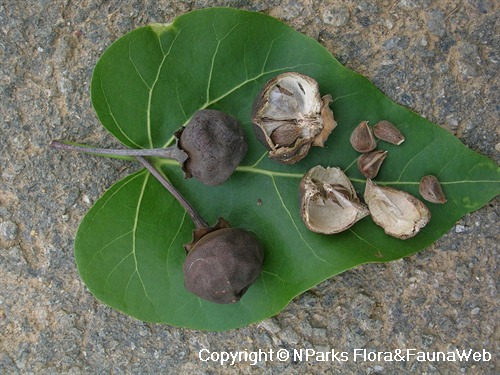
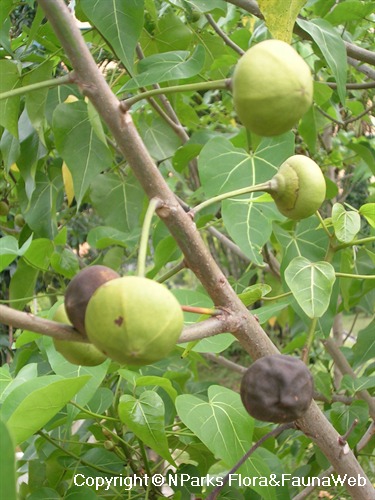
| Fruit | It produces capsules that are brown, round to pear-shaped, 2–5 cm across, contain yellow gum, and can split into 5 parts when ripe. Each part contains 3–4 seeds that are drop-shaped, 8–9 mm across, and can be densely covered by brown short hair. |
| Habitat | It grows on seashores and at the landward edge of mangrove forest. It occurs locally in Pulau Ubin, Pulau Tekong, the vicinity of Punggol Reservoir, in Sungei Buloh Nature Reserve, and Western Catchment Nature Reserve. |
| Associated Fauna | Its flowers are pollinated by insects. The thespesia fire bug (Dysdercus simon) can usually be found associated with the leaves of this plant. |
| Cultivation | It can be propagated by seed or air-layering. |
| Etymology | Greek, thespesios, divinely wondrous; Latin, populneus, similar to the poplar tree (Populus species) |
| Ethnobotanical Uses | Edible Plant Parts : Edible Leaves, Edible Flowers Food (Fruit or Vegetable): Leaves and flower buds may be eaten raw or cooked. Medicinal: Its leaves, woods, fruits, and seeds have medicinal properties. Timber & Products: Fiber from its bark is used to make cordage and to caulk boat. The plant is harvested for its light timber that can be made into paddles, furniture, and parts of carts. Cultural / Religious: The tree is considered sacred in the Pacific, hence is planted around temple, and its leaves are used in religious ceremony. Others: This species can breakdown petroleum hydrocarbons. The wood can also be used as dye. |
Landscaping Features
| Landscaping | It can be used as a roadside tree as it can tolerate full sun, high wind and dry conditions as well as salt spray and immersion of its roots in seawater. The plant also has attractive big yellow flowers. |
|---|---|
| Desirable Plant Features | Ornamental Flowers |
| Landscape Uses | Coastal Plant, Suitable for Roadsides, Parks & Gardens, Small Gardens, Beachfront / Shoreline |
Fauna, Pollination and Dispersal
| Pollination Method(s) | Biotic (Fauna) |
|---|---|
| Seed or Spore Dispersal | Abiotic |
Plant Care and Propagation
| Light Preference | Full Sun |
|---|---|
| Water Preference | Moderate Water |
| Plant Growth Rate | Moderate |
| Rootzone Tolerance | Moist Soils, Waterlogged Soils (Drains Site), Well-Drained Soils, Saline Soils / Salt Spray, Fertile Loamy Soils |
| Propagation Method | Seed, Stem Cutting, Air-Layering |
Foliar
| Foliage Retention | Evergreen |
|---|---|
| Mature Foliage Colour(s) | Green |
| Mature Foliage Texture(s) | Leathery |
| Foliar Type | Simple / Unifoliate |
| Foliar Arrangement Along Stem | Spiral |
| Foliar Attachment to Stem | Petiolate |
| Foliar Shape(s) | Non-Palm Foliage |
| Foliar Venation | Pinnate / Net |
| Leaf Area Index (LAI) for Green Plot Ratio | 3.0 (Tree - Intermediate Canopy) |
Floral (Angiosperm)
| Flower & Plant Sexuality | Bisexual Flowers |
| Flower Colour(s) | Yellow / Golden, Purple |
|---|---|
| Flower Texture(s) | Wrinkled |
| Flower Grouping | Cluster / Inflorescence |
| Flower Location | Axillary |
| Flower Symmetry | Radial, Asymmetrical |
| Individual Flower Shape | Trumpet-shaped |
| Flower Transitional Changes | Colour |
Fruit, Seed and Spore
| Mature Fruit Colour(s) | Brown, Yellow / Golden |
|---|---|
| Mature Fruit Texture(s) | Smooth |
| Fruit Classification | Simple Fruit |
| Fruit Type |
References
| References | Yong J, Tan PY, Nor Hafiz Hassan, Tan SN. 2010. A Selection of Plants for Greening of Waterways and Waterbodies in the Tropics. Singapore: Chung Printing . 480 pp. |
|---|
Image Repository
Others
| Master ID | 1897 |
|---|---|
| Species ID | 3190 |
| Flora Disclaimer | The information in this website has been compiled from reliable sources, such as reference works on medicinal plants. It is not a substitute for medical advice or treatment and NParks does not purport to provide any medical advice. Readers should always consult his/her physician before using or consuming a plant for medicinal purposes. |