







Back
Parastemon urophyllus (Wall. ex A.DC.) A.DC.
| Family Name: | Chrysobalanaceae |
| Common Name: | Kelat, Kelat Pasir, Kelat Puteh |
Name
Classifications and Characteristics
| Plant Division | Angiosperms (Flowering Seed Plants) (Dicotyledon) |
|---|---|
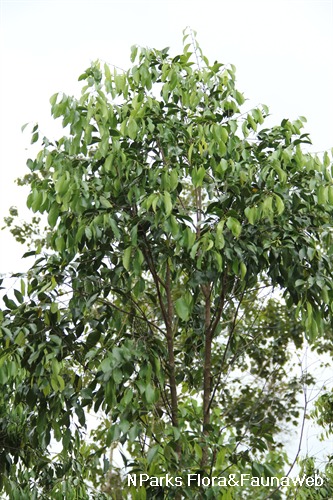
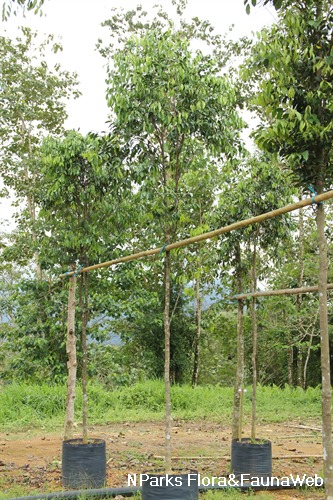
| Plant Growth Form | Tree (Big (>30m)) |
| Lifespan (in Singapore) | Perennial |
| Mode of Nutrition | Autotrophic |
| Plant Shape | Irregular |
| Maximum Height | 35 m |
Biogeography
| Native Distribution | Nicobar Islands, Sumatra, Peninsular Malaysia, Singapore, and Borneo |
|---|---|
| Native Habitat | Terrestrial (Primary Rainforest, Secondary Rainforest, Coastal Forest, Freshwater Swamp Forest, Riverine), Shoreline (Sandy Beach) |
| Preferred Climate Zone | Tropical |
| Local Conservation Status | Native to Singapore (Critically Endangered (CR)) |
Description and Ethnobotany
| Growth Form | It is a tree up to 35 m tall. |
|---|---|
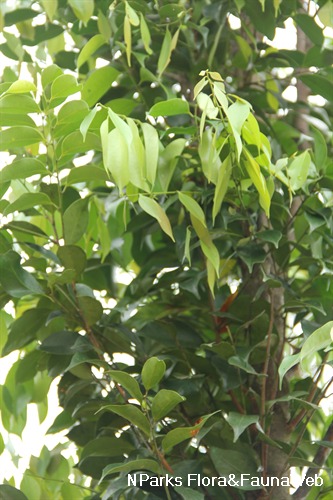
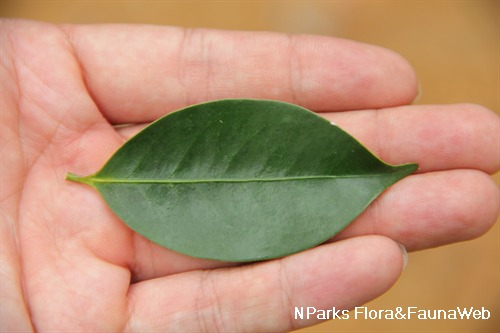
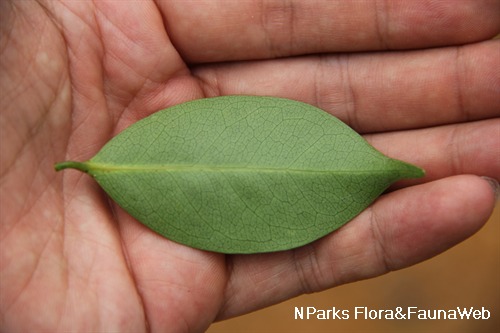
| Foliage | Its alternate, stalked, bright green leaves have thinly leathery leaf blades that are narrowly oblong, and 2.5-8 by 1.4-2.5 cm. |
| Flowers | Its 5-petalled flowers are about 0.5 cm long, and grow on 4-14 cm-long flowering shoots. |
| Fruit | Its yellowish fruits are pink when ripe, ellipsoid, and 1-1.5 cm long. |
| Habitat | It grows in peat swamp forests, river banks, seashores, and secondary forests with poor soil. It occurs locally in Bukit Timah Nature Reserve. |
| Cultivation | It can be propagated by seed. |
| Etymology | Greek para, near; Greek stamen, referring to both the fertile and sterile stamens being located near one another on one side of the flower; Greek aura, tail; Greek phyllon, leaf, the reference to which is unknown |
| Ethnobotanical Uses | Timber & Products: Its timber is suitable for heavy construction. |
Landscaping Features
| Landscaping | It is suitable for parks, streetscape and gardens for its bushy crown. |
|---|---|
| Desirable Plant Features | Ornamental Form |
| Landscape Uses | General, Suitable for Roadsides, Parks & Gardens, Small Gardens, Coastal Plant, Beachfront / Shoreline |
Fauna, Pollination and Dispersal
| Pollination Method(s) | Biotic (Fauna) |
|---|---|
| Seed or Spore Dispersal | Biotic (Fauna) |
Plant Care and Propagation
| Light Preference | Full Sun |
|---|---|
| Water Preference | Moderate Water |
| Plant Growth Rate | Moderate |
| Rootzone Tolerance | Moist Soils, Well-Drained Soils, Saline Soils / Salt Spray, Fertile Loamy Soils |
| Propagation Method | Seed |
Foliar
| Foliage Retention | Evergreen |
|---|---|
| Mature Foliage Colour(s) | Green |
| Mature Foliage Texture(s) | Leathery, Thin |
| Foliar Type | Simple / Unifoliate |
| Foliar Arrangement Along Stem | Alternate |
| Foliar Attachment to Stem | Petiolate |
| Foliar Shape(s) | Non-Palm Foliage |
| Foliar Venation | Pinnate / Net |
| Foliar Margin | Entire |
Floral (Angiosperm)
| Flower & Plant Sexuality | Bisexual Flowers |
| Flower Grouping | Cluster / Inflorescence |
|---|
Fruit, Seed and Spore
| Mature Fruit Colour(s) | Yellow / Golden, Pink |
|---|---|
| Fruit Classification | Simple Fruit |
| Fruit Type | Fleshy Fruit , Non-Accessory Fruit |
Image Repository
Others
| Master ID | 30206 |
|---|---|
| Species ID | 4515 |
| Flora Disclaimer | The information in this website has been compiled from reliable sources, such as reference works on medicinal plants. It is not a substitute for medical advice or treatment and NParks does not purport to provide any medical advice. Readers should always consult his/her physician before using or consuming a plant for medicinal purposes. |