

Back
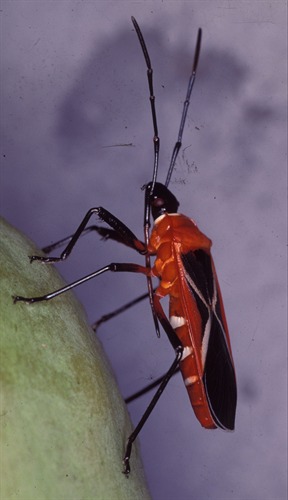
Dysdercus simon (Taeuber, 1927)
| Family Name: | Pyrrhocoridae |
| Taxonomic Group: | Invertebrates (Bug) |
| Common Name: | Thespesia Fire-bug |
Name
Ecology, Habitat & Location
| Ecological Notes | Apparently strictly associated with the back-mangrove shrub or small tree Thepesia populnea, this is a "cotton-stainer" bug with a St. Andrew's cross on its back, very much like a common species regularly seen on Sea Hibiscus, but with a black head instead of red. Larvae feed on the seeds exposed as soon as the capsules split open. The adutls seem to remain mainly on this host plant and are rarely seen elsewhere. |
|---|---|
| Habitats | Mangroves |
| Distribution | Previously known from the Philippines, and now from a single location in Singapore. |
| Nature Reserves | Sungei Buloh Wetland Reserve |
Conservation
| Trends & Threats | Habitat destruction, and especially host plant loss, as the species is totally dependent on it. |
|---|---|
| Scientific Interest & Potential Value | From early times, these brightly coloured bugs were classified mainly on differences in colour pattern and many names were proposed. By the middle of this century workers became convinced that structural characters of the male genitalia were the real clue to relationships and many of the apparently striking colour forms were no more than local variants. In a comprehensive review of the group, Freeman (1946) concluded that almost all of the X-marked bugs were one species, now called Dysdercus decussatus Boisduval, because the genitalia look the same and colour differences on museum specimens from many places seem to grade into each other when you see enough of them. Among other things there seemed to be a "cline" or gradation from blacker forms in the east (out to the Pacific) and redder forms to the west (where it reaches India). Now however we find two forms in Singapore (sympatric), breeding on different hosts, and consistently different in colour pattern, which have morphological differences. The rostrum of D. siimon is slightly longer and the proportion of its segments strikingly different from that of what passes for D. decussatus, the common local species which feeds on Hibiscus tiliaceus. Perhaps feeling that the striking similarity in genitalia settled the matter, Freeman gives no information on the rostrum for his material, nor do any earlier workers - perhaps because these bugs are usually preserved gummed belly down on cards. Since we certainly have two species here this throws the whole question of the numerous synonyms currently assigned to D. decussatus wide open again! |
| Conservation Notes | Found only at one site, the mangroves between Sungei Buloh and Kranji (the same general area as the firefly Pteroptyx). This area is under immediate threat of development. |
Status
| Singapore Red Data Book Status | Endangered (EN) [2008] |
|---|
Photos
References
| References | Davison, G.W.H., Ng, P.K.L. & Ho, H.C (Eds.). 2008. The Singapore Red Data Book (2nd Edition). Singapore: Nature Society (Singapore). 285pp |
|---|