







Back
Hugonia griffithiana (Planch.) Byng & Christenh.
| Family Name: | Linaceae |
| Synonyms: | Indorouchera griffithiana (Planch.) Hallier f., Roucheria griffithiana Planch. |
| Common Name: | Akar Biji, Akar Kait Putih, Akar Putih, Akar Tenggadin, Akar Tuai, Garam-garam |
Name
Classifications and Characteristics
| Plant Division | Angiosperms (Flowering Seed Plants) (Dicotyledon) |
|---|---|
| Plant Growth Form | Climber |
| Lifespan (in Singapore) | Perennial |
| Mode of Nutrition | Autotrophic |
Biogeography
| Native Distribution | India, Thailand, Sumatra, Peninsular Malaysia, Singapore, and Java |
|---|---|
| Native Habitat | Terrestrial (Primary Rainforest, Secondary Rainforest) |
| Preferred Climate Zone | Tropical, Sub-Tropical / Monsoonal |
| Local Conservation Status | Native to Singapore (Least Concern (LC)) |
Description and Ethnobotany
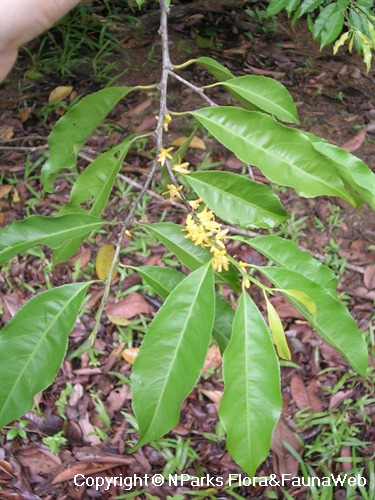
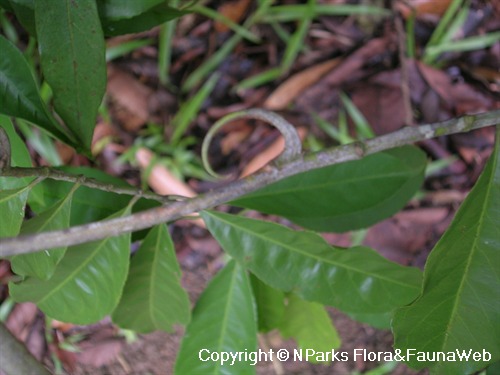
| Growth Form | It is a woody, hooked liana, with white bark, up to 30 m long. It rarely appears as a 4 m tall shrub or treelet. Its hook number varies, usually in pairs on climbing shoots and up to five hooks at the leaf and inflorescence axils. |
|---|---|
| Foliage | Its alternate, stalked leaves have leathery leaf blades that are elliptic to drop-shaped and 4–19 by 1–6.8 cm. The leaf margin is glandular to round-toothed. Its triangular to egg-shaped stipules are 0.7–0.8 by 1.5–1.8 mm. |
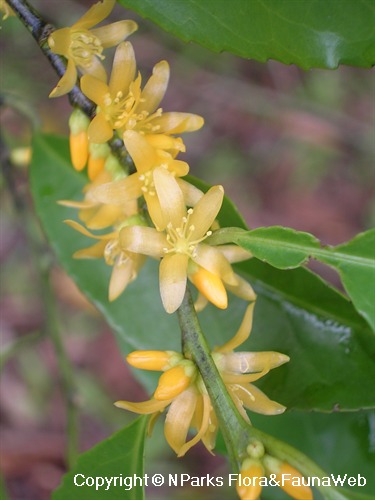
| Flowers | Its flowering clusters bear up to 10 flowers each. Its fragrant, yellow to orange coloured flowers are 0.9 cm wide. |
| Fruit | Its yellow to red fruits are egg-shaped to elliptic drupes that are about 4.5–6 by 3–4.5 mm. Its egg-shaped seeds are 3–4.5 by 2.2–2.3 mm. |
| Habitat | It grows in lowland and hill forests up to 1,500 m in altitude. It occurs locally in Central Catchment Nature Reserve, Nee Soon Swamp Forest, Pulau Tekong, Pulau Tekong Kechil, and Pulau Ubin. |
| Associated Fauna | Its flowers are insect-pollinated. Its fruits are probably eaten by birds. |
| Cultivation | It can be propagated by seed. |
| Etymology | Indorouchera, from the vernacular Indian name Rouchera; Latin griffithiana, commemorating William Griffin, a British botanist and the curator of the Calcutta Botanic Garden, who conducted extensive field observations in India and Afghanistan |
| Ethnobotanical Uses | Medicinal: Its flowers and
leaves are applied to treat headaches whereas a decoction of the root is
effective against bowel complaints. Others: Its bark and sap are used as dart poison. |
Landscaping Features
| Landscaping | It is suitable for parks. |
|---|---|
| Desirable Plant Features | Ornamental Flowers |
| Landscape Uses | Parks & Gardens |
Fauna, Pollination and Dispersal
| Pollination Method(s) | Biotic (Fauna) |
|---|---|
| Seed or Spore Dispersal | Biotic (Fauna) |
Plant Care and Propagation
| Light Preference | Semi-Shade, Full Sun |
|---|---|
| Water Preference | Moderate Water |
| Plant Growth Rate | Fast to Moderate |
| Rootzone Tolerance | Moist Soils, Well-Drained Soils, Fertile Loamy Soils |
| Propagation Method | Seed |
Foliar
| Foliage Retention | Evergreen |
|---|---|
| Mature Foliage Colour(s) | Green |
| Mature Foliage Texture(s) | Leathery |
| Foliar Type | Simple / Unifoliate |
| Foliar Arrangement Along Stem | Alternate |
| Foliar Attachment to Stem | Petiolate |
| Foliar Shape(s) | Non-Palm Foliage (Obovate, Elliptical) |
| Foliar Venation | Pinnate / Net |
| Foliar Margin | Serrate / Toothed |
Floral (Angiosperm)
| Flower & Plant Sexuality | Bisexual Flowers |
| Flower Colour(s) | Yellow / Golden, Orange |
|---|---|
| Flower Grouping | Cluster / Inflorescence |
| Flower Location | Axillary, Cauliflorous |
| Flower Symmetry | Radial |
Fruit, Seed and Spore
| Mature Fruit Colour(s) | Orange, Red |
|---|---|
| Fruit Classification | Simple Fruit |
| Fruit Type | Fleshy Fruit , Non-Accessory Fruit |
Image Repository
Others
| Master ID | 125 |
|---|---|
| Species ID | 1421 |
| Flora Disclaimer | The information in this website has been compiled from reliable sources, such as reference works on medicinal plants. It is not a substitute for medical advice or treatment and NParks does not purport to provide any medical advice. Readers should always consult his/her physician before using or consuming a plant for medicinal purposes. |