








Back
Norantea guianensis Aubl.
| Family Name: | Marcgraviaceae |
| Common Name: | Red Hot Poker Vine, Red Popcorn, Conoro-antegri, Karakara |






Name
Classifications and Characteristics
| Plant Division | Angiosperms (Flowering Seed Plants) (Dicotyledon) |
|---|---|
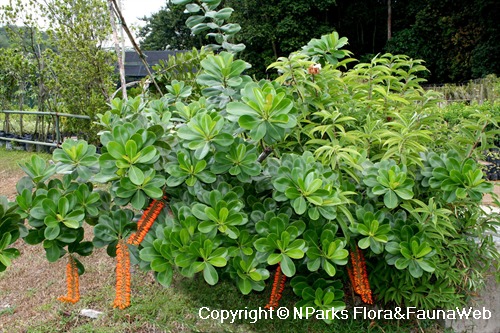
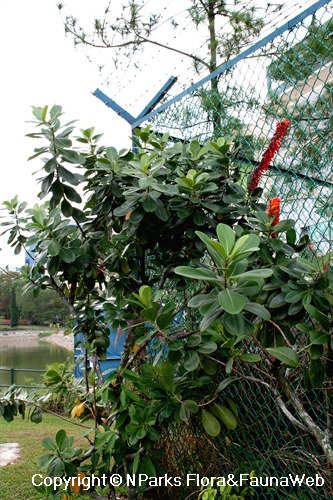
| Plant Growth Form | Climber |
| Mode of Nutrition | Autotrophic |
| Plant Shape | Shrubby |
| Maximum Height | 2 m to 9 m |
| Maximum Plant Spread / Crown Width | 1.2 m to 1.8 m |
Biogeography
| Native Distribution | Caribbean, South America (Amazon Basin) |
|---|
Description and Ethnobotany
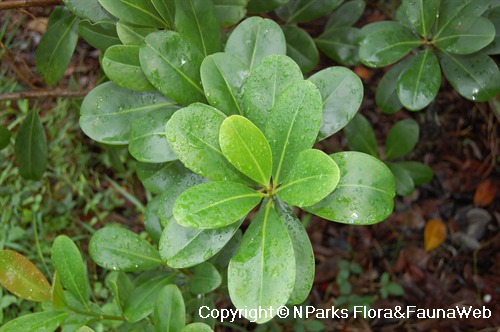
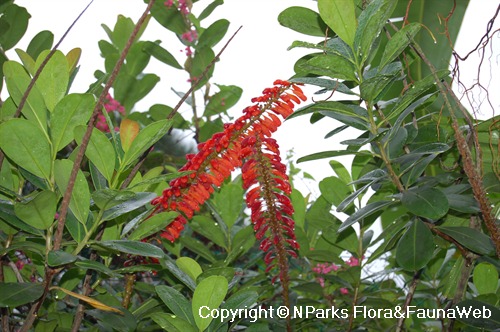
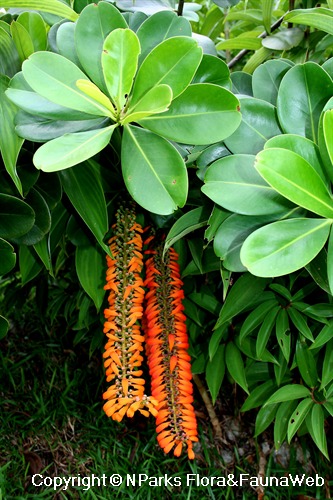
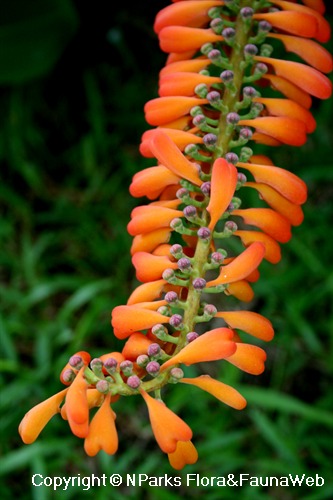
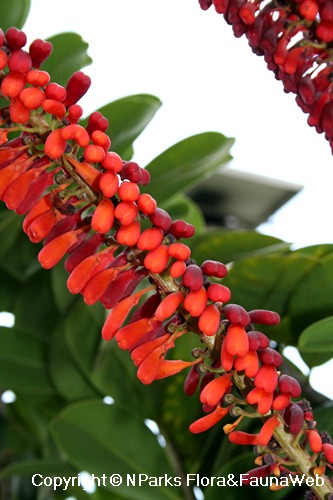
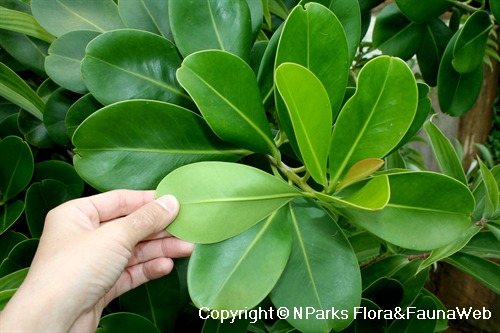
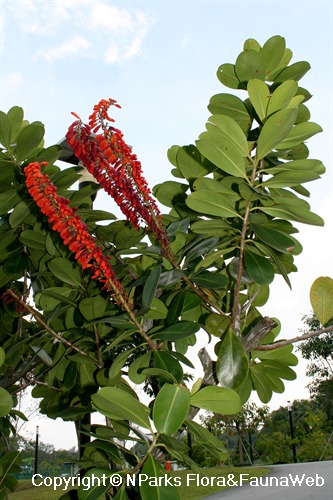
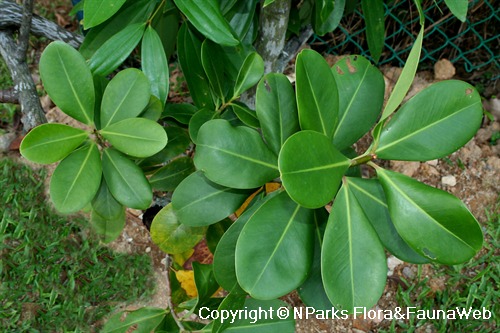
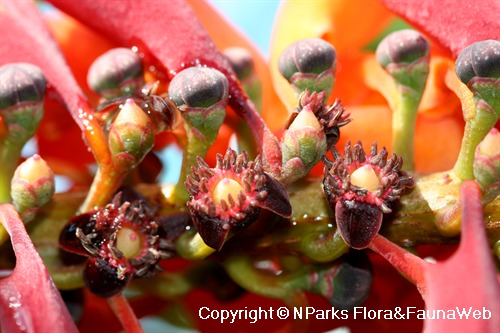
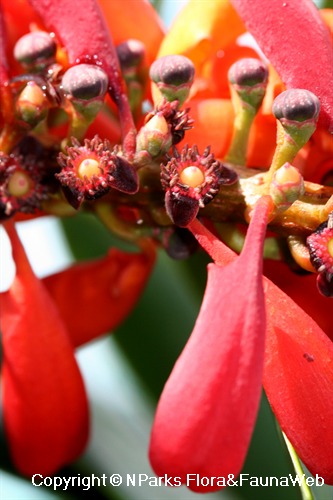
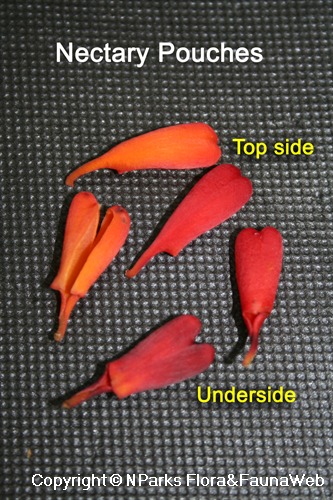
| Others - Plant Morphology | Large woody vine, climbing up to 9m with adventitious roots. Leaves glossy green, smooth and thick; young leaves orangey or reddish.Flowers small and insignificant, borne along middle axis of elongated terminal racemes up to 0.6m long. Narrowly heart-shaped and hollow structures are modified extrafloral nectaries (nectar pouches), mature from orange to dark red. Flowers pollinated by hummingbirds and other small perching birds.Fruits are globuse berries that split open to expose seeds embedded in brightly-coloured fleshy pulp, probably dispersed by animals.Used occasionally as ornamental. Suitable as focal climbing or scrambling shrub in parks and large gardens for attractive leaves and prominent inflorescences. Reported to bloom throughout the year in tropics, but flowering is fairly uncommon in Singapore, perhaps due to limited use and field observations.One of only 2 species in genus. Genus epithet 'Norantea' is latinization of "Conoro-antegri", the vernacular name of the plant in Guyana. Species epithet guianensis' is a reference to French Guinea (Guyana), South America. |
|---|---|
| Ethnobotanical Uses | Food (Herb or Spice) Others: Bark or wood cut into pieces and boiled in water for 1 hour, and the bright red tea drunk as treatment for diarrhoea and vomiting. Leaves used in bath or rubbed against body as fever remedy. |
Landscaping Features
| Desirable Plant Features | Ornamental Flowers, Ornamental Foliage |
|---|---|
| Landscape Uses | General, Focal Plant |
| Thematic Landscaping | Naturalistic Garden |
Fauna, Pollination and Dispersal
| Fauna Pollination Dispersal Associated Fauna | Bird-Attracting Plant |
|---|---|
| Pollination Method(s) | Biotic (Fauna) (Vertebrates (Bird)) |
Plant Care and Propagation
| Light Preference | Full Sun |
|---|---|
| Water Preference | Moderate Water |
| Plant Growth Rate | Moderate |
| Rootzone Tolerance | Drought Tolerant |
| Propagation Method | Stem Cutting |
Foliar
| Foliage Retention | Evergreen |
|---|---|
| Mature Foliage Colour(s) | Green |
| Mature Foliage Texture(s) | Smooth, Glossy / Shiny, Leathery, Thick |
| Prominent Young Flush Colour(s) | Orange |
| Foliar Type | Simple / Unifoliate |
| Foliar Arrangement Along Stem | Alternate |
| Foliar Shape(s) | Non-Palm Foliage (Obovate) |
| Foliar Venation | Pinnate / Net |
| Foliar Margin | Entire |
| Foliar Apex - Tip | Obtuse |
| Foliar Base | Cuneate |
| Typical Foliar Area | Mesophyll ( 45cm2 - 182.25 cm2 ) |
Non - Foliar and Storage
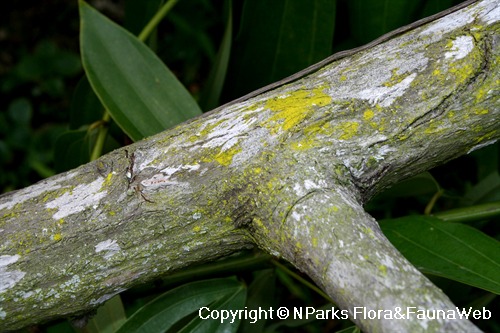
| Bark Colour(s) | Grey |
|---|---|
| Mature Bark Texture | Scaly |
| Stem Type & Modification | Woody |
| Root Type | Underground (Fibrous Root) |
Floral (Angiosperm)
| Flower & Plant Sexuality | Bisexual Flowers |
| Flower Colour(s) | Orange, Red |
|---|---|
| Flower Size - Remarks | Actual flowers small and insignificant. Promiment orange-red structures are modified extraflora nectaries. |
| Inflorescence Type | Raceme |
| Flowering Period | Rarely |
| Flower Lifespan on Plant | Several Weeks |
| Flowering Habit | Polycarpic |
| Inflorescence Size Remarks | Orange to red to dark red |
Fruit, Seed and Spore
| Fruit Classification | Simple Fruit |
|---|---|
| Fruit Type | Fleshy Fruit , Berry |
Image Repository
Others
| Master ID | 164 |
|---|---|
| Species ID | 1460 |
| Flora Disclaimer | The information in this website has been compiled from reliable sources, such as reference works on medicinal plants. It is not a substitute for medical advice or treatment and NParks does not purport to provide any medical advice. Readers should always consult his/her physician before using or consuming a plant for medicinal purposes. |