







Name
Classifications and Characteristics
| Plant Division | Angiosperms (Flowering Seed Plants) (Dicotyledon) |
|---|---|
| Plant Growth Form | Shrub |
| Lifespan (in Singapore) | Perennial |
| Mode of Nutrition | Autotrophic |
| Plant Shape | Irregular |
| Maximum Height | 2 m to 5 m |
Biogeography
| Native Distribution | Tropical Africa |
|---|---|
| Native Habitat | Terrestrial (Grassland / Savannah/ Scrubland) |
| Preferred Climate Zone | Tropical |
| Local Conservation Status | Non-native (Horticultural / Cultivated Only) |
Description and Ethnobotany
| Growth Form | It is a shrub up to 2-5 m tall. |
|---|---|
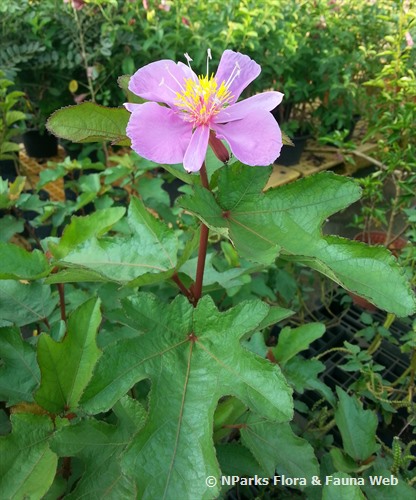
| Foliage | Its alternately-arranged, stalked leaves have palmate leaf blades that are broadly oblong to ovate, about 13 by 7 cm, 3-7-lobed, but more often 5-lobed. Both surfaces are covered with fine hairs, and the leaf margins are coarsely serrate. |
| Stems | Its branches are covered with orange-brown hairs. |
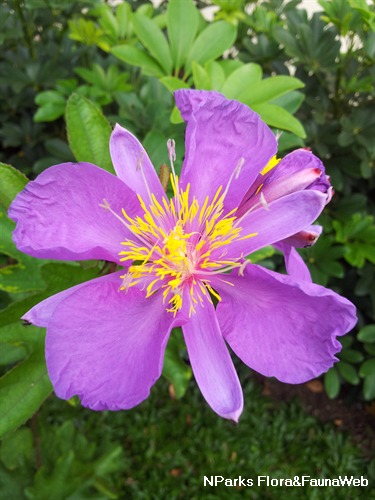
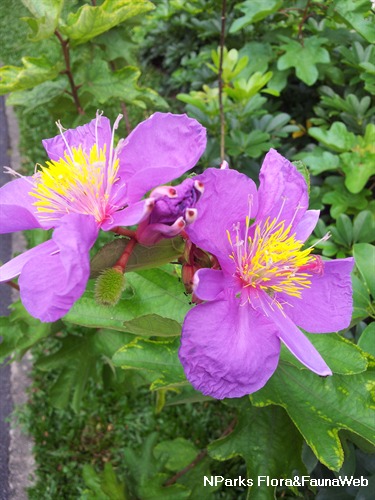
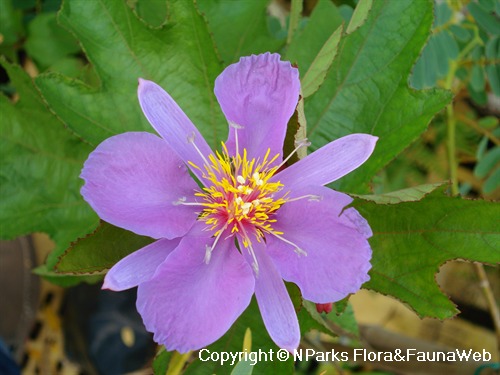
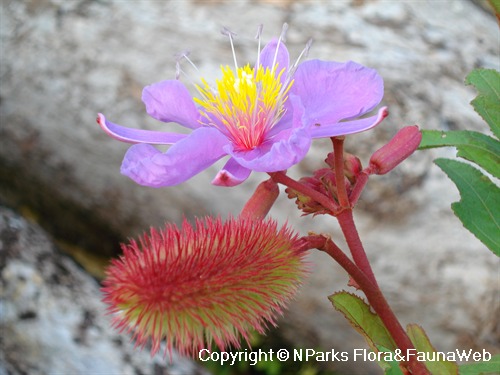
| Flowers | Its large, conspicuous flowers have pink-purple petals and sepals, and are 8-10 cm wide, borne on terminal inflorescences. |
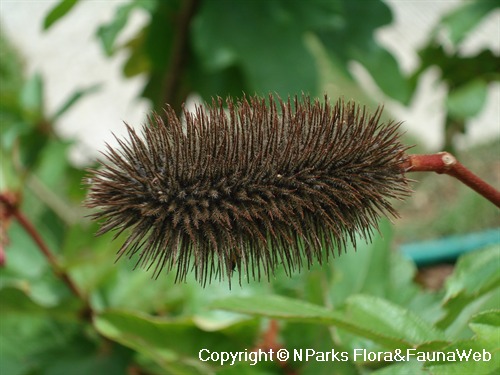
| Fruit | Its fruits are spiny oblong capsules, about 5 by 2.5 cm, ripening from green to pink and finally black. |
| Habitat | It grows in marshy grassland. |
| Cultivation | It can be propagated by seed. |
| Etymology | Latin Clappertonia, after Bain Hugh Clapperton (18 May 1788 – 13 April 1827), a Scottish naval officer and explorer of West and Central Africa. Latin ficifolia, fig-leaved, referring to the similarity in leaf shape with some species of the genus Ficus. |
| Ethnobotanical Uses | Others: The plant is used for producing fibres. |
Landscaping Features
| Landscaping | It is suitable for parks and gardens for its showy flowers and palmate leaves. It is also suitable for growing in waterlogged areas. |
|---|---|
| Desirable Plant Features | Ornamental Flowers, Ornamental Foliage |
| Landscape Uses | Parks & Gardens, Riverine, Marsh / Bog |
Fauna, Pollination and Dispersal
| Pollination Method(s) | Biotic (Fauna) |
|---|---|
| Seed or Spore Dispersal | Abiotic (Explosive Dehiscence) |
Plant Care and Propagation
| Light Preference | Full Sun |
|---|---|
| Water Preference | Moderate Water, Lots of Water |
| Plant Growth Rate | Moderate |
| Rootzone Tolerance | Well-Drained Soils, Moist Soils, Waterlogged Soils (Drains Site) |
| Maintenance Requirements | Moderate |
| Propagation Method | Seed |
Foliar
| Foliage Retention | Evergreen |
|---|---|
| Mature Foliage Colour(s) | Green |
| Mature Foliage Texture(s) | Hairy / Hirsute |
| Prominent Young Flush Colour(s) | Red |
| Young Flush Texture(s) | Hairy / Hirsute |
| Foliar Type | Simple / Unifoliate |
| Foliar Arrangement Along Stem | Alternate |
| Foliar Attachment to Stem | Petiolate |
| Foliar Shape(s) | Non-Palm Foliage |
| Foliar Venation | Palmate |
| Foliar Margin | Serrate / Toothed, Palmately Lobed |
| Leaf Area Index (LAI) for Green Plot Ratio | 4.5 (Shrub & Groundcover - Dicot) |
Floral (Angiosperm)
| Flower & Plant Sexuality | Bisexual Flowers |
| Flower Colour(s) | Purple, Pink |
|---|---|
| Flower Grouping | Cluster / Inflorescence |
| Flower Location | Terminal |
| Flower Symmetry | Radial |
| Flowering Habit | Polycarpic |
Fruit, Seed and Spore
| Mature Fruit Colour(s) | Black |
|---|---|
| Mature Fruit Texture(s) | Bristly |
| Fruit Classification | Simple Fruit |
| Fruit Type |
Image Repository
Others
| Master ID | 519 |
|---|---|
| Species ID | 1815 |
| Flora Disclaimer | The information in this website has been compiled from reliable sources, such as reference works on medicinal plants. It is not a substitute for medical advice or treatment and NParks does not purport to provide any medical advice. Readers should always consult his/her physician before using or consuming a plant for medicinal purposes. |