




Back
Crinum moorei
| Family Name: | Amaryllidaceae |
| Synonyms: | Amaryllis moorei, Crinum colensoi, Crinum imbricatum, Crinum mackenii, Crinum makoyanum, Crinum natalense, Crinum schmidtii |
| Common Name: | Moore's Crinum, Natal Lily |
Name
Classifications and Characteristics
| Plant Division | Angiosperms (Flowering Seed Plants) (Monocotyledon) |
|---|---|
| Plant Growth Form | Herbaceous Plant |
| Lifespan (in Singapore) | Perennial |
| Mode of Nutrition | Autotrophic |
Biogeography
| Native Distribution | Eastern Cape to KwaZulu-Natal |
|---|---|
| Local Conservation Status | Non-native (Horticultural / Cultivated Only) |
Description and Ethnobotany
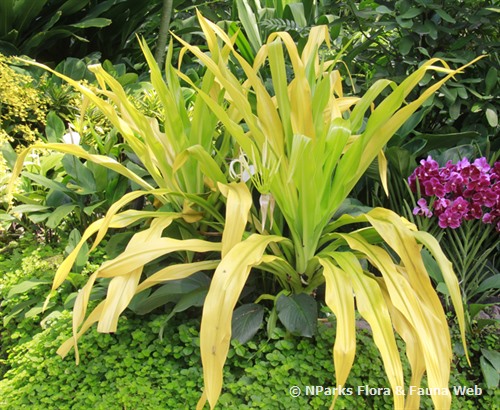
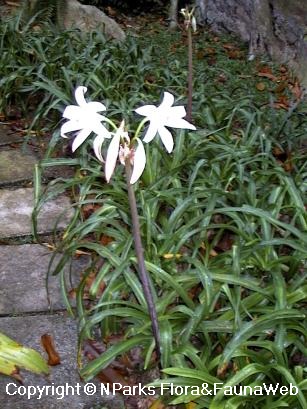
| Growth Form | A deciduous herbaceous shrub which grows up to 1.4 m tall. |
|---|---|
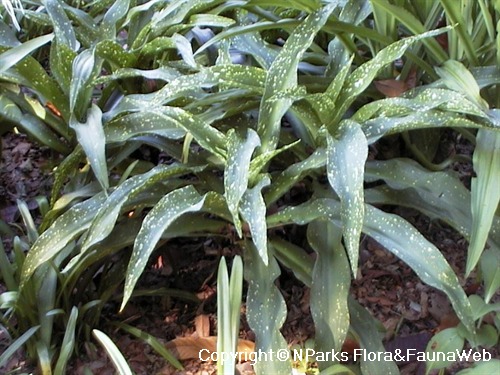
| Foliage | Foliage measuring less than 1 m long, around 20 cm wide, which die back after flowering. |
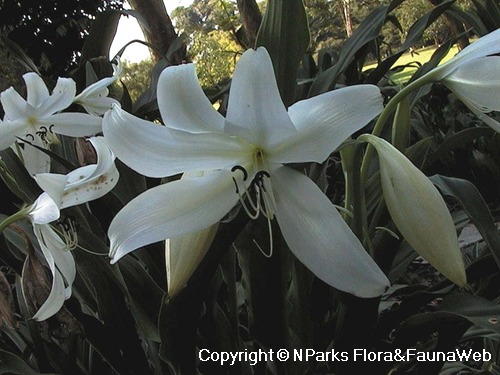
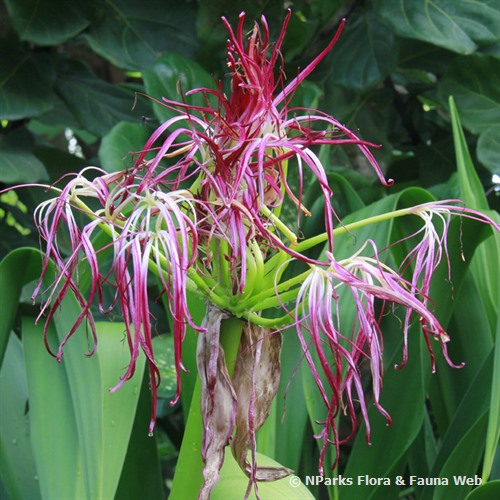
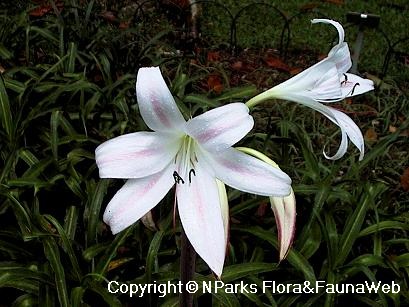
| Flowers | Flowers are 5 - 10 for each inflorescence, colour pink or white, funnel shape, lobes are broad lanceolate and measuring around 10 cm long and 4 cm wide. |
| Habitat | This species occurs in big colonies in marsh areas under shade, on the margin of coastal forest. |
| Cultivation | It must be planted under shade or in semi-shade areas as full sun will burn the leaves and flowers. Bulbs takes 3 to 4 growing seasons to flower. Spacing is important to prevent overcrowding as this species continues to produce new bulbs. The bulbs require fertilizers or natural compost. |
| Etymology | The genus Crinum is derived from the Greek word 'krinon' which means lily. The specific epithet moorei is for Dr. David Moore (1807 - 79), Curator of Glasnevin Botanic Garden. |
| Ethnobotanical Uses | Medicinal: It was recorded by Pooley (1998) that this species is used to treat urinary tract infections and treating cattle. Another source by Nichols (2002) mentioned that the bulbs are used traditionally to cleanse blood, treat infected sores and even acne. |
Landscaping Features
| Desirable Plant Features | Ornamental Flowers, Fragrant |
|---|---|
| Landscape Uses | Parks & Gardens, Small Gardens, Swimming Poolside, Flowerbed / Border |
Fauna, Pollination and Dispersal
| Pollination Method(s) | Biotic (Fauna) (Insects (Butterfly, Moth)) |
|---|
Plant Care and Propagation
| Light Preference | Semi-Shade |
|---|---|
| Water Preference | Lots of Water |
| Rootzone Tolerance | Moist Soils, Waterlogged Soils |
| Propagation Method | Division |
Foliar
| Foliage Retention | Deciduous |
|---|---|
| Mature Foliage Colour(s) | Green |
| Mature Foliage Texture(s) | Smooth, Leathery |
| Foliar Type | Simple / Unifoliate |
| Foliar Shape(s) | Non-Palm Foliage |
| Foliar Margin | Entire |
| Leaf Area Index (LAI) for Green Plot Ratio | 3.5 (Shrub & Groundcover - Monocot) |
Floral (Angiosperm)
| Flower & Plant Sexuality | Bisexual Flowers |
| Flower Colour(s) | White, Pink |
|---|---|
| Flower Texture(s) | Smooth |
| Flower Grouping | Cluster / Inflorescence |
| Individual Flower Shape | Funnelform / Funnel-shaped |
| Inflorescence Type | Umbel |
Image Repository
Others
| Master ID | 587 |
|---|---|
| Species ID | 1882 |
| Flora Disclaimer | The information in this website has been compiled from reliable sources, such as reference works on medicinal plants. It is not a substitute for medical advice or treatment and NParks does not purport to provide any medical advice. Readers should always consult his/her physician before using or consuming a plant for medicinal purposes. |