






Back
Desmos chinensis Lour.
| Family Name: | Annonaceae |
| Synonyms: | Unona chinensis |
| Common Name: | Chinese Desmos, Akar Pisang-Pisang, Kenanga Hutan, Akar Darah, 假鹰爪 |
Name
Classifications and Characteristics
| Plant Division | Angiosperms (Flowering Seed Plants) (Dicotyledon) |
|---|---|
| Plant Growth Form | Climber, Shrub |
| Lifespan (in Singapore) | Perennial |
| Mode of Nutrition | Autotrophic |
| Maximum Height | 4 m |
Biogeography
| Native Distribution | Indian Subcontinent to Vietnam and Malesia |
|---|---|
| Native Habitat | Terrestrial |
| Preferred Climate Zone | Tropical |
| Local Conservation Status | Non-native (Spontaneous (Casual)) |
Description and Ethnobotany
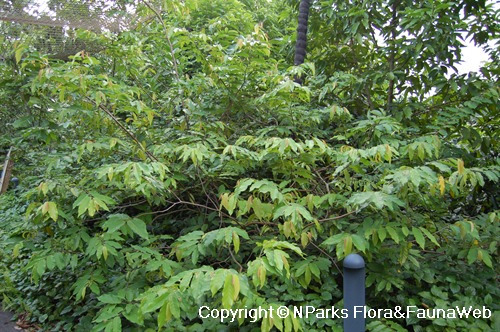
| Growth Form | It is a woody, climbing shrub or liana that grows up to 4 m tall. |
|---|---|
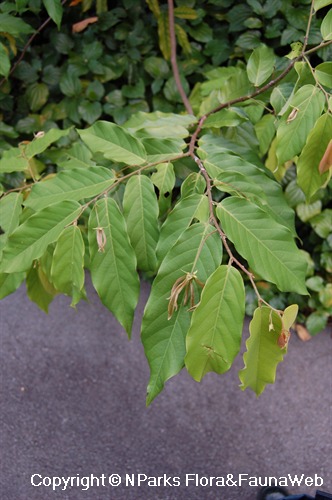
| Foliage | Leaf blades green, oblong to elliptical in shape, measuring 6 - 14 cm long and 2 - 6.5 cm wide, texture thinly papery, petiolate measuring 3 - 8 mm, base rounded to slightly oblique, apex acute to acuminate. |
| Stems | Stems have greyish white lenticels. |
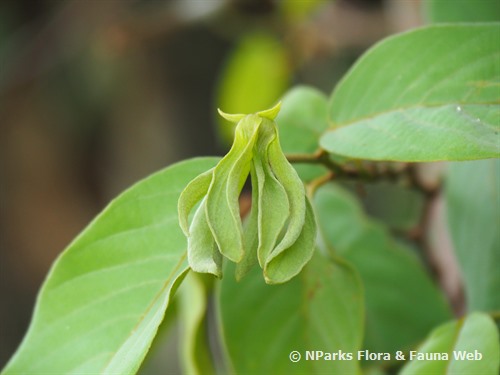
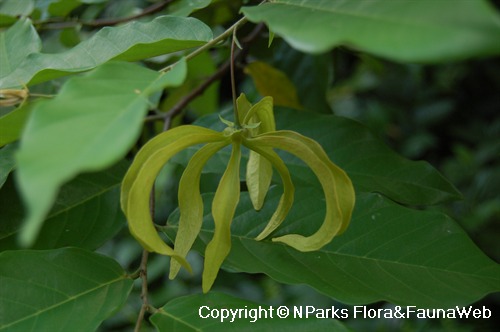
| Flowers | Younger flowers are green and inconspicuous while mature flowers are yellow, having strong lemon scent which will turn to red when the flower fades and drop; inflorescence, axillary, each flower measuring 3 - 6 cm wide and pendulous; sepals are ovate or lanceolate, petals oblong to lanceolate |
| Fruit | Fruit stalk is 2-6 cm long, subglobose-shaped, measuring about 7 x 6 mm, sparsely hairy, |
| Habitat | Occurs in wastelands, disturbed terrain and dense bushes or trees in the valleys. |
| Etymology | The genus Desmos means united stamens. The specific epithet chinensis means from China, one of the Asian countries. |
| Ethnobotanical Uses | Medicinal: The decoction of roots is used to treat dysentery. Others: The fibers are used to make as ropes. The leaves are used in Southern China in liquor brewing. Essential oil from the flowers is used in perfumery. |
Landscaping Features
| Desirable Plant Features | Ornamental Flowers, Fragrant (Flowers) |
|---|---|
| Landscape Uses | Small Gardens |
Plant Care and Propagation
| Light Preference | Semi-Shade, Full Sun |
|---|---|
| Water Preference | Moderate Water |
| Plant Growth Rate | Moderate |
| Rootzone Tolerance | Well-Drained Soils |
| Propagation Method | Seed |
Foliar
| Foliage Retention | Evergreen |
|---|---|
| Mature Foliage Colour(s) | Green |
| Mature Foliage Texture(s) | Papery, Thin |
| Foliar Attachment to Stem | Petiolate |
| Foliar Shape(s) | Non-Palm Foliage (Elliptical, Oblong) |
| Foliar Venation | Pinnate / Net |
| Foliar Apex - Tip | Acute, Acuminate |
| Foliar Base | Rounded / Obtuse, Oblique / Asymmetrical |
| Leaf Area Index (LAI) for Green Plot Ratio | 4.5 (Shrub & Groundcover - Dicot) |
Floral (Angiosperm)
| Flower Colour(s) | Yellow / Golden, Green, Red |
|---|---|
| Flower Location | Axillary |
| Flowering Period | Free-Flowering |
| Flower Colour(s) Remarks | Green to yellow and in the end turns to red just before dropping. |
Image Repository
Others
| Master ID | 632 |
|---|---|
| Species ID | 1927 |
| Flora Disclaimer | The information in this website has been compiled from reliable sources, such as reference works on medicinal plants. It is not a substitute for medical advice or treatment and NParks does not purport to provide any medical advice. Readers should always consult his/her physician before using or consuming a plant for medicinal purposes. |