









Back
Duranta erecta 'Variegata'
| Family Name: | Verbenaceae |
| Common Name: | Variegated Sky Flower, Variegated Golden Dew Drop, Variegated Honey Drops, Variegated Pigeon Berry |
Name
Classifications and Characteristics
| Plant Division | Angiosperms (Flowering Seed Plants) (Dicotyledon) |
|---|---|
| Plant Growth Form | Shrub, Tree (Shrubby (1m-5m)) |
| Lifespan (in Singapore) | Perennial |
| Mode of Nutrition | Autotrophic |
| Plant Shape | Weeping / Pendulous |
| Maximum Height | 5 m to 7.5 m |
| Maximum Plant Spread / Crown Width | 2.5 m to 4 m |
Biogeography
| Native Habitat | Terrestrial |
|---|---|
| Preferred Climate Zone | Tropical |
Description and Ethnobotany
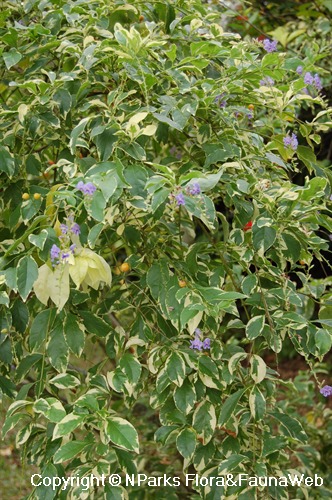
| Growth Form | Shrub with dense canopy and weeping growth habit. |
|---|---|
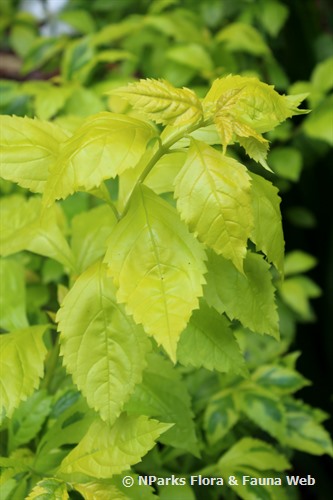
| Foliage | Ovate, variegated leaves (2.5 cm long) are mostly light green with serrated, cream to light yellow leaf margin. Leaf arrangement is opposite. Leaves contain toxic saponins. |
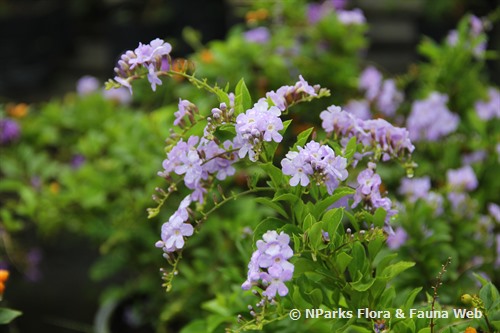
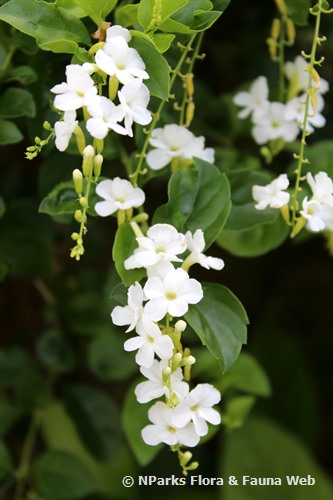
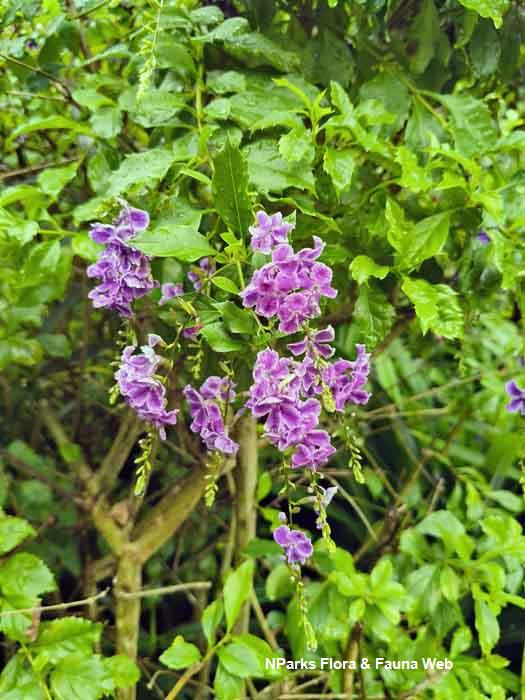
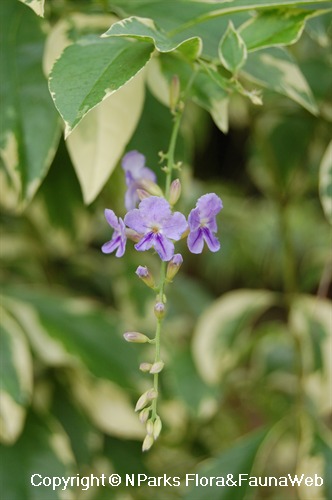
| Flowers | Tubular, 5-lobed flowers are light blue. The flowers are attractive to butterflies as a nectar source. This cultivar is free-flowering. Salverform flowers have a light vanilla-like fragrance. Flowers are arranged in drooping inflorescences known as racemes (flowers on short stalks are arranged along one main axis). The cultivar blooms continuously throughout the year. |
| Fruit | Orange-yellow fruits are round berries. The berries contain toxic saponins. They are 2-seeded and arranged in long drooping clusters. |
| Cultivation | This easy-to-grow cultivar should be planted in fertile, loamy soil with 0.6 m of spacing between individuals. It is drought resistant and should be pruned on a regular basis. It is most attractive in semi-shady areas. |
| Etymology | The genus "Duranta" was named after Castore Durantes, a 16th century Italian botanist and physician. The species epithet "erecta" means that the species is erect. |
Landscaping Features
| Landscaping | This cultivar is planted for its variegated foliage, purplish flowers and attractive golden fruits. For a unique look, it can be grown against a wall as an espalier where the branches are pruned to occur in only one plane. Alternatively, it may be grown as a standard in which a shrub is pruned to have the form of a mini-tree. This cultivar can serve well as a specimen plant, hedge, screen or nectar plant for butterflies. It is suitable for planting in large containers. |
|---|---|
| Desirable Plant Features | Ornamental Flowers, Ornamental Foliage, Ornamental Fruits, Fragrant (Flowers) (Day) |
| Landscape Uses | General, Shade Providing Tree / Palm, Hedge / Screening, Focal Plant, Container Planting |
| Usage Hazard - Cons | Spines/Thorns - Stem/Branch, Irritant - Sap, Toxic Upon Ingestion |
| Usage Hazard - Cons Remarks | Caution: The sap may be irritating for some people. Although the fruits are edible to birds, they are toxic to people. |
Fauna, Pollination and Dispersal
| Fauna Pollination Dispersal Associated Fauna | Bird-Attracting Plant, Butterfly-Attracting Plant (Flower Nectar) |
|---|
Plant Care and Propagation
| Light Preference | Semi-Shade, Full Sun |
|---|---|
| Water Preference | Moderate Water |
| Plant Growth Rate | Moderate |
| Rootzone Tolerance | Fertile Loamy Soils, Well-Drained Soils |
| Maintenance Requirements | Moderate |
| Propagation Method | Stem Cutting, Air-Layering |
Foliar
| Foliage Retention | Evergreen |
|---|---|
| Mature Foliage Colour(s) | Green, White, Yellow / Golden |
| Mature Foliage Texture(s) | Smooth, Glossy / Shiny |
| Foliar Type | Simple / Unifoliate |
| Foliar Arrangement Along Stem | Opposite, Whorled |
| Foliar Shape(s) | Non-Palm Foliage (Elliptical) |
| Foliar Venation | Pinnate / Net |
| Foliar Margin | Serrate / Toothed |
| Foliar Apex - Tip | Acuminate |
| Foliar Base | Acute |
| Typical Foliar Area | Microphyll ( 2.25cm2 - 20.25 cm2 ) |
| Leaf Area Index (LAI) for Green Plot Ratio | 4.5 (Shrub & Groundcover - Dicot) |
Non - Foliar and Storage
| Trunk Type (Non Palm) | Woody |
|---|---|
| Bark Colour(s) | grey |
| Stem Type & Modification | Woody |
| Root Type | Underground (Tap Root) |
Floral (Angiosperm)
| Flower Colour(s) | Blue, Purple |
|---|---|
| Flower Symmetry | Bilateral |
| Individual Flower Shape | Salverform |
| Inflorescence Type | Raceme |
| Flowering Period | Free-Flowering |
| Flowering Habit | Polycarpic |
Fruit, Seed and Spore
| Mature Fruit Colour(s) | Orange, Yellow / Golden |
|---|---|
| Fruit Classification | Simple Fruit |
| Fruit Type | Fleshy Fruit , Drupe |
Image Repository
Others
| Master ID | 684 |
|---|---|
| Species ID | 1979 |
| Flora Disclaimer | The information in this website has been compiled from reliable sources, such as reference works on medicinal plants. It is not a substitute for medical advice or treatment and NParks does not purport to provide any medical advice. Readers should always consult his/her physician before using or consuming a plant for medicinal purposes. |