







Back
Eichhornia azurea (Sw.) Kunth
| Family Name: | Pontederiaceae |
| Common Name: | Anchored Water Hyacinth, Peacock Water Hyacinth, Rooted Water Hyacinth, |
Name
Classifications and Characteristics
| Plant Division | Angiosperms (Flowering Seed Plants) (Monocotyledon) |
|---|---|
| Plant Growth Form | Herbaceous Plant |
| Lifespan (in Singapore) | Perennial |
| Mode of Nutrition | Autotrophic |
Biogeography
| Native Distribution | Tropical America |
|---|---|
| Native Habitat | Freshwater (Emergent Freshwater, Submerged Freshwater) |
| Preferred Climate Zone | Tropical |
| Local Conservation Status | Non-native (Horticultural / Cultivated Only) |
Description and Ethnobotany
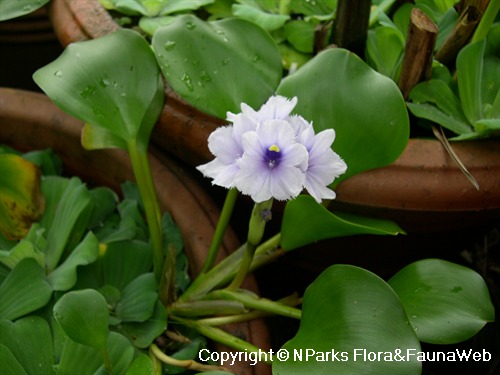
| Growth Form | A perennial aquatic plant, floating, rooted in the mud. Can grow up to 100 cm tall. |
|---|---|
| Foliage | Leaves submerged, floating or emergent, sometimes a combination of any two; the sessile leaves are submerged, alternate on stem while petiolated leaves are emerged. |
| Stems | Elongated vegetative stems which develops and grow on water surface. |
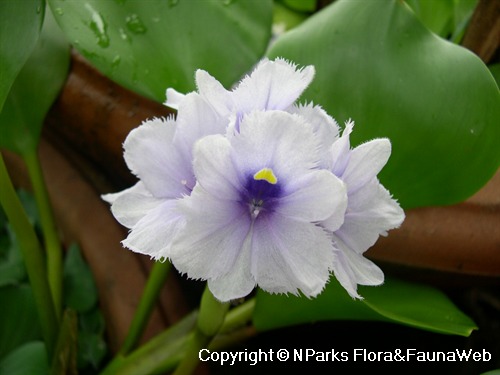
| Flowers | Inflorescence, spike or panicle type; a spike has about 50 flowers; flowers are zygomorphic, spathe is obovate, measuring 3 - 6 cm, peduncle measuring 2 - 15 cm, orange hairs; perianth white or blue. Flowers will open for one day in which at the end of flowering, the inflorescence bends down and sink into the water to develop capsules and seeds. |
| Fruit | Fruit has about 10 winged seeds, measuring 1.5 - 2.6 mm long and 0.3 - 0.9 mm wide. |
| Habitat | Commonly occurs in mud along lakes, rivers, canals with open and slow-moving water environment. |
| Similar | Similar with E. crassipes but can be distinguished by its elongated and fan-like submerged leaves. E. azurea also has long floating stems with large, erect leaves. Its flowers are more bluish. On the other hand, E. crassipes floats freely unlike E. azurea which roots to the substrate. |
Landscaping Features
| Desirable Plant Features | Ornamental Flowers |
|---|---|
| Landscape Uses | Container Planting |
Fauna, Pollination and Dispersal
| Pollination Method(s) | Biotic (Fauna) (Insects (Bee)) |
|---|---|
| Seed or Spore Dispersal | Biotic (Fauna), Abiotic (Water) |
Plant Care and Propagation
| Light Preference | Full Sun |
|---|---|
| Water Preference | Lots of Water |
| Plant Growth Rate | Fast |
| Propagation Method | Seed, Root Cutting |
Foliar
| Foliage Retention | Evergreen |
|---|---|
| Mature Foliage Colour(s) | Green |
| Foliar Arrangement Along Stem | Alternate |
| Foliar Attachment to Stem | Petiolate, Sessile |
| Foliar Shape(s) | Non-Palm Foliage (Orbicular / Round) |
| Foliar Margin | Entire, Entire - Wavy / Undulate |
Floral (Angiosperm)
| Flower Colour(s) | Purple, Blue |
|---|---|
| Flower Grouping | Cluster / Inflorescence |
| Inflorescence Type | Spike, Panicle |
| Flower Lifespan on Plant | 1 Day |
Image Repository
Others
| Master ID | 688 |
|---|---|
| Species ID | 1983 |
| Flora Disclaimer | The information in this website has been compiled from reliable sources, such as reference works on medicinal plants. It is not a substitute for medical advice or treatment and NParks does not purport to provide any medical advice. Readers should always consult his/her physician before using or consuming a plant for medicinal purposes. |