







Back
Ixora grandifolia Zoll. & Moritzi var. grandifolia
| Family Name: | Rubiaceae |
| Common Name: | Pink River Ixora, Jarum Hutan, Kelat Tandok, Segading Jantan |
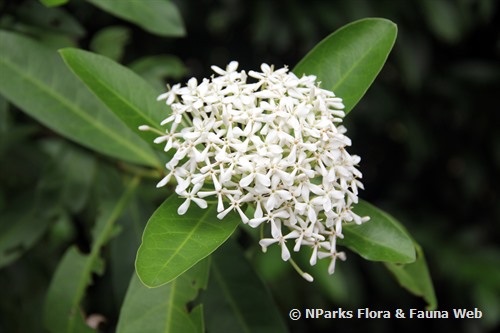
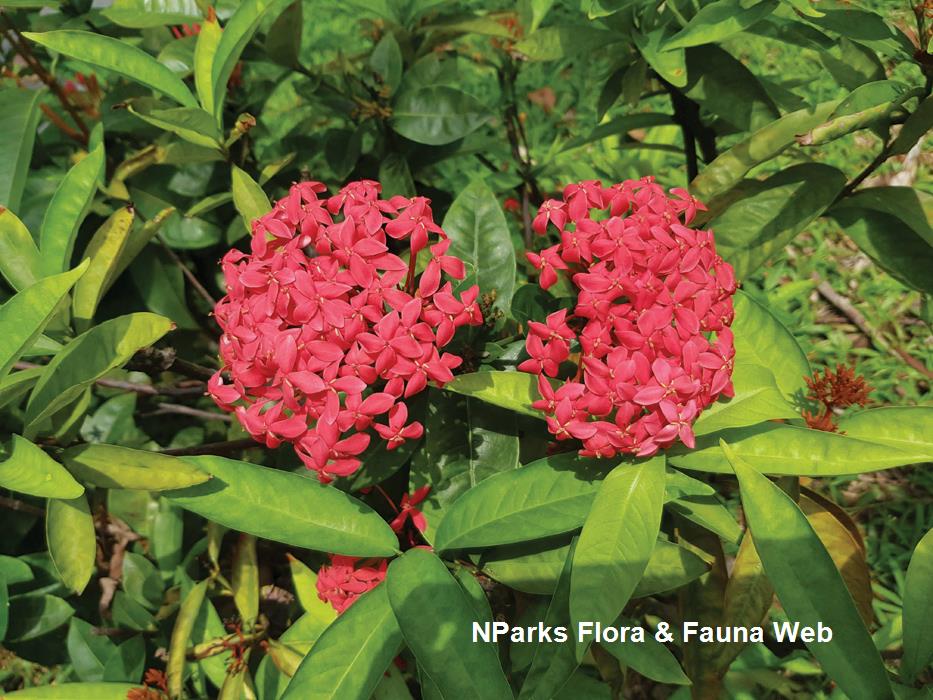
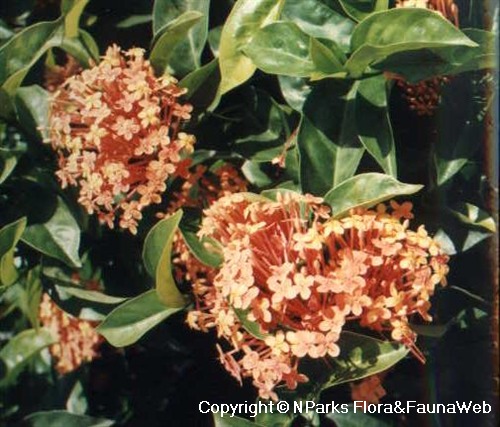
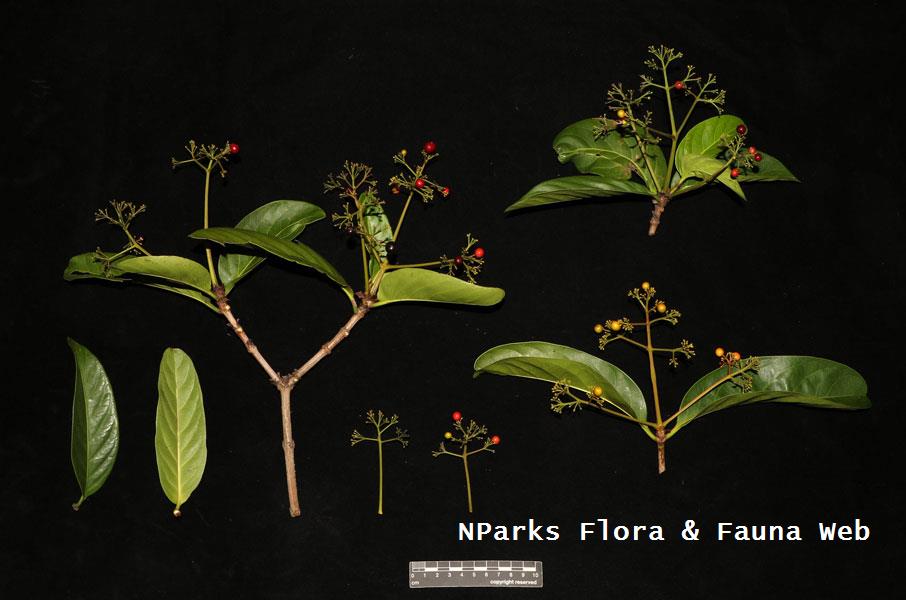
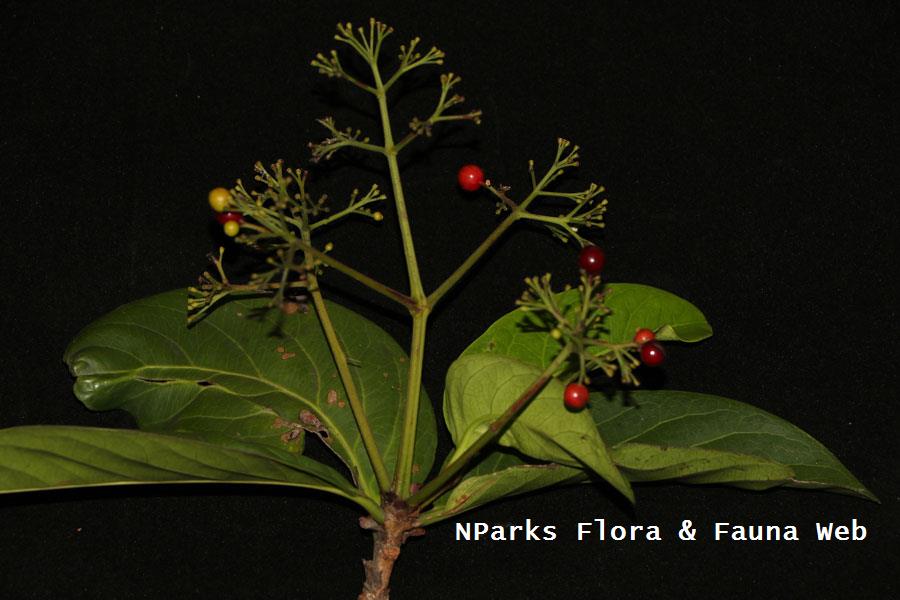
Ixora grandifolia var. grandifolia, also known as Pink River Ixora, is a shrub or tree that can reach up to 18 m tall, making it the tallest species in the genus. It is found in rainforests and swamp forests, and produces fragrant white tubular flowers that are sometimes pink-tipped. This species is native to Singapore and presumed to be nationally extinct locally.

Name
Classifications and Characteristics
| Plant Division | Angiosperms (Flowering Seed Plants) (Dicotyledon) |
|---|---|
| Plant Growth Form | Tree, Shrub |
| Maximum Height | 18 m |
Biogeography
| Native Distribution | From Thailand and throughout Malesia (including Singapore). |
|---|---|
| Native Habitat | Terrestrial |
| Preferred Climate Zone | Tropical |
| Local Conservation Status | Native to Singapore (Presumed Nationally Extinct (NEx)) |
Description and Ethnobotany
| Growth Form | It is a shrub or tree that can reach up to 18 m tall. |
|---|---|
| Foliage | The leaves are elliptic or ovate (14 −15.5 cm long and 7 − 9.5 cm wide), leathery and in opposite arrangement. The leaf tip is blunt while the leaf base is rounded or heart-shaped. Each leaf has 9 – 10 pairs of lateral veins. The stipule is broadly triangular and the leaf stalk (petiole) is about 1.2 – 1.5 cm long. |
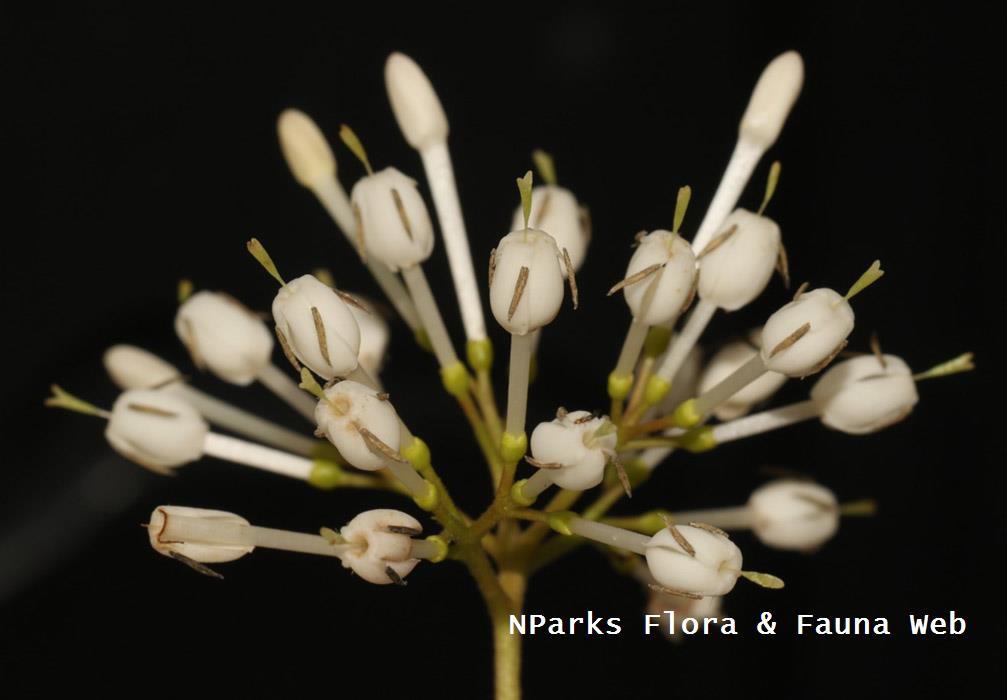
| Flowers | The inflorescence is upright and about 13 cm long. The flowers are fragrant, tubular (about 3cm long), with white petals that are sometimes pink-tipped. |
| Fruit | The fruit is berry-like, nearly globose to strongly two-lobed, measuring about 1 cm long and 1.2 cm wide. It is green when immature, gradually ripening to red and finally black. |
| Habitat | It is found in rainforests and swamp forests, up to 400 m altitude. |
| Associated Fauna | Flowers are pollinated by insects. |
| Cultivation | It can be propagated by seed. |
| Etymology | The genus Ixora is the name of Malabar deity, Iswara. The specific epithet grandifolia means large leaves. |
Landscaping Features
| Desirable Plant Features | Ornamental Flowers, Fragrant |
|---|---|
| Landscape Uses | Parks & Gardens, Small Gardens, Reforestation |
Fauna, Pollination and Dispersal
| Fauna Pollination Dispersal Associated Fauna | Bird-Attracting Plant |
|---|---|
| Pollination Method(s) | Biotic (Fauna) |
| Seed or Spore Dispersal | Biotic (Fauna) |
Plant Care and Propagation
| Light Preference | Full Sun |
|---|---|
| Water Preference | Moderate Water |
| Plant Growth Rate | Moderate |
| Rootzone Tolerance | Well-Drained Soils |
| Propagation Method | Seed |
Foliar
| Mature Foliage Colour(s) | Green |
|---|---|
| Foliar Type | Simple / Unifoliate |
| Foliar Arrangement Along Stem | Opposite |
| Foliar Attachment to Stem | Petiolate |
| Foliar Margin | Entire |
| Foliar Base | Rounded / Obtuse, Cordate |
| Leaf Area Index (LAI) for Green Plot Ratio | 4.5 (Shrub & Groundcover - Dicot) |
Non - Foliar and Storage
| Trunk Type (Non Palm) | Woody |
|---|---|
| Root Type | Underground |
Floral (Angiosperm)
| Flower & Plant Sexuality | Bisexual Flowers |
| Flower Colour(s) | White |
|---|---|
| Flower Grouping | Cluster / Inflorescence |
| Flower Location | Axillary |
| Flower Symmetry | Radial |
| Individual Flower Shape | Tubular |
Fruit, Seed and Spore
| Mature Fruit Colour(s) | Black |
|---|---|
| Fruit Classification | Simple Fruit |
| Fruit Type | Fleshy Fruit , Non-Accessory Fruit |
| Seed Quantity Per Fruit | Few (1-5) |
References
| References | <1> Keng, H. (1990). The Concise Flora of Singapore: Gymnosperms and Dicotyledons. Singapore: Singapore University Press. <2> Wong, K.M., Turner, I.M., Wang, R.J., Harwood, R., Seah, W.W., Ng, X.Y., Lim, R.C.J., Lua, H.K. & Mahyuni, R. (2019). Rubiaceae. In: Middleton, D.J., Leong-Škorničková, J. & Lindsay, S. (ed.) Flora of Singapore, vol. 13, pp. 1–358. Singapore: National Parks Board. |
|---|
Image Repository
Others
| Master ID | 839 |
|---|---|
| Species ID | 2134 |
| Flora Disclaimer | The information in this website has been compiled from reliable sources, such as reference works on medicinal plants. It is not a substitute for medical advice or treatment and NParks does not purport to provide any medical advice. Readers should always consult his/her physician before using or consuming a plant for medicinal purposes. |