






Back
Nicoteba betonica (L.) Lindau
| Family Name: | Acanthaceae |
| Synonyms: | Justicia betonica L., Dicliptera trinervia Juss., Justicia pallidior (Nees) C.B.Clarke, Adhatoda lupulina Nees, Adhatoda variegata Nees, Adhatoda variegata var. pallidior Nees, Justicia cheiranthifolia (Nees) C.B.Clarke |
| Common Name: | Paper Plume, White Shrimp Plant, Squirrel's Tail, Ekor Tupai, Tapak Murai |
Name
Classifications and Characteristics
| Plant Division | Angiosperms (Flowering Seed Plants) (Dicotyledon) |
|---|---|
| Plant Growth Form | Herbaceous Plant |
| Mode of Nutrition | Autotrophic |
| Maximum Height | 1.5 m |
Biogeography
| Native Distribution | Tropical Asia, South Africa, South America |
|---|
Description and Ethnobotany
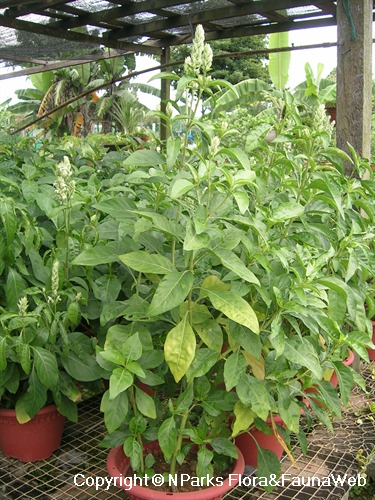
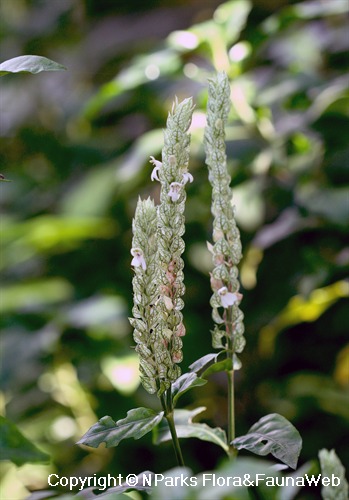
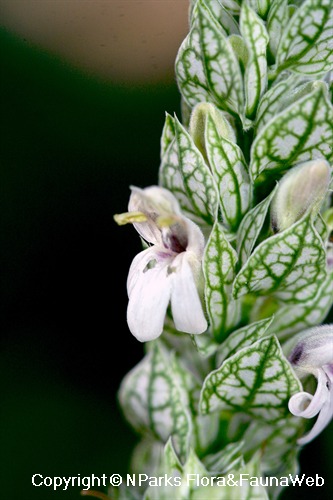
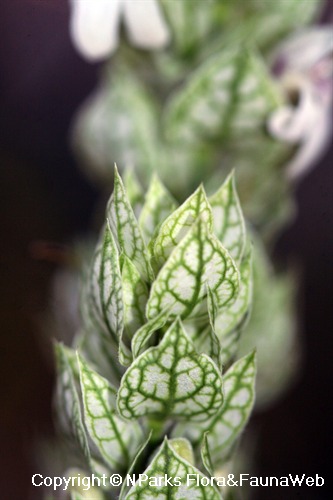
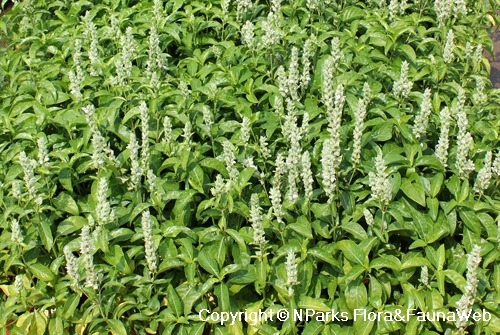
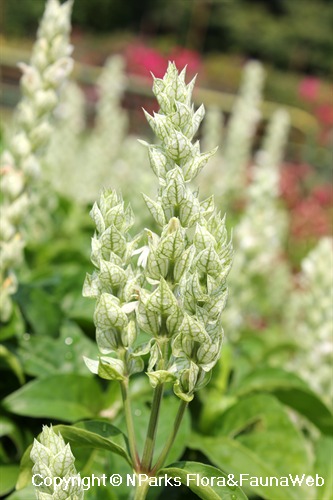
| Growth Form | An attractive, shrubby herb that produces an abundance of upright, compact white-violet inflorescences with overlapping, papery, cream to pale green (sometimes with a tinge of pink) bracts that have distinct green net veins. |
|---|---|
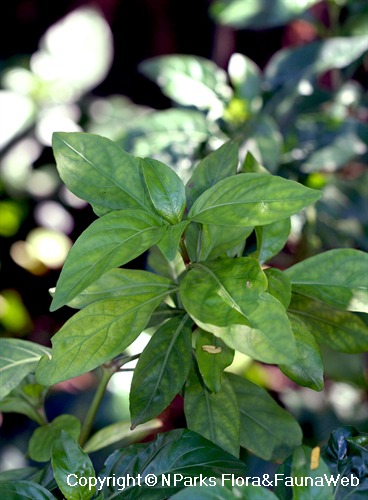
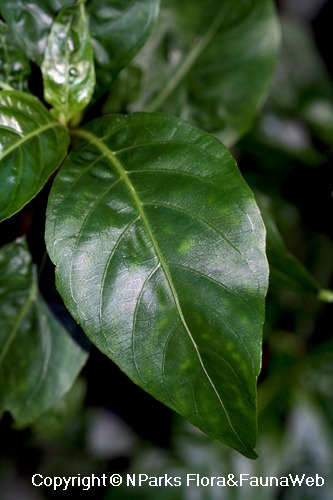
| Foliage | Leaves are simple, entire, opposite, ovate (egg-shaped; oval) to elliptic (in a form of an ellispe; narrow at the ends and broad near the center), up to 22 cm long and 12 cm wide. |
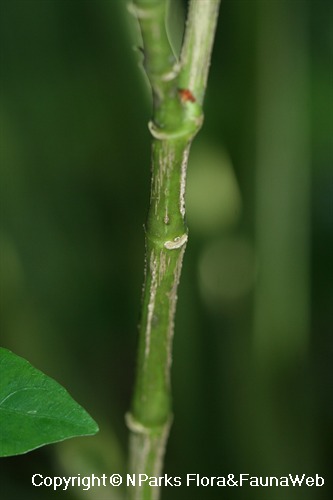
| Stems | Stems herbaceous, rigid, free-branching, green, often with a purple tinge, may be rough to the touch. |
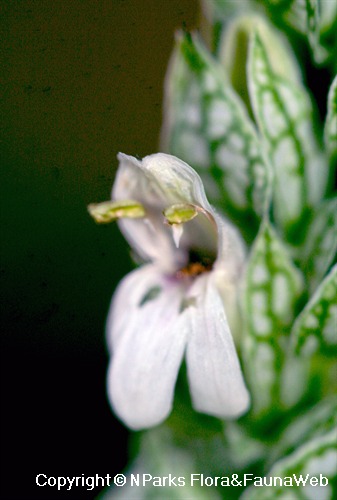
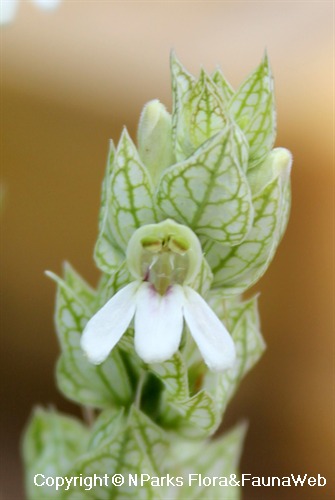
| Flowers | Inflorescences consist of green-striped cream to pale green (sometimes with a tinge of pink) bracts, upright, compact, with flowers aging from white to violet; corolla two-lipped, mauve, with a white spot on the lower lip. |
| Fruit | Fruit is 2-lobed capsule. |
| Cultivation | Likes full sun to bright indirect sunlight and prefers rich soil that retains water yet drains well. Keep soil moist but allow soil to become moderately dry between waterings. Feed once every 2 to 3 weeks with an acidic water soluble fertiliser during growth. Prune plant back occasionally to maintain a compact shape as plant tends to become leggy. Pinch to a node when flowers have bloomed and withered. Plant may be prone to spider mites and mealy bugs. Propagate by stem cuttings, which can be placed in indirect sunlight for 2 to 4 weeks in sandy media with bottom heat. Repot into a regular mix when cuttings have rooted and established. |
| Ethnobotanical Uses | Others: Medicinal: An infusion is prepared from the leaves and offered as a drink in Kenya for snake-bite. A poultice made from the leaves is used to treat to boils in Ceylon, and to swellings in Malaya. Leaves are also prepared and mixed in Ceylon for diarrhoea. The Sukuma of Tanganyika, prepare an ointment from the plant-ash in butter to treat scaly skin. Others: Leaves are boiled to a soup by cattle-folk in Uganda to cows-in-milk to drink as galactagogue (agent that promotes milk flow). |
Landscaping Features
| Desirable Plant Features | Ornamental Flowers |
|---|
Plant Care and Propagation
| Light Preference | Full Sun |
|---|---|
| Water Preference | Moderate Water |
| Plant Growth Rate | Moderate |
Foliar
| Mature Foliage Colour(s) | Green |
|---|---|
| Leaf Area Index (LAI) for Green Plot Ratio | 4.5 (Shrub & Groundcover - Dicot) |
Floral (Angiosperm)
| Flower Colour(s) | Purple |
|---|
Image Repository
Others
| Master ID | 860 |
|---|---|
| Species ID | 2155 |
| Flora Disclaimer | The information in this website has been compiled from reliable sources, such as reference works on medicinal plants. It is not a substitute for medical advice or treatment and NParks does not purport to provide any medical advice. Readers should always consult his/her physician before using or consuming a plant for medicinal purposes. |