





Back
Stenotaphrum secundatum (variegated)
| Family Name: | Poaceae (Gramineae) |
| Common Name: | Variegated Saint Augustine Grass |
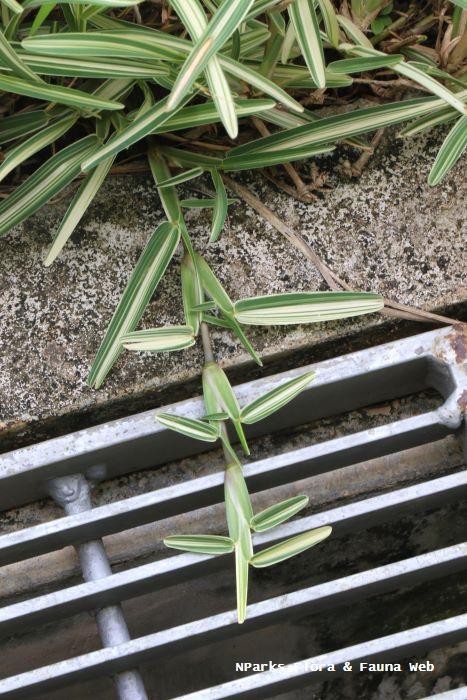
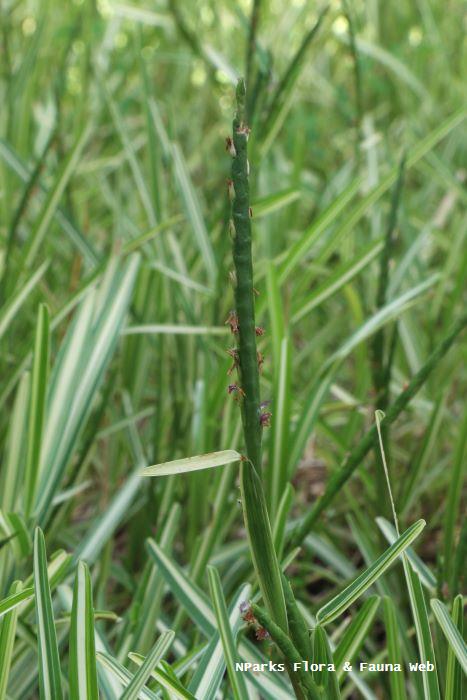
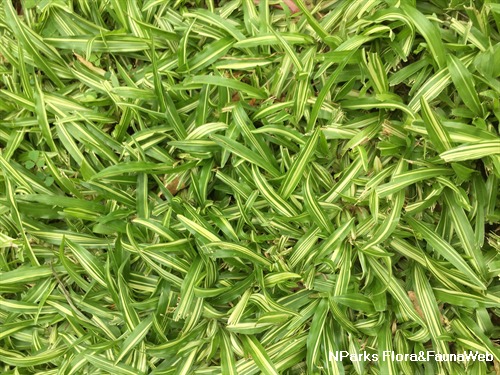
The variegated Stenotaphrum secundatum, or known as Variegated Saint Augustine Grass, is an attractive, mat-forming turf. The linear, round-tipped leaves are variegated with creamy-white or white longitudinal stripes. Strong sunlight in an exposed area is necessary to maintain the grass's variegation.
Name
Classifications and Characteristics
| Plant Division | Angiosperms (Flowering Seed Plants) (Monocotyledon) |
|---|---|
| Plant Growth Form | Grass or Grass-like Plant |
| Lifespan (in Singapore) | Perennial |
| Mode of Nutrition | Autotrophic |
Biogeography
| Native Habitat | Terrestrial |
|---|---|
| Preferred Climate Zone | Tropical |
| Local Conservation Status | Non-native (Horticultural / Cultivated Only) |
Description and Ethnobotany
| Growth Form | It is a perennial, mat-forming, stoloniferous grass that reaches 10–50 cm tall. |
|---|---|
| Foliage | The leaves are green with creamy-white or white longitudinal stripes. The leaf blades are linear with a rounded tip, sparsely hairy, reaching 3–15 cm long × 4–15 mm wide. The leaf sheaths are 3–15 cm long and folded. The leaf sheaths tuck closely to the culms, while the leaf blades bend outwards at an angle. The leaves are arranged alternately but can be distichous (arranged alternately in two ranks) or appear paired when the nodes (stem joints) are close together. |
| Stems | The stems are smooth and stoloniferous, mostly horizontal and rooting at the nodes, with the tips decumbent (growing along the ground with the leafy shoot curving upwards). |
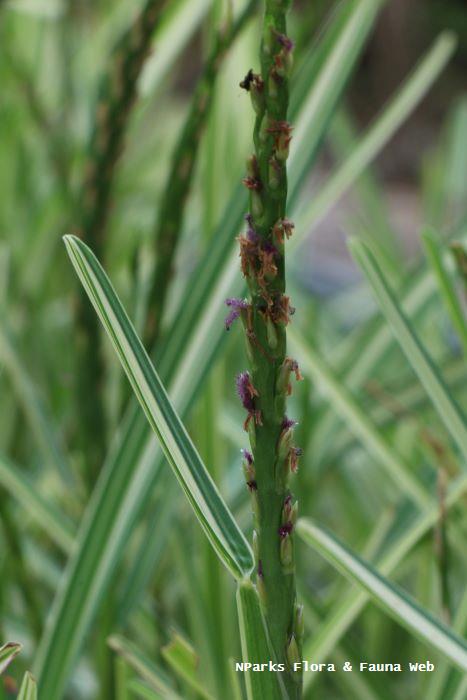
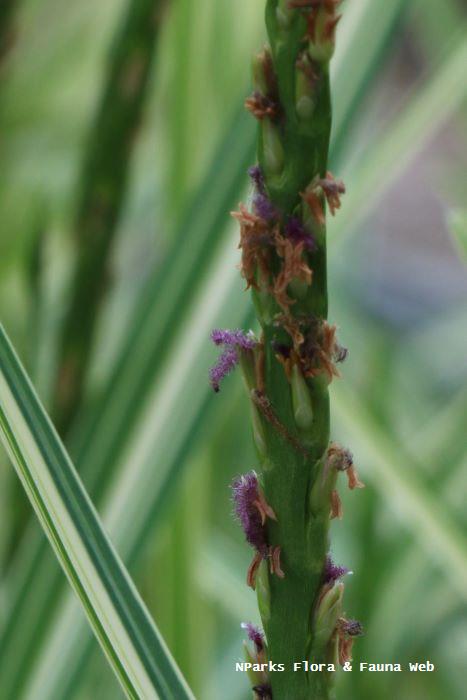
| Flowers | The flowers are known as florets, and consist of heavily reduced petals and sepals, yellow anthers, and conspicuously purple stigmas. The two florets form a spikelet, and two to three spikelets form a spike-like raceme. These are arranged alternately along a rachis in a ribbon-like panicle (a type of inflorescence with repeated branching and spikelets). |
| Fruit | The fruit is a caryopsis (a type of dry, indehiscent fruit, commonly known as a grain). |
| Cultivation | It grows best in full sunlight and tolerates a wide range of soil types. If there is insufficient light, the leaves may revert to green. Apply balanced fertiliser every two weeks. It can be propagated by soft stem cuttings and division. |
| Etymology | The genus Stenotaphrum is derived from Greek steno "narrow", and taphrum, "canal", referring to the narrow cavities in which the racemes are recessed. The specific epithet secundatum means "one-sided", referring to the inflorescence embedded in the rachis. |
Landscaping Features
| Landscaping | Its ability to form a dense mat makes it suitable for lawns and small gardens. |
|---|---|
| Desirable Plant Features | Ornamental Foliage |
| Landscape Uses | Groundcover, Small Gardens, Slope Stabilization, Turf / Lawn / Sports Field |
| Thematic Landscaping | Golden Garden |
| Usage Hazard - Cons | Invasive / Potentially Invasive |
| Usage Hazard - Cons Remarks | Invasive / Potentially Invasive: This fast-growing grass can reproduce vegetatively and easily root upon soil contact. |
Plant Care and Propagation
| Light Preference | Full Sun |
|---|---|
| Water Preference | Moderate Water |
| Plant Growth Rate | Fast |
| Rootzone Tolerance | Moist Soils, Well-Drained Soils |
| Pest(s) | Chewing Insects |
| Propagation Method | Stolon / Runner, Division |
Foliar
| Foliage Retention | Evergreen |
|---|---|
| Mature Foliage Colour(s) | Green, White, Cream / Off-White |
| Mature Foliage Texture(s) | Hairy / Hirsute |
| Foliar Modification | Flower/Fruit Bract |
| Foliar Type | Simple / Unifoliate |
| Foliar Arrangement Along Stem | Alternate |
| Foliar Attachment to Stem | Sessile |
| Foliar Shape(s) | Non-Palm Foliage (Linear) |
| Foliar Venation | Parallel |
| Foliar Apex - Tip | Obtuse |
| Foliar Base | Clasping |
| Leaf Area Index (LAI) for Green Plot Ratio | 2.0 (Turfgrass) |
Non - Foliar and Storage
| Stem Type & Modification | Culm |
|---|---|
| Root Type | Underground (Fibrous Root) |
Floral (Angiosperm)
| Flower & Plant Sexuality | Bisexual Flowers |
| Flower Colour(s) | Purple |
|---|---|
| Flower Grouping | Cluster / Inflorescence |
| Flower Location | Terminal |
| Inflorescence Type | Spikelet / Pseudospikelet / Compound Spike |
| Flowering Habit | Polycarpic |
Fruit, Seed and Spore
| Fruit Classification | Simple Fruit |
|---|---|
| Fruit Type | Indehiscent Dry Fruit , Caryopsis / Grain |
| Seed Quantity Per Fruit | Few (1-5) |
Image Repository
Others
| Master ID | 1183 |
|---|---|
| Species ID | 2476 |
| Flora Disclaimer | The information in this website has been compiled from reliable sources, such as reference works on medicinal plants. It is not a substitute for medical advice or treatment and NParks does not purport to provide any medical advice. Readers should always consult his/her physician before using or consuming a plant for medicinal purposes. |