






Back
Zoysia matrella (L.) Merr.
| Family Name: | Poaceae (Gramineae) |
| Synonyms: | Zoysia tenuifolia Thiele, Zoysia pungens Willd., Zoysia malaccensis Gand., Agrostis matrella L., |
| Common Name: | No Mow Grass, Siglap Grass, Manila Grass, Mascarene Grass, Korean Velvet Grass, Rumput Zoysia |
Zoysia matrella is a coastal turf grass that is native to India, East Asia, Southeast Asia (including Singapore), Australia and the Pacific Islands.
Name
Classifications and Characteristics
| Plant Division | Angiosperms (Flowering Seed Plants) (Monocotyledon) |
|---|---|
| Plant Growth Form | Grass or Grass-like Plant, Creeper |
| Lifespan (in Singapore) | Perennial |
| Mode of Nutrition | Autotrophic |
Biogeography
| Native Distribution | India, Sri Lanka, Bangladesh, Southeast China, Hainan, Taiwan, Korea, Japan, Nicobar Islands, Myanmar, Laos, Vietnam, Thailand, Peninsular Malaysia, Singapore, Borneo, Philippines, Indonesia, Sumatra, Java, Sulawesi, Maluku, Lesser Sunda Islands, New Guinea, Cocos (Keeling) Island, Australia (Queensland), & Pacific Islands (Caroline Island, Marshall Island, Solomon Islands) |
|---|---|
| Native Habitat | Shoreline (Sandy Beach) |
| Preferred Climate Zone | Tropical, Sub-Tropical / Monsoonal |
| Local Conservation Status | Native to Singapore (Least Concern (LC)) |
Description and Ethnobotany
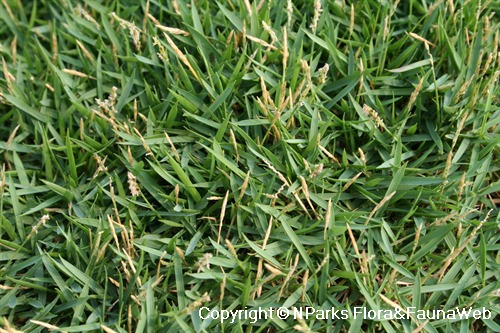
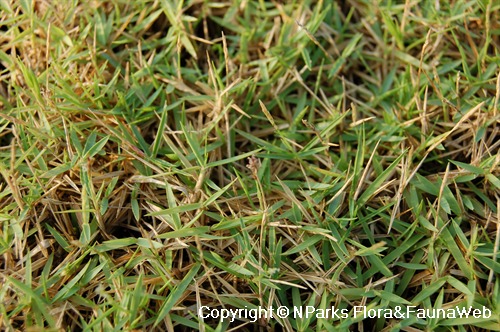
| Growth Form | It is a perennial, mat-forming, stoloniferous grass that reaches up to 0.4 m tall. |
|---|---|
| Foliage | The leaves are smooth or sparsely hairy. The leaf blades are green, slender to linear, erect to spreading, flat or involute (with margins rolled upwards & inwards), and reaching 1.3–9 cm long × 1–2.5 mm wide. The leaf sheaths are green or tinged reddish purple, with long hairs up to 5 mm long at the base of the leaf blade. Ligules (projection at the top of the leaf sheath) are present as 0.2–0.25 mm long hairs. The leaf sheaths tuck closely to the culms, while the leaf blades bend outwards at an angle. The leaves are arranged alternately. |
| Stems | The hollow stems spread horizontally for up to 45 cm long with internodes (parts of the stem between two nodes) up to 40 mm long. The stems that grow underground are known as stoloniferous rhizomes. |
| Flowers | The flowers are known as florets, and consist of heavily reduced petals and sepals, yellow anthers, and conspicuously white stigmas. The single floret forms a spikelet, and 10–20 spikelets are arranged alternately along a spike-like raceme (a type of inflorescence in which the stalkless flowers are borne along a central axis). The spikes are 1–4.2 cm long and are borne above the foliage. |
| Fruit | The fruit is a caryopsis (a type of dry, indehiscent fruit, commonly known as a grain). |
| Habitat | It can be found on sandy beaches on the landward side, dry salt-marsh pastures, lawns, roadsides and other disturbed areas. In Singapore, it can be found in Balestier Plain, Central Catchment, Pulau Seletar, Pulau Ubin, and Sungei Buloh. |
| Similar | This species is similar to two other cultivated species in Singapore; Zoysia japonica and Zoysia pacifica. In general, Zoysia japonica has a coarser appearance with wider leaf blades (2–4 mm) while Zoysia pacifica has finer leaves than Zoysia matrella with leaf blades that are 0.7–1 mm wide. In flower, the inflorescence of Zoysia pacifica is borne slightly above the foliage, while the other two species have theirs raised above the foliage. |
| Cultivation | It grows best in full sunlight and well-draining, sandy to loamy soil. Apply balanced fertiliser to maintain vibrant colour & healthy growth. Mowing is necessary to keep the height. It can be propagated by division. |
| Etymology | The genus Zoysia is named in honour of Karl von Zois zu Laibach (1756–1800), amateur botanist and plant collector. The specific epithet matrella is from Latin, diminutive of mater "mother", though the reason is unclear. |
Landscaping Features
| Landscaping | Its ability to form a dense mat makes it suitable for lawns and small gardens. |
|---|---|
| Desirable Plant Features | Ornamental Form |
| Landscape Uses | Coastal Plant, Beachfront / Shoreline, Turf / Lawn / Sports Field |
Plant Care and Propagation
| Light Preference | Full Sun |
|---|---|
| Water Preference | Moderate Water |
| Plant Growth Rate | Fast |
| Rootzone Tolerance | Drought Tolerant, Well-Drained Soils, Saline Soils / Salt Spray |
| Maintenance Requirements | High |
| Pest(s) | Soil Insects |
| Propagation Method | Division |
Foliar
| Foliage Retention | Evergreen |
|---|---|
| Mature Foliage Colour(s) | Green |
| Mature Foliage Texture(s) | Hairy / Hirsute, Smooth |
| Foliar Type | Simple / Unifoliate |
| Foliar Arrangement Along Stem | Alternate |
| Foliar Attachment to Stem | Sessile |
| Foliar Shape(s) | Non-Palm Foliage (Linear) |
| Foliar Venation | Parallel |
| Foliar Apex - Tip | Acute |
| Foliar Base | Clasping |
| Leaf Area Index (LAI) for Green Plot Ratio | 2.0 (Turfgrass) |
Non - Foliar and Storage
| Stem Type & Modification | Culm, Runner / Stolon |
|---|---|
| Root Type | Underground (Fibrous Root) |
Fruit, Seed and Spore
| Mature Fruit Colour(s) | Brown |
|---|---|
| Mature Fruit Texture(s) | Smooth |
| Fruit Classification | Simple Fruit |
| Fruit Type | |
| Mature Seed Colour(s) | Brown |
| Seed Quantity Per Fruit | Few (1-5) |
References
| References | Clayton, W.D., Vorontsova, M.S., Harman, K.T. and Williamson, H. (2006 onwards). Zoysia Matrella. GrassBase - The Online World Grass Flora. https://www.kew.org/data/grasses-db/www/imp10910.htm. Accessed 18 November 2025. Veldkamp, J.F., Duistermaat, H., Wong, K.M., & Middleton, D.J. (2019). Poaceae (Gramineae). Flora of Singapore, Volume 7. Singapore: National Parks Board. pp 219 - 501. |
|---|
Image Repository
Others
| Master ID | 1283 |
|---|---|
| Species ID | 2576 |
| Flora Disclaimer | The information in this website has been compiled from reliable sources, such as reference works on medicinal plants. It is not a substitute for medical advice or treatment and NParks does not purport to provide any medical advice. Readers should always consult his/her physician before using or consuming a plant for medicinal purposes. |