





Back
Lodoicea maldivica (J.F.Gmel.) Pers.
| Family Name: | Arecaceae (Palmae) |
| Synonyms: | Lodoicea callypige Comm. ex J.St.Hil., Cocos maritima Comm. ex H.Wendl. |
| Common Name: | Double Coconut, Coco De Mer, Kelapa Laut, Seychelles Nut |
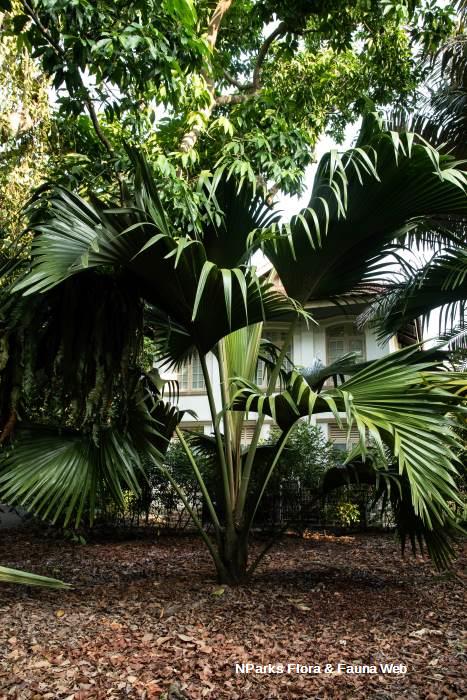
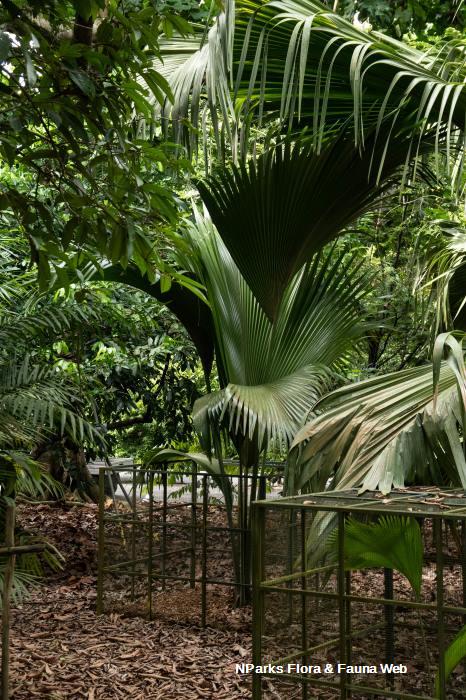
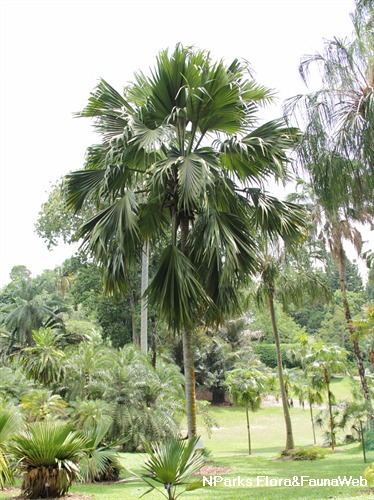
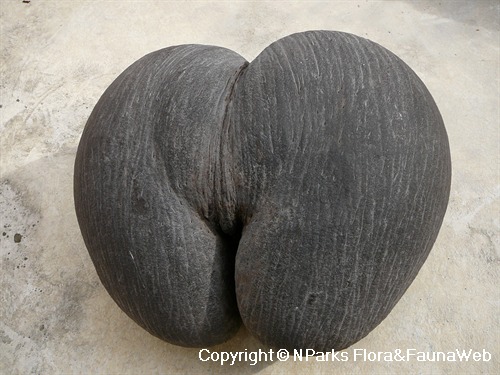
Lodoicea maldivica, commonly known as Double Coconut, holds the world record for the heaviest and largest seed in the world, weighing up to 25 kg and measuring 50 cm long! The largest of the six palm species endemic to the Seychelles, it can reach up to 35 m tall. Its large, fan-shaped fronds funnel rainwater, debris, and excess pollen to the base of the palm as an adaptation to dry, nutrient-poor soil in its native granite-rich rainforest habitat.
Name
Classifications and Characteristics
| Plant Division | Angiosperms (Flowering Seed Plants) (Monocotyledon) |
|---|---|
| Plant Growth Form | Palm (Solitary Habit) |
| Lifespan (in Singapore) | Perennial |
| Mode of Nutrition | Autotrophic |
| Plant Shape | Fountain (Palm-like) |
| Maximum Height | 25 m to 34 m |
Biogeography
| Native Distribution | The Seychelles |
|---|---|
| Native Habitat | Terrestrial (Primary Rainforest) |
| Preferred Climate Zone | Tropical |
| Local Conservation Status | Non-native (Horticultural / Cultivated Only) |
Description and Ethnobotany
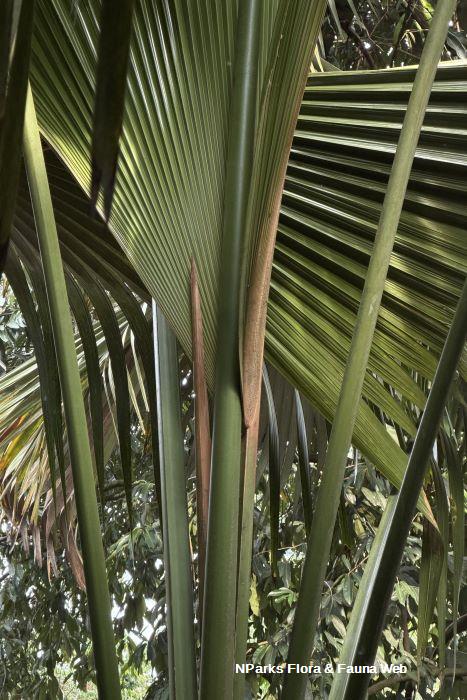
| Growth Form | It is a robust, solitary palm, up to 25–34 m tall. The rosette of fan-shaped fronds funnels rainwater, debris, and excess pollen to the base of the palm in order to recycle nutrients. |
|---|---|
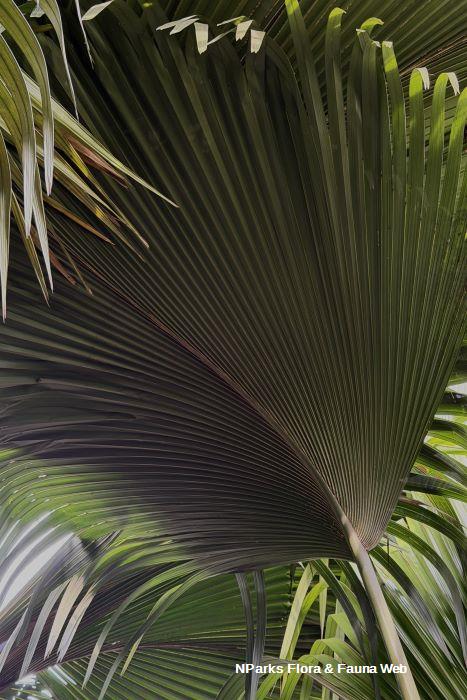
| Foliage | The fronds are large (7–10 m long × up to 4.5 m wide) and costapalmate (a type of palmately compound leaf in palms in which the petiole extends into the leaf blade, known as the costa). The petiole (leaf stalk) can reach up to 4 m long. The fronds lack a hastula (a small flange of tissue between the blade and petiole of palm fronds). |
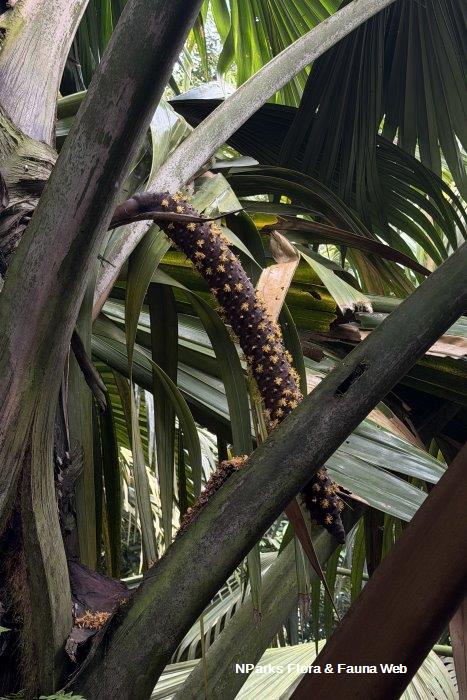
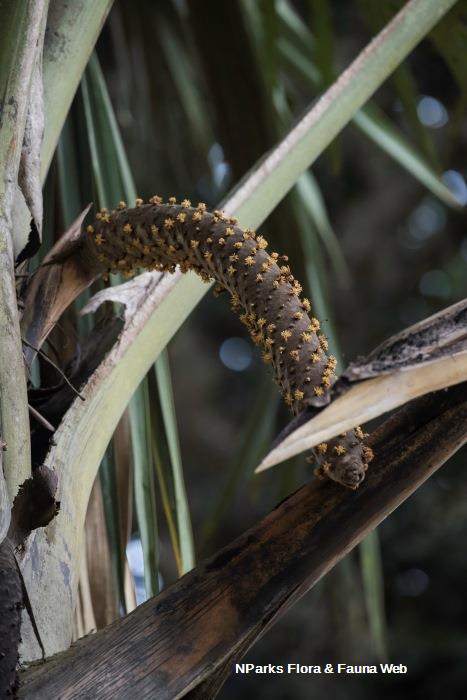
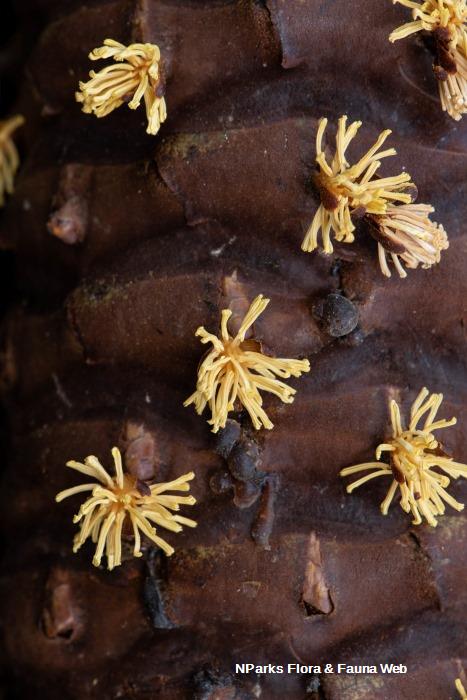
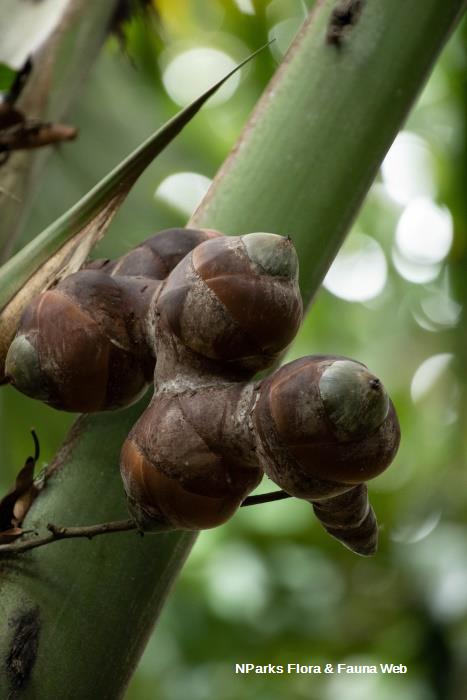
| Flowers | The inflorescence is an interfoliar (emerging between the fronds) spikes. The species is dioecious, with male and female flowers found on separate individuals. Male inflorescences are catkin-like, reaching 1.2–1.8 m long × 8–10 cm wide. Male flowers are borne in clusters and hidden with 17-22 stamens visible. Female inflorescences produce 5–13 large, bulbous 5 cm wide flowers enveloped in round petals and sepals. |
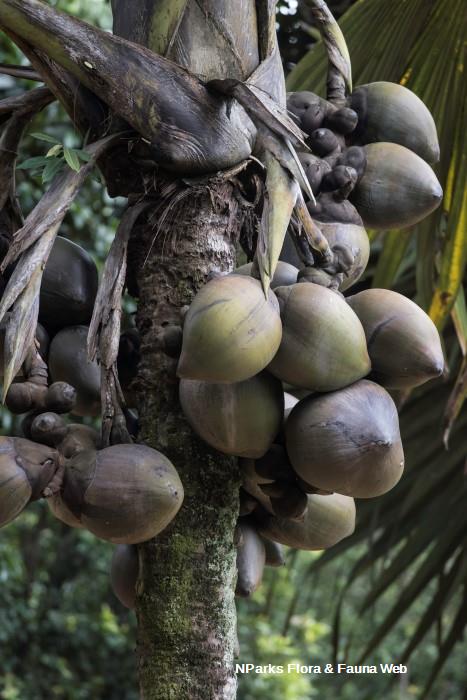
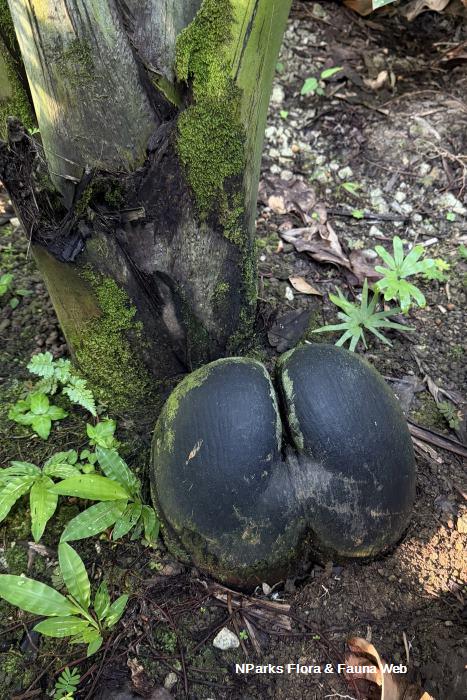
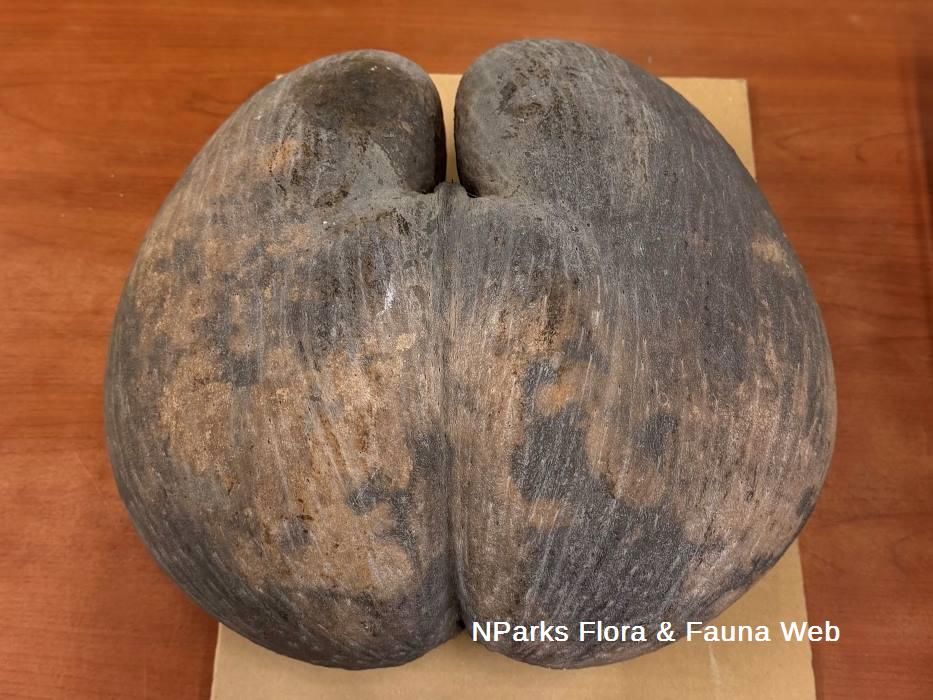
| Fruit | The fruit is a flattened, bilobed drupe that measures 40–50 cm long × up to 30 cm wide and weighs 25–45 kg. The number of lobes may range from one to four. The fruit may take 6–7 years to develop and contain one seed (sometimes up to four). The seed is the largest and heaviest seed in the world, measuring 40–50 cm in length and weighing 10–25 kg. |
| Habitat | It can be found on open slopes and valleys with deep, well-drained, granite-rich soils. Lodoicea maldivica is the predominant species in its native rainforest habitat. |
| Similar | Lodoicea maldivica can be distinguished from other fan palm species by the its large, more or less diamond-shaped fronds in juvenile plants, the lack of hastulae on both surfaces of the frond, and the enormous bilobed fruits and seeds. |
| Associated Fauna | In its native habitat, the flowers are most likely pollinated by stingless bees (Trigona sp.) and dolichopodid flies (Cyrturella sp.). Geckos, slugs and other bee species have been observed visiting the male flowers. In Singapore, wasps have been observed visiting the flowers of female specimens at Singapore Botanic Gardens. |
| Taxonomy | This species is monotypic, being the sole species in this genus. |
| Cultivation | It grows best in full sun and moist, well-drained soil. Germination may take up to 2 years and saplings require a tall container or deep soil for their root. Saplings are tolerant of semi-shaded conditions. It can only be propagated by seeds. |
| Etymology | The genus Lodoicea is named in honour of Louis XV of France (1710–74). |
| Ethnobotanical Uses | Timber & Products: In the Seychelles, the fronds are used as thatch and plaiting. the wood as palisades and water-troughs, the seeds for dishes and vegetable ivory, and the down from young fronds for pillow stuffings. |
Landscaping Features
| Desirable Plant Features | Ornamental Form |
|---|---|
| Landscape Uses | Parks & Gardens, Shade Providing Tree / Palm |
| Thematic Landscaping | Naturalistic Garden |
Fauna, Pollination and Dispersal
| Pollination Method(s) | Biotic (Fauna) (Insects (Bee), Insects (Ant, Beetle, Fly, Thrip, Wasp)) |
|---|---|
| Seed or Spore Dispersal | Abiotic (Gravity) |
Plant Care and Propagation
| Light Preference | Full Sun |
|---|---|
| Water Preference | Moderate Water |
| Plant Growth Rate | Very Slow |
| Rootzone Tolerance | Moist Soils |
| Pest(s) | Chewing Insects |
| Propagation Method | Seed |
| Propagation Ease | Difficult |
| Seed / Spore Germination Duration | 2 years |
Foliar
| Foliage Retention | Evergreen |
|---|---|
| Mature Foliage Colour(s) | Green |
| Mature Foliage Texture(s) | Smooth |
| Foliar Type | Compound (Palmate) |
| Foliar Arrangement Along Stem | Spiral |
| Foliar Shape(s) | Palm Fronds (Fan / Costapalmate) |
| Typical Foliar Area | Megaphyll (>1640.25cm2 ) |
| Leaf Area Index (LAI) for Green Plot Ratio | 2.5 (Palm - Solitary) |
Non - Foliar and Storage
| Trunk Type (Palm) | Aboveground, Solitary Habit |
|---|---|
| Root Type | Underground (Fibrous Root) |
Floral (Angiosperm)
| Flower & Plant Sexuality | Unisexual Flowers , Dioecious |
| Flower Colour(s) | Yellow / Golden |
|---|
| Flower Texture(s) | Leathery |
| Flower Grouping | Cluster / Inflorescence |
| Flower Location | Axillary |
| Flower Symmetry | Radial |
| Inflorescence Type | Spike |
| Flowering Habit | Polycarpic |
Fruit, Seed and Spore
| Mature Fruit Colour(s) | Silver / Grey, Brown |
|---|---|
| Mature Fruit Texture(s) | Wrinkled |
| Fruit Classification | Simple Fruit |
| Fruit Type | |
| Mature Seed Colour(s) | Brown |
| Mature Seed Texture(s) | Fibrous |
| Seed Description | The seed can be 40–50 cm long and weighs 10–25 kg, making it largest and heaviest seed in the world, |
| Seed Quantity Per Fruit | Few (1-5) |
References
| References | Blackmore, S., Chin, S-C., Chong Seng, L., Christie, F., Inches, F., Winda Utami, P., Watherston, N., & Wortley, Al.H., (201). Observations on the Morphology, Pollination and Cultivation of Coco de Mer (Lodoicea maldivica (J F Gmel.) Pers., Palmae), Journal of Botany Dransfield, J., Uhl, N.W., Asmussen, C.B., Baker, W.J. & Harley, M.M. (2008). Genera Palmarum - The Evolution and Classificiation of the Palms.Royal Botanic Gardens, Kew. 323-325. Edwards, P.J., Fleischer-Dogley, F. & Kaiser-Bunbury, C.N. (2015), The nutrient economy of Lodoicea maldivica, a monodominant palm producing the world's largest seed. New Phytol, 206: 990-999. Edwards, P.J., Kollmann, J. & Fleischmann, K. (2003). Life history evolution in Lodoicea maldivica (Arecaceae). Nord. J. Bot. 22: 221-237. Tomlinson, P.B. (2006). The uniqueness of palms. Botanical Journal of the Linnean Society, 151: 5-14. |
|---|
Image Repository
Others
| Master ID | 1361 |
|---|---|
| Species ID | 2654 |
| Flora Disclaimer | The information in this website has been compiled from reliable sources, such as reference works on medicinal plants. It is not a substitute for medical advice or treatment and NParks does not purport to provide any medical advice. Readers should always consult his/her physician before using or consuming a plant for medicinal purposes. |