






Back
Gustavia superba
| Family Name: | Lecythidaceae |
| Synonyms: | Japarandiba superba (Kunth) Kuntze, Pirigara insignis Kunth ex Hemsl., Pirigara superba Kunth |
| Common Name: | Membrillo, Heaven Lotus, 莲玉蕊 |
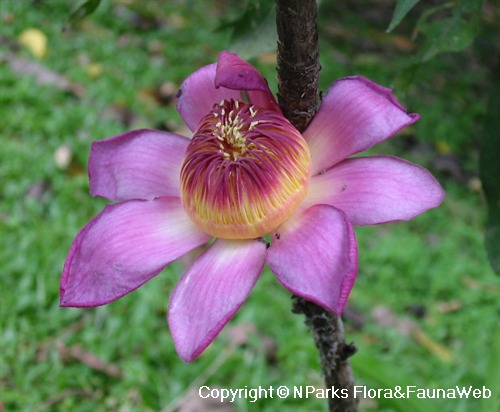
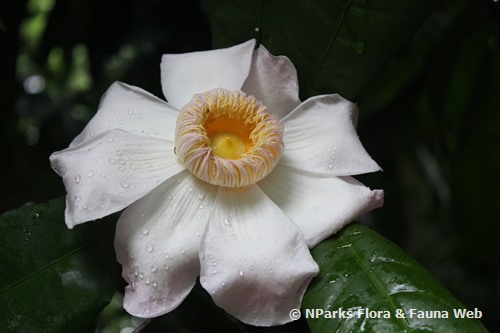
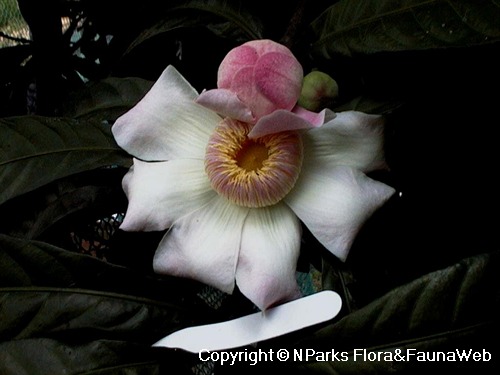
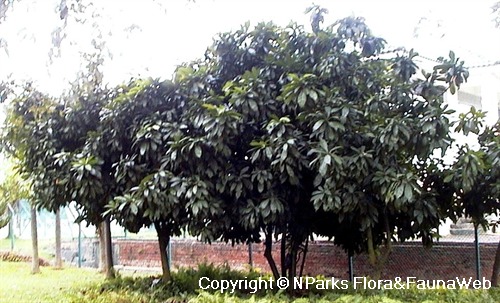
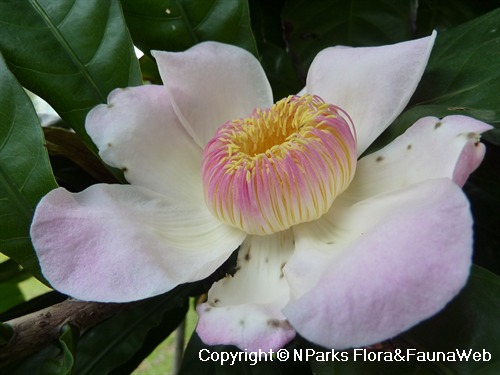
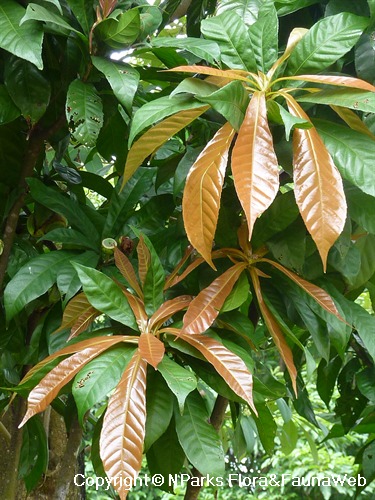
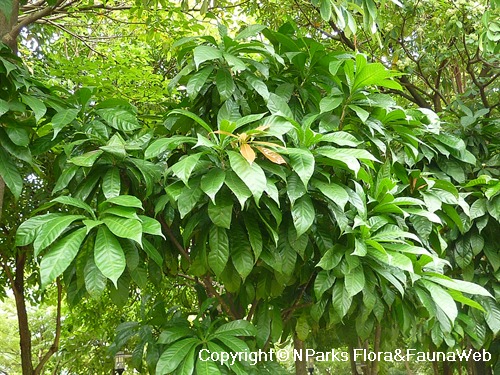
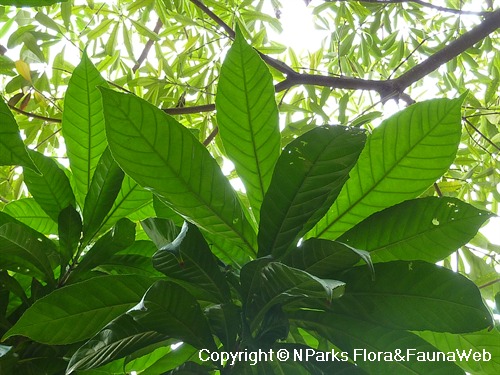
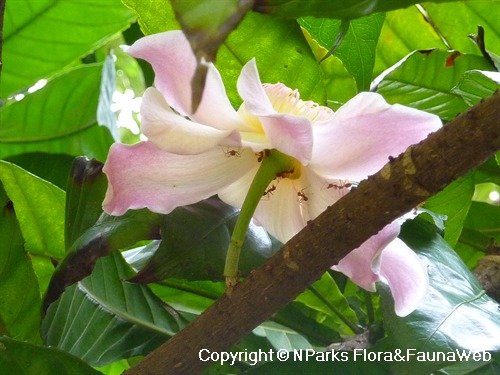
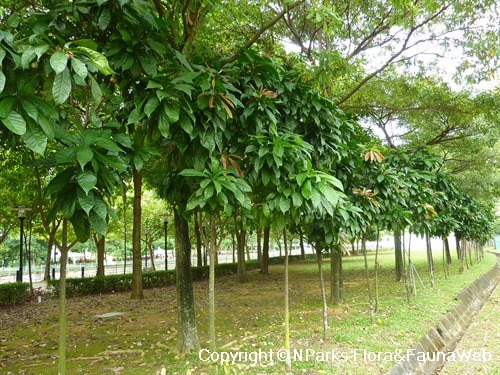
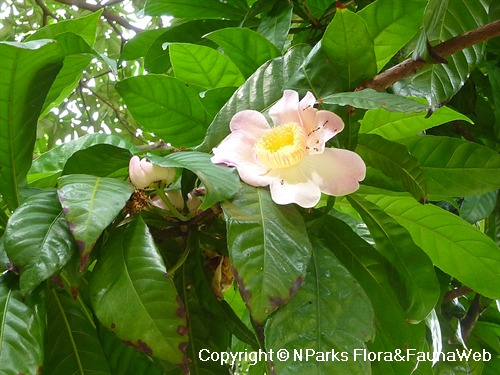
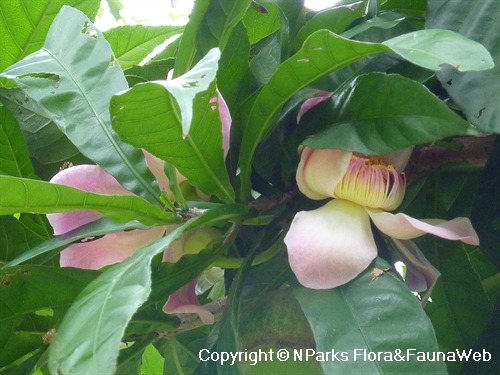
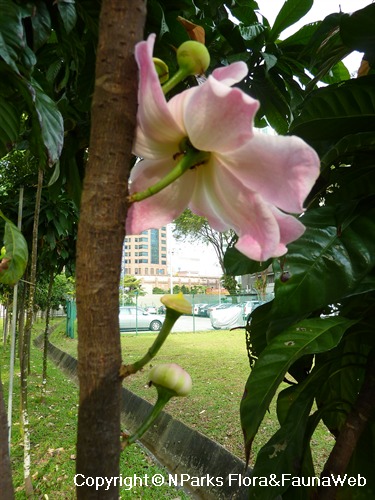
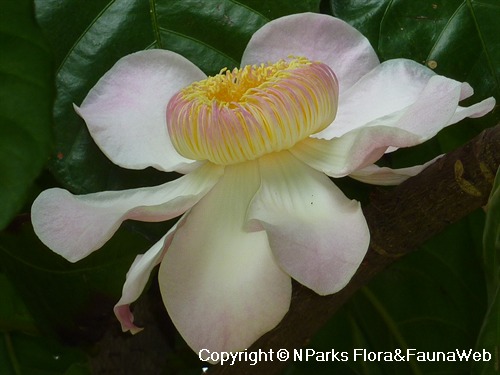
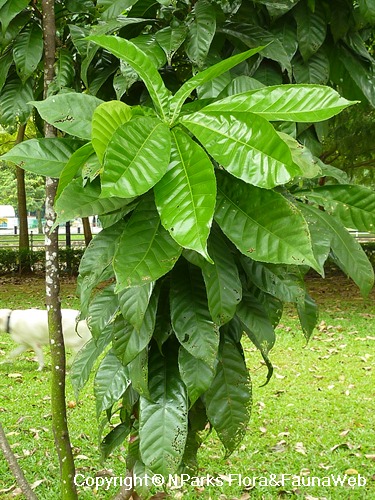
Gustavia superba, also known as Membrillo, has large showy flowers, along with large and tufted leaves at the ends of the stout branches. These features give Membrillo a very striking appearance in the landscape. It is no wonder this tree is highly sought after.

_lowres.jpg)
_lowres.jpg)
_lowres.jpg)
Name
Classifications and Characteristics
| Plant Division | Angiosperms (Flowering Seed Plants) (Dicotyledon) |
|---|---|
| Plant Growth Form | Tree |
| Lifespan (in Singapore) | Perennial |
| Mode of Nutrition | Autotrophic |
| Plant Shape | Irregular |
| Maximum Height | 20 m |
Biogeography
| Native Distribution | Central and South America |
|---|---|
| Native Habitat | Terrestrial |
| Preferred Climate Zone | Tropical |
| Local Conservation Status | Non-native |
Description and Ethnobotany
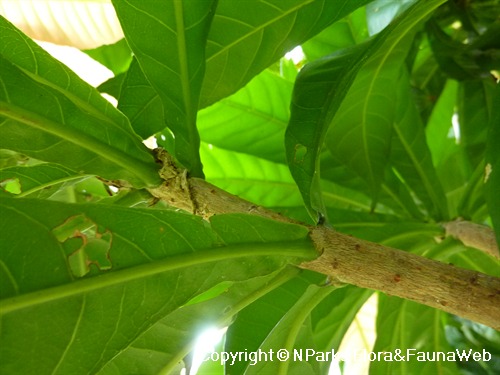
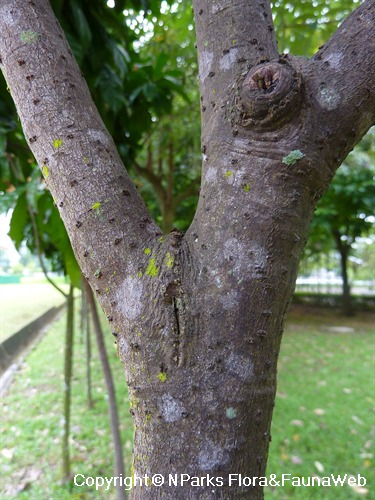
| Growth Form | It is a tree, up to 20 m tall, with slightly fissured bark. |
|---|---|
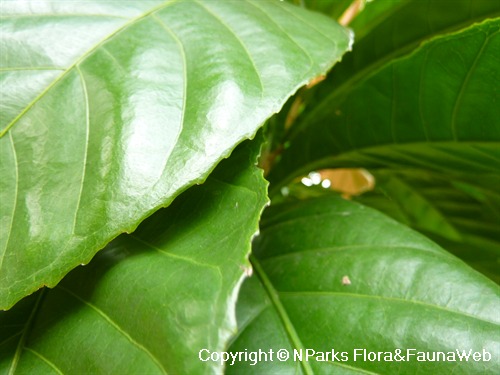
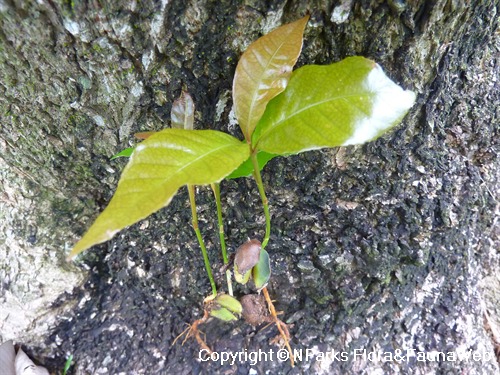
| Foliage | Arranged in whorls, the leaves are smooth, leather and oblanceolate shaped (about 15 – 128 cm long and 6 – 25 cm wide). The large and tufted leaves at the ends of the stout branches gives a very striking appearance in the landscape. Each leaf has 16 – 36 pairs of lateral veins with toothed margin (serrate). The leaf tip is acuminate while the leaf base is long tapering to cuneate. The petiole is 0.5 – 15 cm long and 0.1 – 0.9 cm wide. Young leaves flush red and gradually turn to green as they mature. |
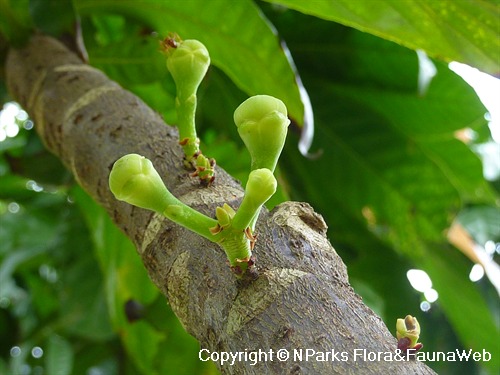
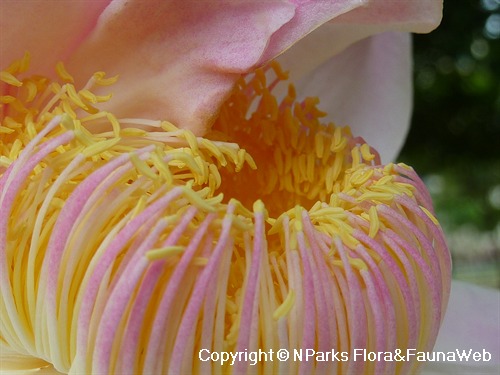
| Flowers | Inflorescence occurs on the stem or older branches, as a raceme (about 0.1 to 6.4 cm long), and comprises of 3 – 12 flowers. Flower is showy (10 – 15 cm diameter) with (7-) 8 (-9) petals. The petals are mostly white with pink hues at the tips. The androecium contains many stamens which are fused at the base, forming a yellowish ring. Ovary is inferior and (5-)6-locular. The stigma has 6 (-7) lobes. |
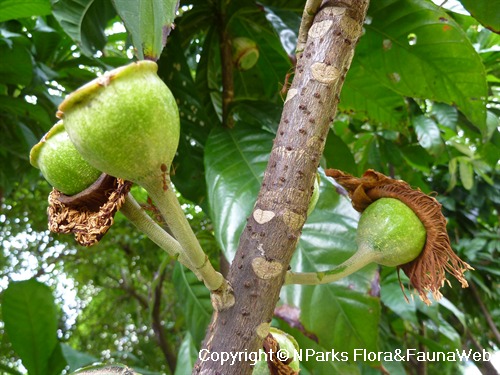
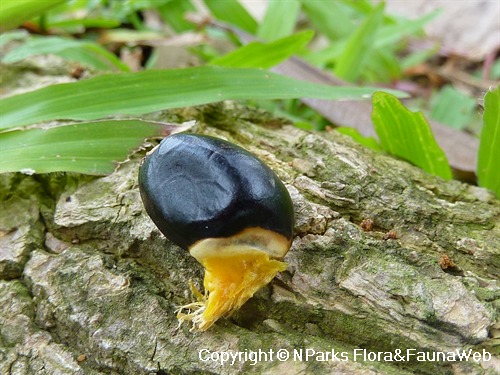
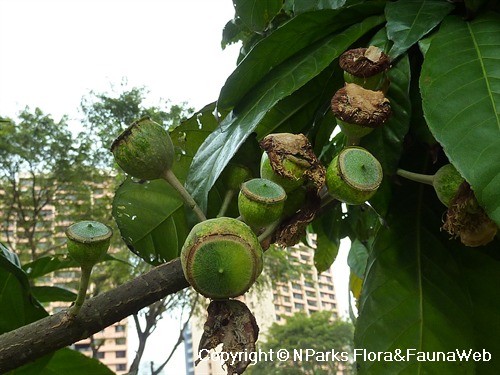
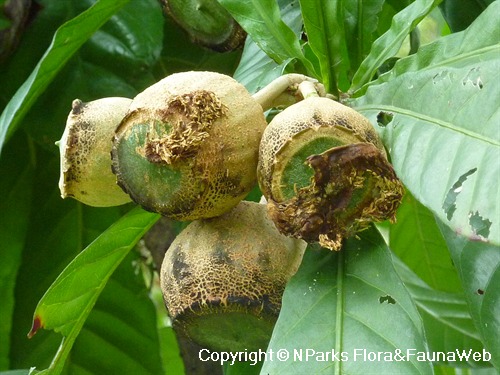
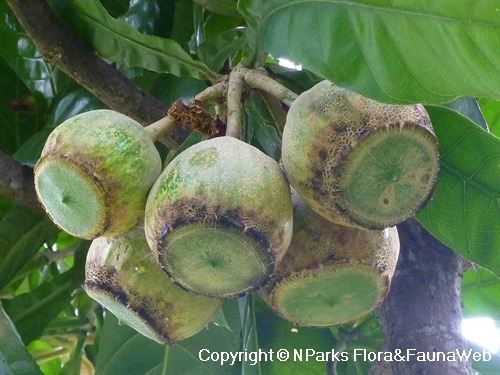
| Fruit | Fruit woody and round or depressed globose (3 – 9 cm long and 4 – 10 cm wide) with a ring at the apex. The fruit turn from green to yellow at maturity. Each fruit contains several seeds. The seed is about 1.2 – 3.5 cm long and 1.1 – 2.2 cm wide, and surrounded by orange fleshy arils. |
| Habitat | It is found in tropical lowland rainforest. |
| Associated Fauna | Flowers are pollinated by insects and fruits are dispersed by small animals. In Singapore, stingless bees are observed to visit the flowers. |
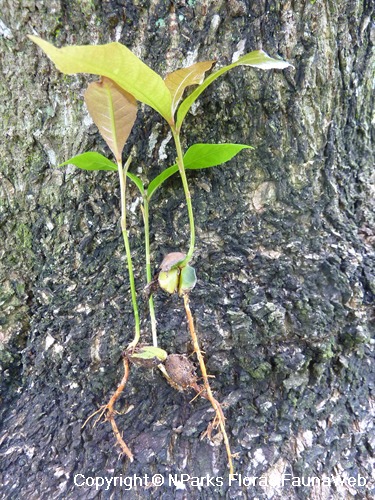
| Cultivation | It can be propagated by seed or stem cutting. It can tolerate semi-shade condition but thrives in full sun condition. |
| Etymology | The genus was named in honour of King Gustavus III of Sweden (1746 – 1792), who was Carl Linnaeus’ patron. The specific epithet superba, in Latin, means superb or magnificent. |
| Ethnobotanical Uses | Others: In Central America, the orange aril is reportedly edible yet unpalatable. |
Landscaping Features
| Desirable Plant Features | Ornamental Flowers |
|---|---|
| Landscape Uses | Suitable for Roadsides, Parks & Gardens |
Fauna, Pollination and Dispersal
| Fauna Pollination Dispersal Associated Fauna | Bee-Attracting Plant |
|---|---|
| Pollination Method(s) | Biotic (Fauna) (Insects (Bee), Insects (Ant, Beetle, Fly, Thrip, Wasp)) |
| Seed or Spore Dispersal | Biotic (Fauna) |
Plant Care and Propagation
| Light Preference | Semi-Shade, Full Sun |
|---|---|
| Water Preference | Moderate Water |
| Plant Growth Rate | Moderate |
| Rootzone Tolerance | Well-Drained Soils |
Foliar
| Foliage Retention | Evergreen |
|---|---|
| Mature Foliage Colour(s) | Green |
| Mature Foliage Texture(s) | Smooth, Glossy / Shiny |
| Prominent Young Flush Colour(s) | Pink |
| Foliar Type | Simple / Unifoliate |
| Foliar Arrangement Along Stem | Whorled |
| Foliar Attachment to Stem | Petiolate |
| Foliar Shape(s) | Non-Palm Foliage (Oblanceolate) |
| Foliar Venation | Pinnate / Net |
| Foliar Margin | Serrate / Toothed |
| Foliar Apex - Tip | Acuminate |
| Foliar Base | Cuneate |
| Leaf Area Index (LAI) for Green Plot Ratio | 4.0 (Tree - Dense Canopy) |
Non - Foliar and Storage
| Trunk Type (Non Palm) | Woody |
|---|---|
| Mature Bark Texture | Fissured |
| Stem Type & Modification | Woody |
| Root Type | Underground |
Floral (Angiosperm)
| Flower & Plant Sexuality | Bisexual Flowers |
| Flower Colour(s) | Pink, White |
|---|---|
| Flower Grouping | Cluster / Inflorescence |
| Flower Location | Axillary |
| Flower Symmetry | Radial |
| Individual Flower Shape | Bowl-shaped |
| Inflorescence Type | Raceme |
| Flowering Period | Free-Flowering |
| Flowering Habit | Polycarpic |
Fruit, Seed and Spore
| Mature Fruit Colour(s) | Yellow / Golden |
|---|---|
| Mature Fruit Texture(s) | Leathery |
| Fruit Classification | Aggregate Fruit (Syncarp) |
| Fruit Type | |
| Mature Seed Colour(s) | Black |
| Mature Seed Texture(s) | Smooth |
| Seed Quantity Per Fruit | Several (11-20) |
References
| References | Prance, G.T. & Mori, S. A. (1979). Lecythidaceae: Part I: The Actinomorphic-Flowered New World Lecythidaceae (Asteranthos, Gustavia, Grias, Allantoma, & Cariniana). Flora Neotropica. Vol. 21 (1), pp. 1-270 |
|---|
Image Repository
Others
| Master ID | 1654 |
|---|---|
| Species ID | 2947 |
| Flora Disclaimer | The information in this website has been compiled from reliable sources, such as reference works on medicinal plants. It is not a substitute for medical advice or treatment and NParks does not purport to provide any medical advice. Readers should always consult his/her physician before using or consuming a plant for medicinal purposes. |