






Back
Pseudobombax ellipticum
| Family Name: | Malvaceae |
| Synonyms: | Bombax ellipticum Kunth |
| Common Name: | Shaving-brush Tree, Red Silk Cotton |
Name
Classifications and Characteristics
| Plant Division | Angiosperms (Flowering Seed Plants) |
|---|---|
| Plant Growth Form | Tree (Shrubby (1m-5m)) |
| Lifespan (in Singapore) | Perennial |
| Mode of Nutrition | Autotrophic |
| Maximum Height | 4.5 m to 6 m |
| Maximum Plant Spread / Crown Width | 3 m to 4.5 m |
Biogeography
| Native Distribution | Mexico, El Salvador, Guatemala, Honduras |
|---|---|
| Native Habitat | Terrestrial |
| Preferred Climate Zone | Tropical |
| Local Conservation Status | Non-native (Horticultural / Cultivated Only) |
Description and Ethnobotany
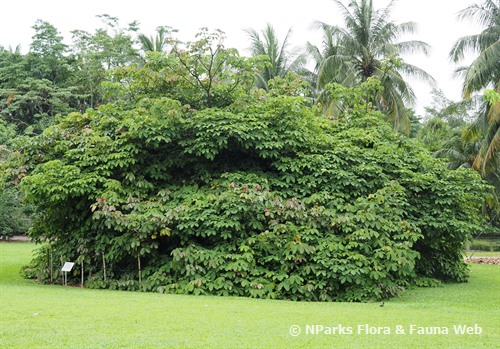
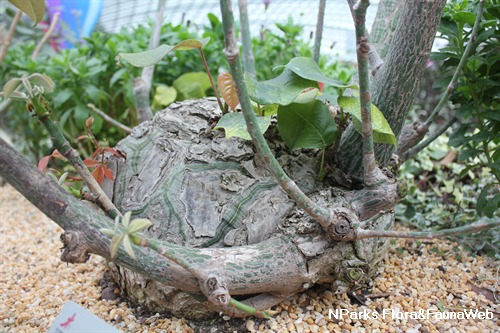
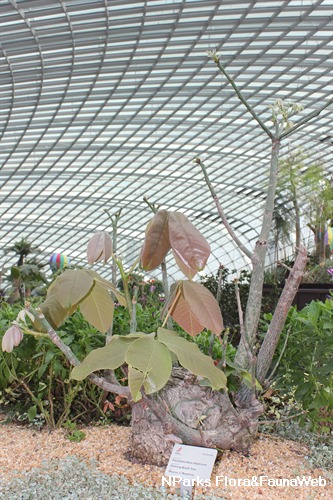
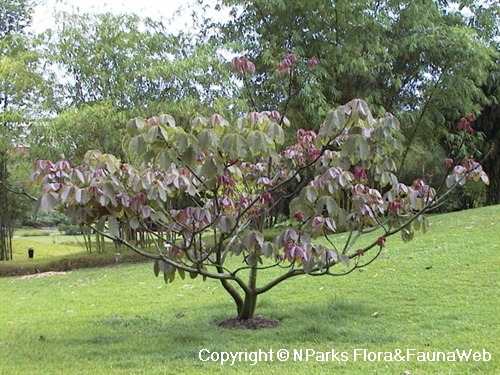
| Growth Form | When grown in the ground, plants adopt a typical tree form up to 9 m tall. When grown in containers, plants become small shrubs with round, swollen stems. |
|---|---|
| Trunk | When grown in containers, the trunk becomes round and swollen. The rough, flaky bark is streaked with green, photosynthetic markings that form a turtle shell-like pattern. |
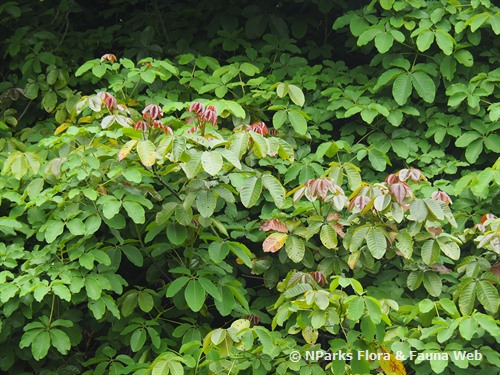
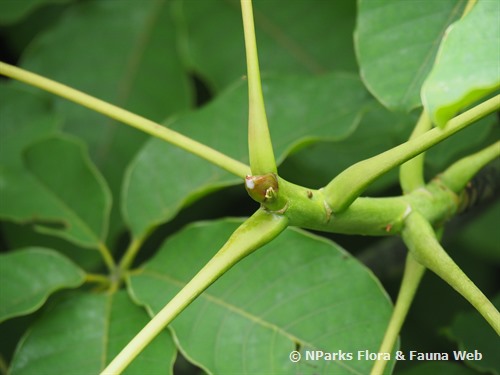
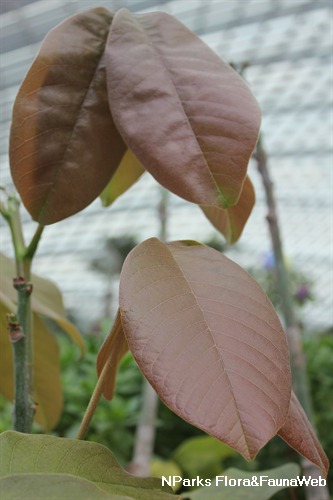
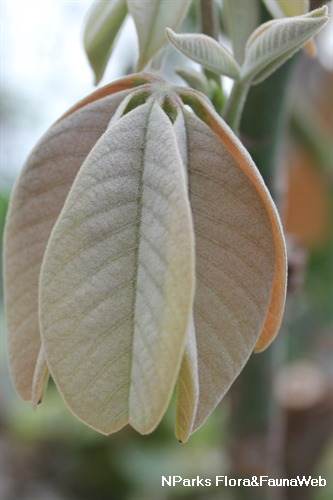
| Foliage | Palmately compound leaves are composed of 5 large, elliptic leaflets (30 cm long, 18 cm wide). New foliage is dark red, smooth and glossy, gradually turning to green. |
| Flowers | White flowers are composed of linear petals which are tightly rolled backwards when in full bloom. They produce a thick bundle of numerous, long, white stamens (13 cm long) which resembles a shaving brush. |
| Fruit | The fruit (15 cm long) is filled with soft, white fibers that surround the seeds. |
| Habitat | This species occurs on dry, rocky soils in tropical climates. |
| Cultivation | Plants in containers are prized for the attractive green markings on the trunk. Growing this plant in partial shade will encourage the formation of more distinct and extensive green markings. It should be pruned early to form low branches if a swollen stem is desired. |
| Ethnobotanical Uses | Edible Plant Parts : Edible Seeds Others: The soft fibers in the fruit are known as kapok and were used to stuff pillows and jackets in the past. |
Landscaping Features
| Desirable Plant Features | Ornamental Trunk |
|---|---|
| Landscape Uses | Parks & Gardens, Container Planting, Suitable for Bonsai |
Plant Care and Propagation
| Light Preference | Full Sun, Semi-Shade |
|---|---|
| Water Preference | Moderate Water |
| Plant Growth Rate | Moderate |
| Rootzone Tolerance | Well-Drained Soils, Rootbound Conditions |
Foliar
| Mature Foliage Colour(s) | Green |
|---|---|
| Mature Foliage Texture(s) | Smooth |
| Prominent Young Flush Colour(s) | Red |
| Young Flush Texture(s) | Smooth, Glossy / Shiny |
| Foliar Type | Compound (Palmate) |
| Foliar Arrangement Along Stem | Alternate |
| Foliar Attachment to Stem | Petiolate |
| Foliar Shape(s) | Non-Palm Foliage (Palmate) |
| Foliar Venation | Pinnate / Net |
| Foliar Margin | Entire |
| Foliar Apex - Tip | Acute |
| Foliar Base | Acute |
| Leaf Area Index (LAI) for Green Plot Ratio | 3.0 (Tree - Intermediate Canopy) |
Floral (Angiosperm)
| Flower & Plant Sexuality | Bisexual Flowers |
| Flower Colour(s) | White |
|---|---|
| Flower Grouping | Cluster / Inflorescence |
| Flower Location | Terminal |
References
| References | de Vosjoli, P.. 2004. Pachyforms: A Guide to Growing Pachycaul and Caudiciform Plants. USA: Advanced Visions Inc.. 319 pp. |
|---|
Image Repository
Others
| Master ID | 1797 |
|---|---|
| Species ID | 3090 |
| Flora Disclaimer | The information in this website has been compiled from reliable sources, such as reference works on medicinal plants. It is not a substitute for medical advice or treatment and NParks does not purport to provide any medical advice. Readers should always consult his/her physician before using or consuming a plant for medicinal purposes. |