






Back
Pternandra coerulescens Jack
| Family Name: | Melastomataceae |
| Synonyms: | Pternandra capitellata Jack, Pternandra jackiana Ridl. |
| Common Name: | Cursed Shade, Sial Menahun, Lidah Katak, Bunut, Bunut Paya, Kelat Biru, Nipis Kulit |


Name
Classifications and Characteristics
| Plant Division | Angiosperms (Flowering Seed Plants) (Dicotyledon) |
|---|---|
| Plant Growth Form | Tree (Medium (16m-30m)) |
| Lifespan (in Singapore) | Perennial |
| Mode of Nutrition | Autotrophic |
| Plant Shape | Irregular |
| Maximum Height | 20 m |
Biogeography
| Native Distribution | Southern China, Thailand, Sumatra, Peninsular Malaysia, Singapore, Borneo, Sulawesi, Moluccas, and New Guinea |
|---|---|
| Native Habitat | Terrestrial (Primary Rainforest, Secondary Rainforest, Freshwater Swamp Forest) |
| Preferred Climate Zone | Tropical, Sub-Tropical / Monsoonal |
| Local Conservation Status | Native to Singapore (Vulnerable (VU)) |
Description and Ethnobotany
| Growth Form | It is a small tree or shrub up to 20 m tall. Its finely fissured bark is grey to greenish-red or brown. |
|---|---|
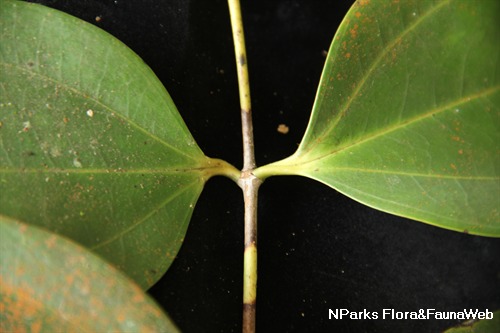
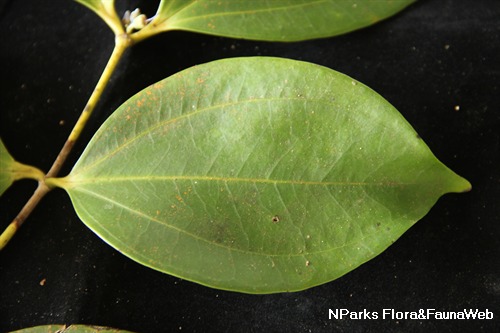
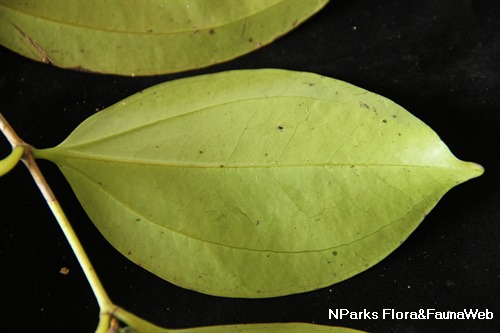
| Foliage | Its opposite, stalked leaves have papery to leathery leaf blades that are oblong-elliptic with a pointed tip. The 3-nerved leaf blades are 5–25 by 2–15 cm. |
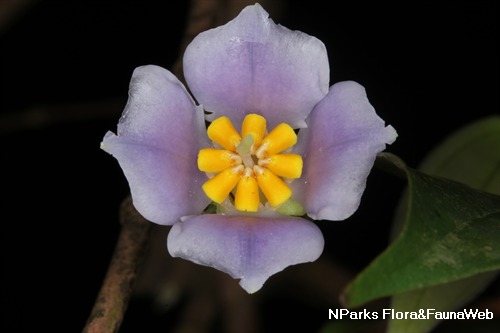
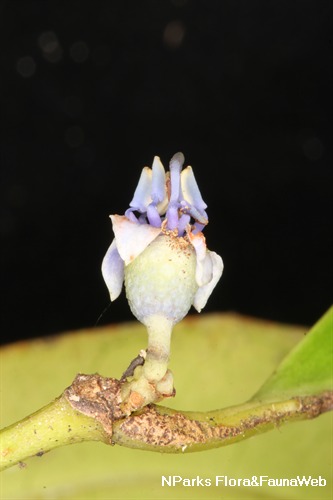
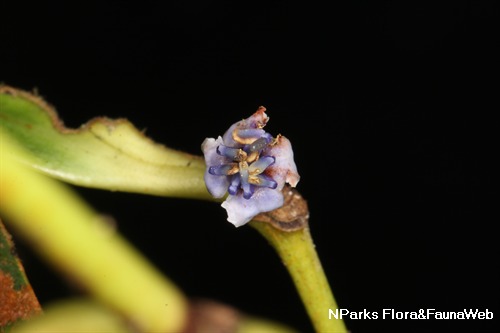
| Flowers | Its flowering clusters are up to 7.6 cm long, with few to many flowers. The 4-merous flowers are pale lilac to dark blue. |
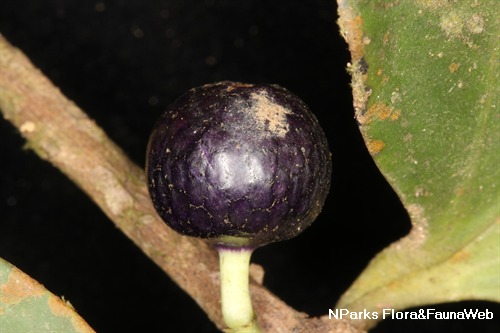
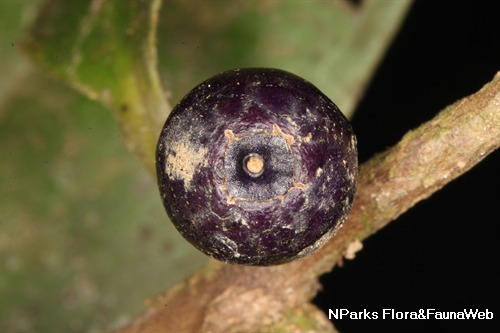
| Fruit | It rather round fruits are berries, 4–8 mm wide, and purplish-black when ripe. |
| Habitat | It grows in lowland and hill forests. |
| Associated Fauna | Its flowers are insect-pollinated, and fruits eaten by birds. |
| Cultivation | It can be propagated by seed. |
| Etymology | Greek pternandra, heel and stamen, refering to the spur; Latin coerulescens, turning blue, referring to the mature fruits that are bluish |
| Ethnobotanical Uses | Medicinal: Its plant parts have
medicinal properties. A poultice prepared from its berries is applied to treat inflammation
of the testes and hydrocele. The berry extract can be drunk to stop vomiting. A
root decoction is administered after childbirth in Pahang. Timber & Products: Its wood is used as a source of timber. |
Landscaping Features
| Landscaping | It is suitable for parks for its attractive blue flowers, and ornamental leaves. |
|---|---|
| Desirable Plant Features | Ornamental Flowers, Ornamental Foliage |
| Landscape Uses | General, Parks & Gardens, Small Gardens |
Fauna, Pollination and Dispersal
| Fauna Pollination Dispersal Associated Fauna | Bird-Attracting Plant |
|---|---|
| Pollination Method(s) | Biotic (Fauna) |
| Seed or Spore Dispersal | Biotic (Fauna) |
Plant Care and Propagation
| Light Preference | Full Sun |
|---|---|
| Water Preference | Moderate Water |
| Plant Growth Rate | Moderate |
| Rootzone Tolerance | Moist Soils, Well-Drained Soils, Fertile Loamy Soils |
| Propagation Method | Seed |
Foliar
| Foliage Retention | Evergreen |
|---|---|
| Mature Foliage Colour(s) | Green |
| Mature Foliage Texture(s) | Papery, Leathery |
| Foliar Type | Simple / Unifoliate |
| Foliar Arrangement Along Stem | Opposite |
| Foliar Attachment to Stem | Petiolate |
| Foliar Shape(s) | Non-Palm Foliage (Elliptical, Oblong) |
| Foliar Venation | Pinnate / Net, Parallel |
| Foliar Margin | Entire |
| Leaf Area Index (LAI) for Green Plot Ratio | 3.0 (Tree - Intermediate Canopy) |
Floral (Angiosperm)
| Flower & Plant Sexuality | Bisexual Flowers |
| Flower Colour(s) | Purple, Blue |
|---|---|
| Flower Grouping | Cluster / Inflorescence |
| Flower Location | Axillary |
| Flower Symmetry | Radial |
Fruit, Seed and Spore
| Mature Fruit Colour(s) | Black, Purple |
|---|---|
| Fruit Classification | Simple Fruit |
| Fruit Type | Fleshy Fruit , Non-Accessory Fruit |
Image Repository
Others
| Master ID | 1798 |
|---|---|
| Species ID | 3091 |
| Flora Disclaimer | The information in this website has been compiled from reliable sources, such as reference works on medicinal plants. It is not a substitute for medical advice or treatment and NParks does not purport to provide any medical advice. Readers should always consult his/her physician before using or consuming a plant for medicinal purposes. |