




Back
Ceriops tagal (Perr.) C.B.Rob.
| Family Name: | Rhizophoraceae |
| Synonyms: | Ceriops australis, Ceriops boiviniana, Ceriops candolleana |
| Common Name: | Tengar, Tengah |
Name
Classifications and Characteristics
| Plant Division | Angiosperms (Flowering Seed Plants) (Dicotyledon) |
|---|---|
| Plant Growth Form | Tree (Medium (16m-30m), Small (6m-15m)) |
| Lifespan (in Singapore) | Perennial |
| Mode of Nutrition | Autotrophic |
Biogeography
| Native Distribution | From Mozambique and East Africa to the Western Pacific, South East Asia, including Singapore, Australia, Taiwan and Papua New Guinea |
|---|---|
| Native Habitat | Shoreline (Mangrove Forest) |
| Preferred Climate Zone | Tropical, Sub-Tropical / Monsoonal |
| Local Conservation Status | Native to Singapore (Vulnerable (VU)) |
Description and Ethnobotany
| Growth Form | Small to medium-sized tree, growing up to 20 m approx. In Singapore, trees tend to be 10 m or less. |
|---|---|
| Trunk | Smooth bark, sometimes fissured, greyish brown in colour, flanged stem base. |
| Roots | Short buttress roots forming from short stilt roots originating from the base of a mature trunk. |
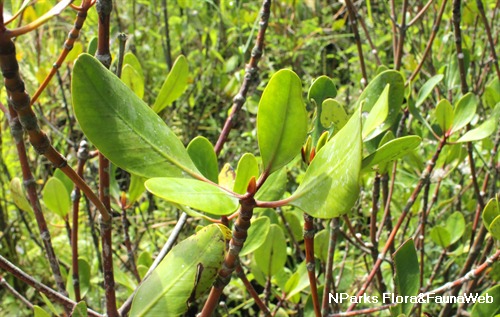
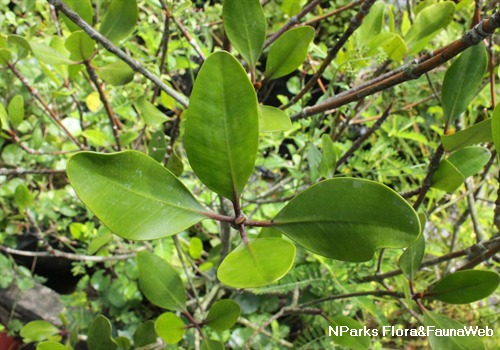
| Foliage | Rounded, glossy-green leaves 5.5 - 10 by 2 - 3.5 cm, obovate-elliptic and often having an inwardly-curled margin. |
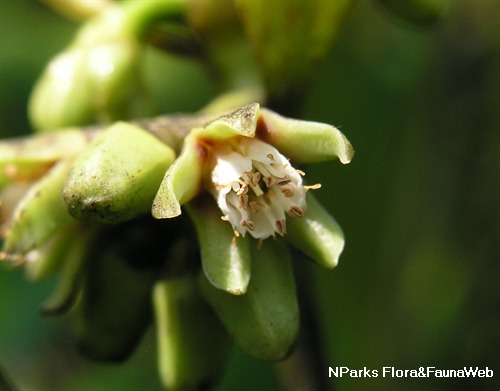
| Flowers | 5 - 10 flowered, pendulous flower head measuring 2 by 10 - 20. It has a long, slender stalk, is resinous and occurs at the ends of new shoots or in the axils on older ones. Calyx lobes are erect in flower, recurved in fruit, 4 - 5 mm in length, with a 2 mm long tube. Stamens have long, slender filaments that extend far beyond the blunt anthers. Fresh flowers are white in colour and they turn brown quickly. Flowers emit a faint fragrance which attracts moths and bees. |
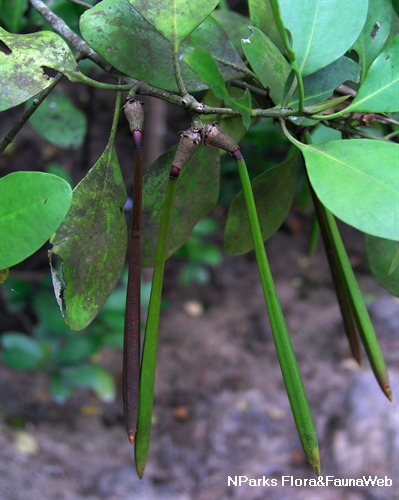
| Fruit | Inverted hypocotyl with angular ridges, slender and measuring 4 - 25 cm in length. Characteristic white collar below the calyx. |
| Others - Plant Morphology | The only mangrove species to have flattened terminal buds. |
| Habitat | Found from downstream to intermediate estuarine areas. Forms dense shrublands on the landward edge of tidal forests, in areas inundated by spring tides. Likes to grow in areas with well-drained soils. |
| Taxonomy | Formally known as Ceriops candolleana. |
| Etymology | Latin word Ceriops originated from Greek word Ceras-opsis, which means horn-like appearance. The horn-like appearance draws resemblance to the small hypocotyl shape. |
| Ethnobotanical Uses | Timber & Products: Bark used for tanning fish lines and nets. Trunk can be used for building houses and firewood. Sap collected to make clothing dye for the batik industry. |
Landscaping Features
| Landscape Uses | Coastal Plant |
|---|
Fauna, Pollination and Dispersal
| Pollination Method(s) | Biotic (Fauna) |
|---|---|
| Seed or Spore Dispersal | Abiotic (Water) |
Plant Care and Propagation
| Light Preference | Full Sun |
|---|---|
| Water Preference | Moderate Water |
| Plant Growth Rate | Moderate |
| Rootzone Tolerance | Moist Soils, Well-Drained Soils, Saline Soils / Salt Spray |
| Potential Problems | Sooty mould and scale insects. |
| Propagation Method | Viviparious Propagule |
Foliar
| Foliage Retention | Evergreen |
|---|---|
| Mature Foliage Colour(s) | Green |
| Mature Foliage Texture(s) | Smooth, Glossy / Shiny, Thick |
| Foliar Type | Simple / Unifoliate |
| Foliar Arrangement Along Stem | Opposite |
| Foliar Attachment to Stem | Petiolate |
| Foliar Shape(s) | Non-Palm Foliage (Elliptical, Oblong) |
| Foliar Venation | Pinnate / Net |
| Foliar Margin | Entire |
| Foliar Apex - Tip | Obtuse |
| Foliar Base | Cuneate |
Floral (Angiosperm)
| Flower & Plant Sexuality | Bisexual Flowers |
| Flower Colour(s) | White |
|---|---|
| Flower Grouping | Cluster / Inflorescence |
| Flowering Opening Time | Night (dusk to dawn) |
Fruit, Seed and Spore
| Mature Fruit Colour(s) | Green |
|---|---|
| Mature Fruit Texture(s) | Smooth |
Image Repository
Others
| Master ID | 29492 |
|---|---|
| Species ID | 3801 |
| Flora Disclaimer | The information in this website has been compiled from reliable sources, such as reference works on medicinal plants. It is not a substitute for medical advice or treatment and NParks does not purport to provide any medical advice. Readers should always consult his/her physician before using or consuming a plant for medicinal purposes. |