






Back
Teijsmanniodendron pteropodum (Miq.) Bakh.
| Family Name: | Lamiaceae (Labiatae) |
| Synonyms: | Vitex peralata King, Vitex pteropoda Miq. |
| Common Name: | Buak-buak, Tapak itik |
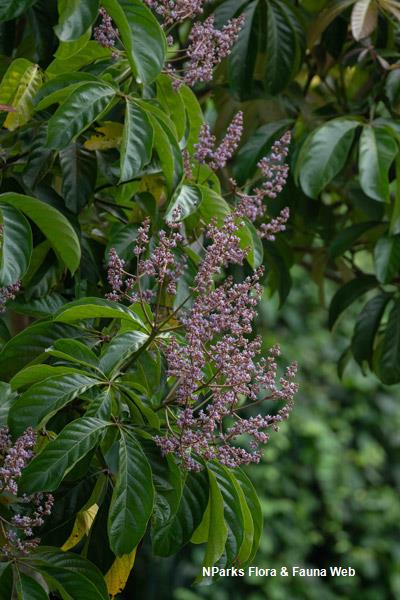
Teijsmanniodendron pteropodum, also known as Buak-buak, is a critically endangered tree in Singapore. It naturally occurs in rainforests and freshwater swamps and can reach up to 40 m tall in the wild. The tree has compound leaves with winged petioles, and its young leaves emerge purple-black before gradually turning green as they mature.
Name
Classifications and Characteristics
| Plant Division | Angiosperms (Flowering Seed Plants) (Dicotyledon) |
|---|---|
| Plant Growth Form | Tree |
| Lifespan (in Singapore) | Perennial |
| Mode of Nutrition | Autotrophic |
| Maximum Height | 40 m |
Biogeography
| Native Distribution | India (Nicobar Islands), Southern Thailand, Sumatra, Peninsular Malaysia, Singapore, Borneo and the Philippines. |
|---|---|
| Native Habitat | Terrestrial |
| Preferred Climate Zone | Tropical |
| Local Conservation Status | Native to Singapore (Critically Endangered (CR)) |
Description and Ethnobotany
| Growth Form | It is a tree that can reach 6 – 40 m tall. The trunk may grow to 12 – 60 cm diameter and buttresses are usually less than 4 m high. |
|---|---|
| Foliage | Leaves are compound with 3 – 7 leaflets. The leaflets are lanceolate, obovate to ovate. The central leaflet is slightly larger than the rest, measuring 10 – 55 cm long and 3 – 19 cm wide. Each leaflet has (5-) 12 – 16 pairs of lateral veins. The leaflet tip is obtuse to tapering (acuminate) while the base is narrow (attenuate) to wedged shaped (cuneate). The petiole is 7–30 cm long and narrowly to broadly winged. It is thickened or swollen at both ends and triangular in cross-section. The winged petiole is a highly variable and may sometimes be wingless. Young leaves emerge purple-black and gradually turn green as they mature. |
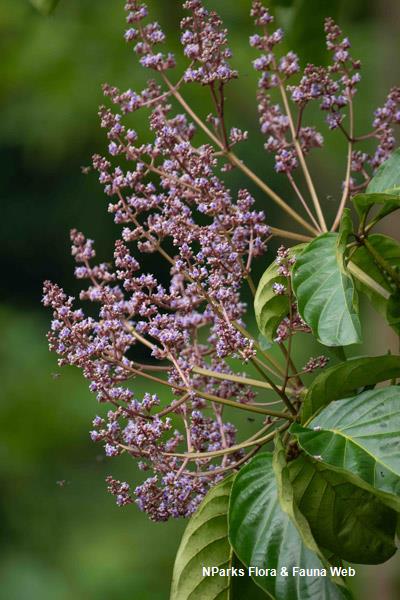
| Flowers | Flowers occur in clusters (paniculate with trichotomous cymes), measuring 20–100 cm long. They are small, with petals fused into an upper and a lower lip. The upper lip has two lobes, while the lower lip has three. The flowers are reddish-brown or pale purplish-red and faintly fragrant. |
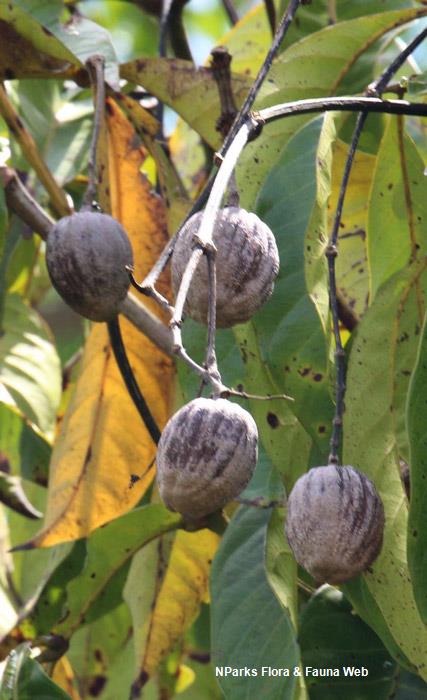
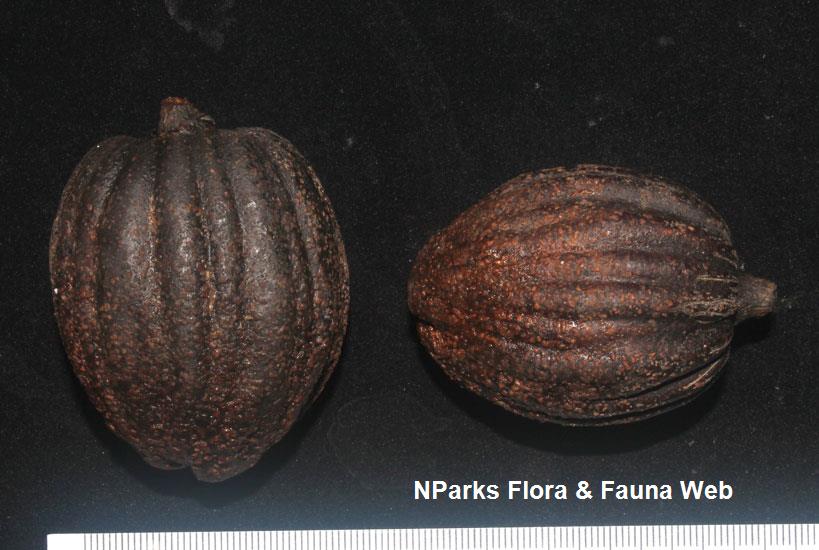
| Fruit | The fruit is an ellipsoid drupe, measuring about 1.5 – 4.5 cm long and 2 – 5 cm in diameter. It is brown and woody, generally smooth but irregularly wrinkled when young. Each fruit contains a single large seed and does not split open at maturity. |
| Habitat | It is found in rainforests, often along riverbanks, or freshwater swamps, up to 960 m altitude. |
| Associated Fauna | Flowers are pollinated by insects. The winged petioles form small chambers that may serve as shelter for ants. |
| Etymology | The genus epithet is named after Johannes Elias Teijsmann (1808 – 1882), curator of Buitenzorg Botanic Gardens (now Bogor Botanic Gardens) in Indonesia. The specific epithet comprises of two parts. pteron, in Greek, means wing while podos, in Greek, means foot, which refers to the winged petioles. |
| Ethnobotanical Uses | Medicinal: Traditional Medicinal Uses
Timber & Products: The timber is used for building houses, interior work, telephone poles, framing, moulding and for making boxes and crates. |
Landscaping Features
| Desirable Plant Features | Fragrant |
|---|---|
| Landscape Uses | General |
Fauna, Pollination and Dispersal
| Pollination Method(s) | Biotic (Fauna) |
|---|
Plant Care and Propagation
| Light Preference | Full Sun |
|---|---|
| Water Preference | Moderate Water |
| Plant Growth Rate | Moderate |
Foliar
| Mature Foliage Colour(s) | Green |
|---|---|
| Mature Foliage Texture(s) | Leathery |
| Prominent Young Flush Colour(s) | Purple, Black |
| Foliar Type | Compound |
| Foliar Arrangement Along Stem | Opposite |
| Foliar Attachment to Stem | Petiolate |
| Foliar Venation | Reticulate |
| Foliar Apex - Tip | Obtuse, Acuminate |
| Foliar Base | Attenuate, Cuneate |
Non - Foliar and Storage
| Root Type | Underground |
|---|
Floral (Angiosperm)
| Flower & Plant Sexuality | Bisexual Flowers |
| Flower Colour(s) | Red, Brown, Purple |
|---|---|
| Flower Grouping | Cluster / Inflorescence |
| Individual Flower Shape | Labiate / Lipped |
Fruit, Seed and Spore
| Mature Fruit Colour(s) | Brown |
|---|---|
| Mature Fruit Texture(s) | Smooth |
| Fruit Classification | Simple Fruit |
| Seed Quantity Per Fruit | Few (1-5) |
References
| References | <1> Bramley, G.L.C., Go, R., and de Kok, R.P.J. (2011). Lamiaceae s.l. In: Soepadmo, E., Saw, L.G., Chung, R.C.K. & Kiew, R. (eds) Tree Flora of Sabah and Sarawak 7: 1–86. Malaysia: Sabah Forestry Department, Forest Research Institute Malaysia (FRIM), Sarawak Forestry Department. <2> de Kok, R. P. J., Rusea, G. and A. Latiff, A. (2009) The genus Teijsmanniodendron Koord. (Lamiaceae). Kew Bulletin 64: 587–625. <3> de Kok, R.P.J. (2022). Teijsmanniodendron. In: Bramley, G.L.C. et. al. (eds) Flora of Peninsular Malaysia. Malayan Forest Records No. 49. Series II: Seed Plants, vol. 9, 301pp. Selangor: Forest Research Institute Malaysia. <4> Sosef, M.SM., Hong, L.T., and Prawirohatmodjo, S. (Editors). 1998. Plant Resources of South-East Asia Volume 5 (3). Timber Trees: Lesser known timbers. Leiden: Prosea Foundation. 859 pages. |
|---|
Image Repository
Others
| Master ID | 29729 |
|---|---|
| Species ID | 4038 |
| Flora Disclaimer | The information in this website has been compiled from reliable sources, such as reference works on medicinal plants. It is not a substitute for medical advice or treatment and NParks does not purport to provide any medical advice. Readers should always consult his/her physician before using or consuming a plant for medicinal purposes. |