






Back
Commersonia bartramia (L.) Merr.
| Family Name: | Malvaceae |
| Common Name: | Brown Kurrajong, Scrub Christmas Tree, 山麻树 |


Name
Classifications and Characteristics
| Plant Division | Angiosperms (Flowering Seed Plants) (Dicotyledon) |
|---|---|
| Plant Growth Form | Tree (Small (6m-15m)) |
| Lifespan (in Singapore) | Perennial |
| Mode of Nutrition | Autotrophic |
| Plant Shape | Irregular |
| Maximum Height | 15 m |
Biogeography
| Native Distribution | From Southeast Asia (including Singapore) to New Guinea, Australia and Solomon Islands |
|---|---|
| Native Habitat | Terrestrial (Secondary Rainforest, Grassland / Savannah/ Scrubland) |
| Preferred Climate Zone | Tropical, Sub-Tropical / Monsoonal |
| Local Conservation Status | Native to Singapore (Least Concern (LC)) |
Description and Ethnobotany
| Growth Form | It is a tree up to 15 m tall. |
|---|---|
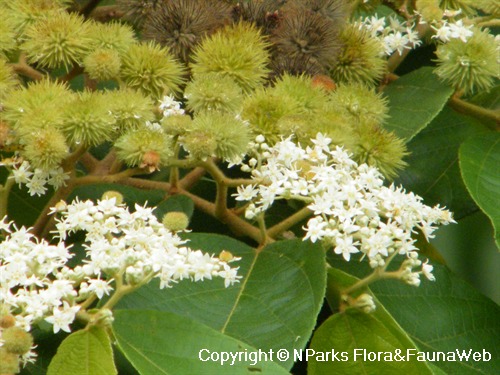
| Foliage | Its alternate, stalked leaves have leaf blades that are broadly egg-shaped, and 9-24 by 5-14 cm. The undersides of the leaves are densely covered with white hair, while its leaf margins are densely toothed. |
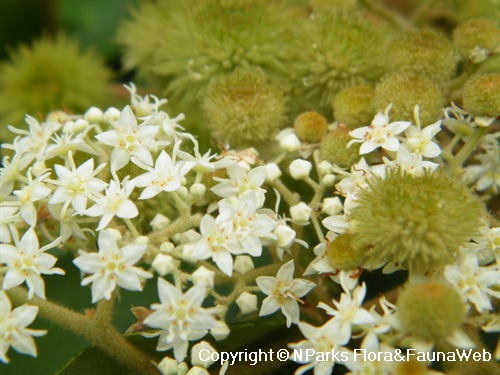
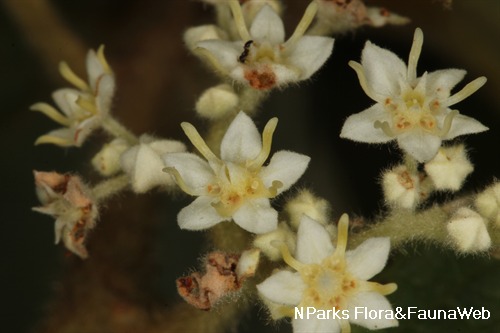
| Flowers | Its white flowers are 5-7 mm wide and grow on much-branched, flowering shoots. |
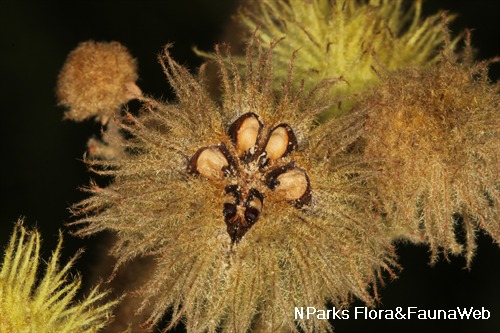
| Fruit | Its fruits are round, about 2-2.5 cm wide, and covered with long, woolly hair. Its glossy black-brown seeds are oval. |
| Habitat | It grows in secondary forests and open habitats, usually as a pioneer species. |
| Associated Fauna | Its flowers are pollinated by insects. |
| Cultivation | It can be propagated by seed. |
| Etymology | Latin Commersonia, commemorating P. Commerson (1727-1773), a French botanist and explorer; Latin bartramia, commemorating J. Bartam (1699-1777), an American botanist. |
| Ethnobotanical Uses | Others: The fibre obtained from its bark is used to make ropes. |
Landscaping Features
| Desirable Plant Features | Ornamental Flowers, Ornamental Fruits |
|---|
Plant Care and Propagation
| Light Preference | Full Sun |
|---|---|
| Water Preference | Moderate Water |
| Plant Growth Rate | Moderate |
Image Repository
Others
| Master ID | 29794 |
|---|---|
| Species ID | 4103 |
| Flora Disclaimer | The information in this website has been compiled from reliable sources, such as reference works on medicinal plants. It is not a substitute for medical advice or treatment and NParks does not purport to provide any medical advice. Readers should always consult his/her physician before using or consuming a plant for medicinal purposes. |