





Back
Swintonia schwenkii (Teijsm. & Binn.) Teijsm. & Binn.
| Family Name: | Anacardiaceae |
| Common Name: | Merpauh, Merpauh Periang |
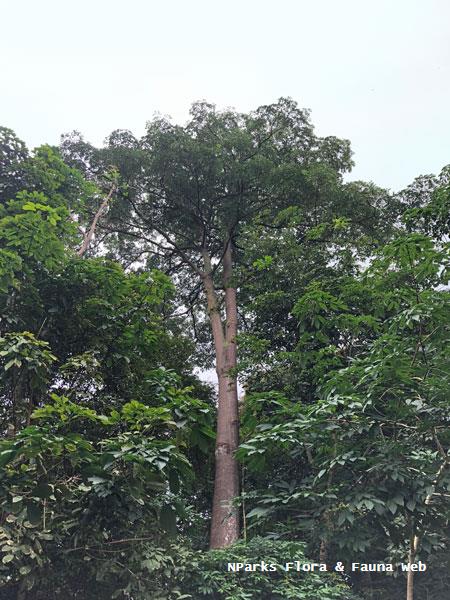
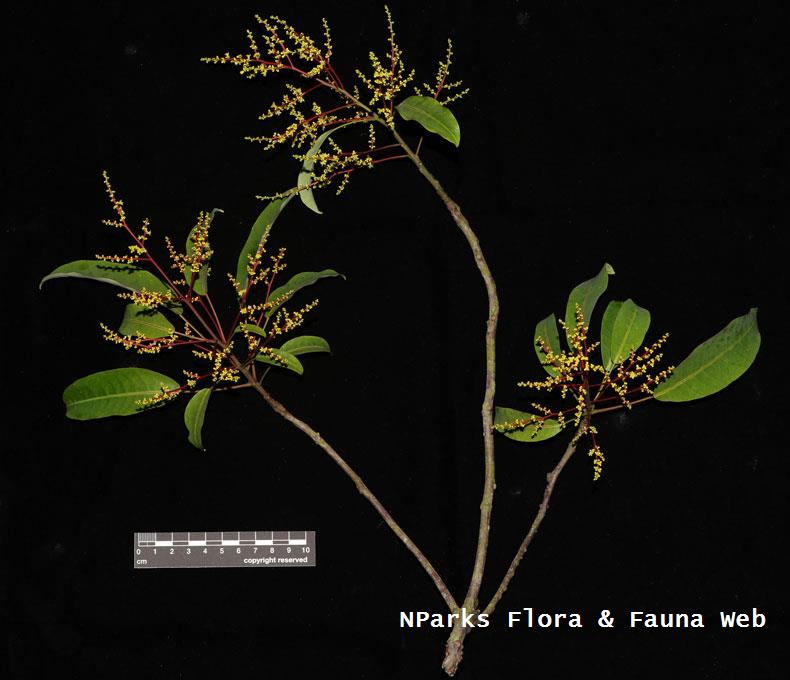
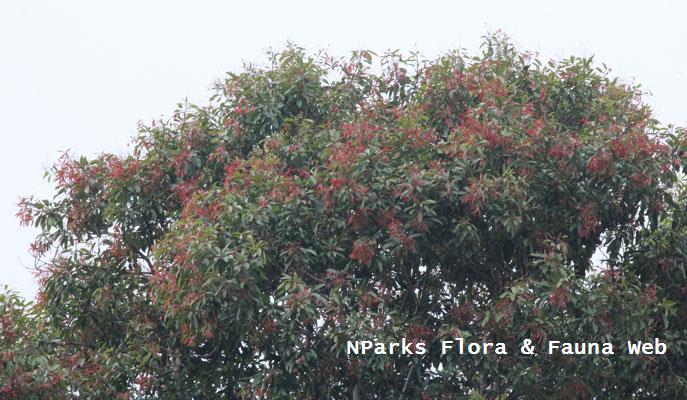
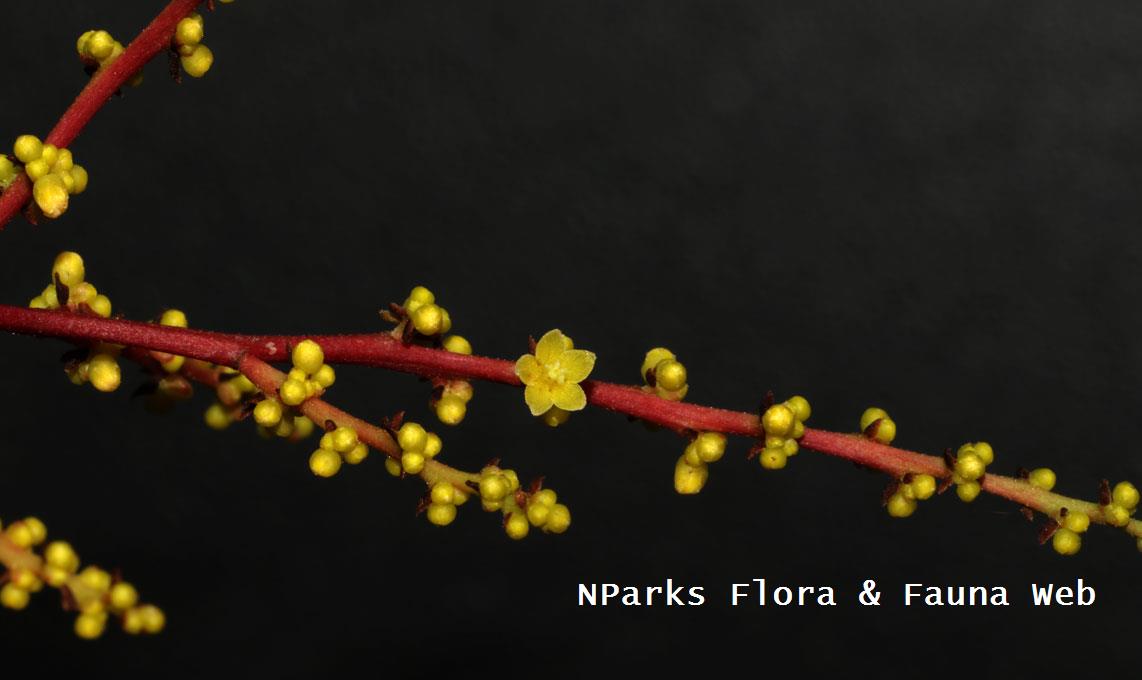
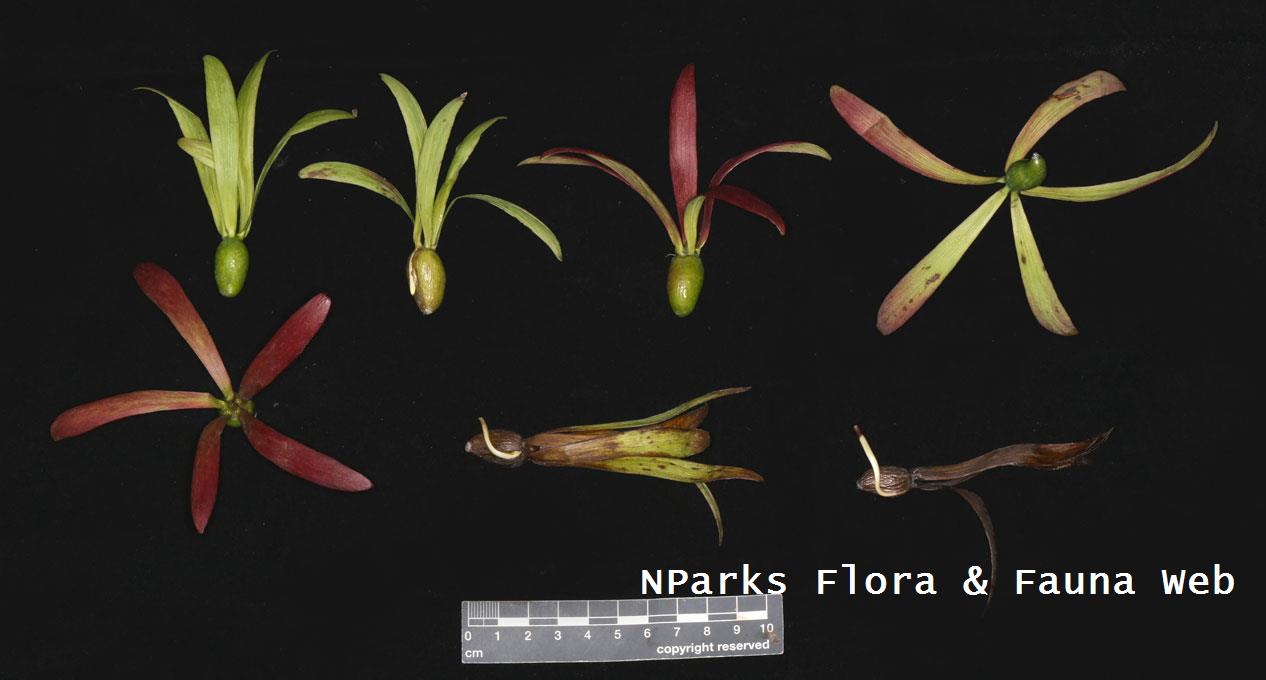
Swintonia schwenkii or Merpauh is a large-sized tree native to Singapore. Growing to a height of 53 m, it produce papery to slightly leathery foliage clustered at the tip of the twigs. Flowers are held on an inflorescence, yellow, 5 petalled, petals covered in short hairs enitrely. The fruit is a 5-winged mango-shaped drupe which dislodge itself upside down, rotating down from the tree upon maturity.
Name
Classifications and Characteristics
| Plant Division | Angiosperms (Flowering Seed Plants) (Dicotyledon) |
|---|---|
| Plant Growth Form | Tree (Big (>30m)) |
| Lifespan (in Singapore) | Perennial |
| Maximum Height | 53 m |
Biogeography
| Native Distribution | Myanmar, Thailand, Cambodia, Sumatra, Peninsular Malaysia, Singapore, Borneo |
|---|---|
| Native Habitat | Terrestrial (Primary Rainforest, Secondary Rainforest) |
| Preferred Climate Zone | Tropical |
| Local Conservation Status | Native to Singapore (Critically Endangered (CR)) |
Description and Ethnobotany
| Growth Form | It is a large-sized tree that can reach to a tall height of 53 m. It has grey-brown or dark-reddish green coloured bark and buttresses reaching to 3 m tall, 5 m wide. |
|---|---|
| Foliage | Leaves found clustered at the ends of the twigs. They are papery to slightly leathery, narrowly elliptic measuring 7 - 16 cm long, 3 - 6 cm wide held on a petiole of 3.5 - 6 cm long. |
| Flowers | Flowers are borne on an inflorescence, covered in small short hairs, loosely branched. The flowers are white to yellow coloured, 5-petalled. Each flower is small, petals are 2 -3 cm long covered in short hairs entirely. |
| Fruit | The fruit is an elliptic to tear-shaped drupe resembling the shape of a mango with 5 wing-like petals measuring 5.5 - 7 cm long and 0.75 - 1 cm wide. Upon maturity, the fruit turns upside-down when it falls from the tree, rotating away in their descent. |
| Habitat | Often occurs in primary rainforest, rarely in secondary and kerangas forest, from lowland forest up to 700 m in altitude. <1,2> |
| Cultivation | It can be propagated by seed |
| Ethnobotanical Uses | Timber & Products: The timber is commonly used for light to medium general use such as construction, boat building (hulls and keels), interior finish, panelling, flooring and furniture. The pulp is developed into writing, printing and wrapping paper. <3> |
Fauna, Pollination and Dispersal
| Seed or Spore Dispersal | Abiotic (Gravity) |
|---|
Plant Care and Propagation
| Light Preference | Full Sun |
|---|---|
| Water Preference | Moderate Water |
| Plant Growth Rate | Slow |
| Rootzone Tolerance | Fertile Loamy Soils, Moist Soils, Well-Drained Soils |
| Propagation Method | Seed |
Foliar
| Foliage Retention | Evergreen |
|---|---|
| Mature Foliage Colour(s) | Green |
| Foliar Type | Simple / Unifoliate |
| Foliar Arrangement Along Stem | Spiral |
| Foliar Attachment to Stem | Petiolate |
| Foliar Shape(s) | Non-Palm Foliage (Elliptical) |
| Foliar Venation | Reticulate |
| Foliar Margin | Entire |
| Foliar Apex - Tip | Acuminate |
| Foliar Base | Cuneate, Rounded / Obtuse |
Non - Foliar and Storage
| Stem Type & Modification | Woody |
|---|---|
| Root Type | Underground |
Floral (Angiosperm)
| Flower & Plant Sexuality | Bisexual Flowers , Bisexual Flowers |
| Flower Colour(s) | Yellow / Golden |
|---|
| Flower Texture(s) | Hairy / Hirsute |
| Flower Grouping | Cluster / Inflorescence |
| Flower Location | Terminal |
| Flower Symmetry | Radial |
| Individual Flower Shape | Salverform |
| Inflorescence Type | Panicle |
| Flowering Habit | Polycarpic |
Fruit, Seed and Spore
| Mature Fruit Colour(s) | Red |
|---|---|
| Fruit Classification | Simple Fruit |
| Fruit Type | Fleshy Fruit , Drupe |
| Seed Quantity Per Fruit | Few (1-5) |
References
| References | <1> Chayamarit, K. (2010). Anacardiaceae. Flora of Thailand, vol. 10 (3), pp. 329. Bangkok: The Forest Herbarium, Department of National Parks, Wildlife and Plant Conservation. <2> Hou, D. (1974). Swintonia. In: Hou, D. (ed.) Flora Malesiana, ser. 1, vol. 8, pt. 3, pp. 443. Leiden: Rijksherbarium. <3> Lemmens, R.H.M.J, Soerianegara, I. & Wong, W.C. (1995). Plant Resources of South-East Asia, Timber trees: Minor commercial timber, pp. 435-436. Leiden: Backhuys Publishers. |
|---|
Image Repository
Others
| Master ID | 30445 |
|---|---|
| Species ID | 4754 |
| Flora Disclaimer | The information in this website has been compiled from reliable sources, such as reference works on medicinal plants. It is not a substitute for medical advice or treatment and NParks does not purport to provide any medical advice. Readers should always consult his/her physician before using or consuming a plant for medicinal purposes. |