





Back
Maclurodendron porteri (Hook.f.) T.G.Hartley
| Family Name: | Rutaceae |
| Synonyms: | Acronychia porteri Hook.f. |
| Common Name: | Katiak, Bunan Hutan, Melaman |
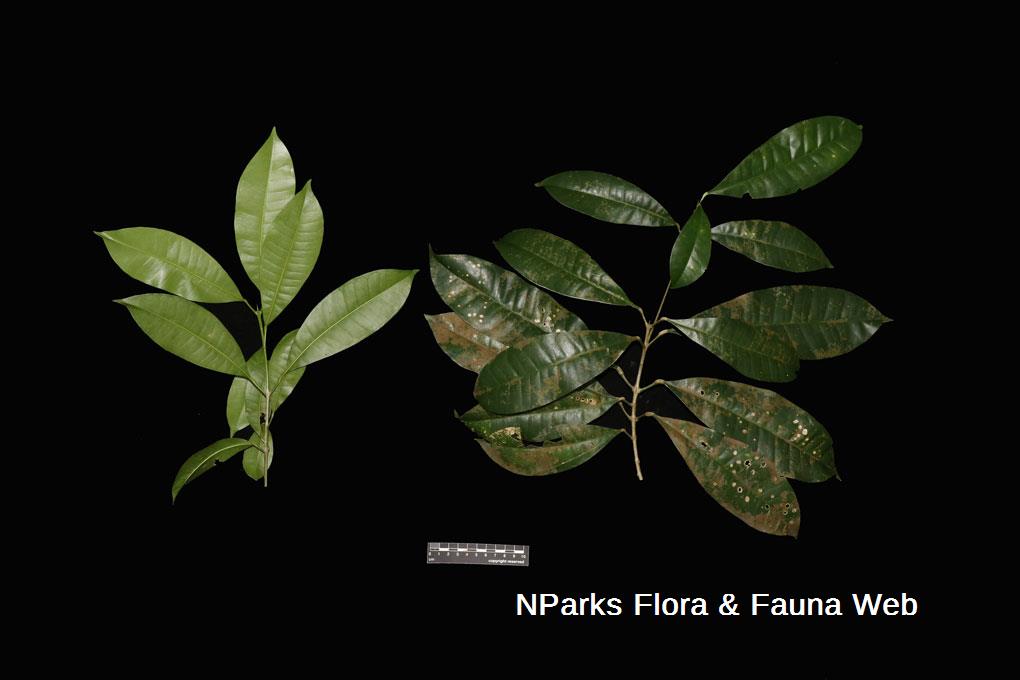
Maclurodendron porteri or Katiak is a native tree to Singapore. Growing to a height of 25 m tall, leaves are slightly leathery to stiff papery, obovate, oblanceolate to elliptic shaped with faintly visible veinlets. Flowers are dioecious, 4-petalled, green, yellow or white coloured, held on an inflorescence found along the axils. The fruit is an oval to round drupe, shallowly 4-lobed, consist of 4 cavities.
Name
Classifications and Characteristics
| Plant Division | Angiosperms (Flowering Seed Plants) (Dicotyledon) |
|---|---|
| Plant Growth Form | Tree (Medium (16m-30m)) |
| Lifespan (in Singapore) | Perennial |
| Mode of Nutrition | Autotrophic |
Biogeography
| Native Distribution | Myanmar, Thailand, Peninsular Malaysia, Singapore, Sumatra to Philippines |
|---|---|
| Native Habitat | Terrestrial (Primary Rainforest, Secondary Rainforest) |
| Preferred Climate Zone | Tropical |
| Local Conservation Status | Native to Singapore (Endangered (EN)) |
Description and Ethnobotany
| Growth Form | It is a medium sized tree that grows to 25 m tall. |
|---|---|
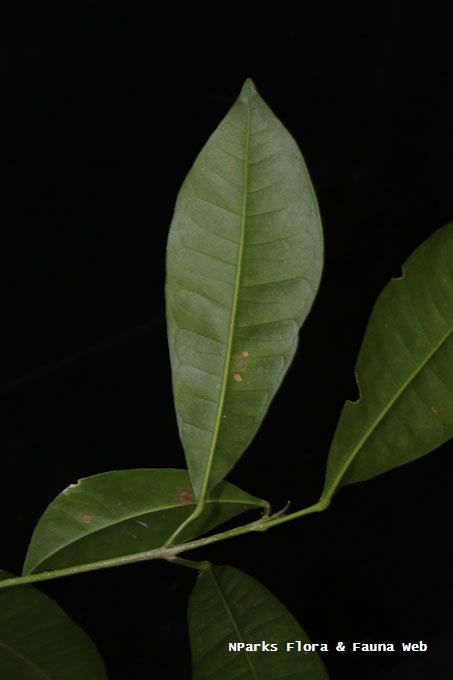
| Foliage | Leaves are slightly leathery to stiff-papery, spoon- shaped, inversely lance-shaped to elliptic measuring 5.5 - 24 cm long, 1.8 - 10 cm wide. There are 6 - 11 pairs of lateral veins, faintly visible veinlets and pellucid oil dots are present within the blade. The petiole is 0.7 - 5 cm long, swollen at the tip - near the base of the blade. |
| Flowers | Flowers are dioecious where the female and male flowers are held on separate individuals. The flowers are on an inflorescence of 2 - 15 cm long found along the axils. They are 4-petalled, green to yellow to white coloured, hairy on the inside. |
| Fruit | The fruit is an oval to round drupe, dark green, shallowly 4-lobed, consist of 4 cavities measuring 6 - 11 mm wide. Each cavity usually hold 2 seeds. |
| Habitat | Occurs in primary rain forest, occasionally within secondary forest from sea level to 1500 m in altitude. |
| Cultivation | It can be propagated by seed. |
| Etymology | The genus epithet, Maclurodendron is named after Floyd A. McClure (1897—1970) known for his extensive studies of the bamboos, and for his plant explorations in Southeast Asia. <1, 2, 3> |
Plant Care and Propagation
| Light Preference | Full Sun |
|---|---|
| Water Preference | Moderate Water |
| Plant Growth Rate | Moderate |
| Rootzone Tolerance | Fertile Loamy Soils, Moist Soils |
Foliar
| Foliage Retention | Evergreen |
|---|---|
| Foliar Type | Simple / Unifoliate |
| Foliar Arrangement Along Stem | Opposite |
| Foliar Attachment to Stem | Petiolate |
| Foliar Shape(s) | Non-Palm Foliage (Oblanceolate, Obovate) |
| Foliar Venation | Reticulate |
| Foliar Margin | Entire |
| Foliar Apex - Tip | Acuminate, Acute, Obtuse, Rounded, Retuse |
| Foliar Base | Cuneate, Acute, Attenuate |
Non - Foliar and Storage
| Stem Type & Modification | Woody |
|---|
Floral (Angiosperm)
| Flower & Plant Sexuality | Unisexual Flowers , Dioecious |
| Flower Colour(s) | Green, White, Yellow / Golden |
|---|
| Flower Grouping | Cluster / Inflorescence |
| Flower Location | Axillary |
| Flower Symmetry | Radial |
| Flowering Habit | Polycarpic |
Fruit, Seed and Spore
| Mature Fruit Colour(s) | Green |
|---|---|
| Fruit Classification | Simple Fruit |
| Fruit Type | Fleshy Fruit , Drupe |
References
| References | <1> Davison, G. et. al. (2024) The Singapore Red Data Book: 3rd ed. Singapore: National Parks Board, Singapore Botanic Gardens. <2> Hartley, T.G. (1982). Maclurodendron: A New Genus of Rutaceae from Southeast Asia. Garden's Bulletin Singapore 35(1): 8-11. <3> Ridley, H.N. et. al (1922). The flora of Malay Peninsula, vol. 1. London: L. Reeve & Co., Ltd. pp. 66. |
|---|
Image Repository
Others
| Master ID | 30864 |
|---|---|
| Species ID | 5234 |
| Flora Disclaimer | The information in this website has been compiled from reliable sources, such as reference works on medicinal plants. It is not a substitute for medical advice or treatment and NParks does not purport to provide any medical advice. Readers should always consult his/her physician before using or consuming a plant for medicinal purposes. |