





Back
Caryota monostachya Becc.
| Family Name: | Arecaceae (Palmae) |
| Common Name: | 单穗鱼尾葵, Dwarf Fishtail Palm |
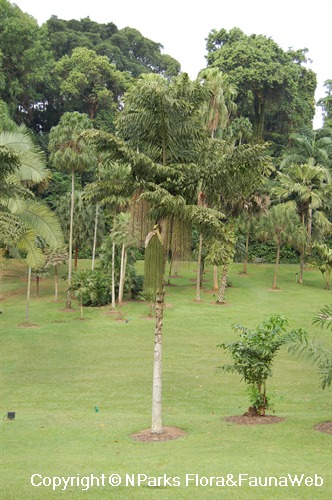
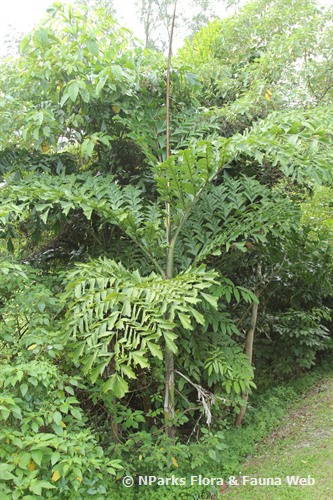
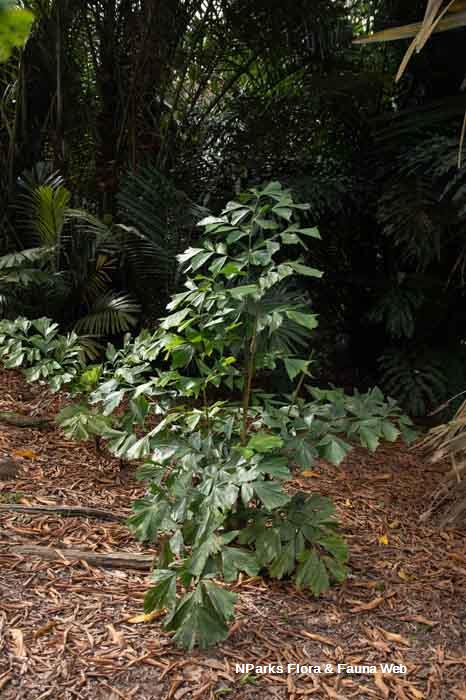
Caryota monostachya is a slow-growing, clustering palm that reaches up to 3 m in height. Native to southern China and northern Vietnam, this palm produces bipinnately compound fronds with jagged margins and a single unbranched flowering spike with purple to maroon flowers.

Name
Classifications and Characteristics
| Plant Division | Angiosperms (Flowering Seed Plants) (Monocotyledon) |
|---|---|
| Plant Growth Form | Palm (Clustered Habit) |
| Lifespan (in Singapore) | Perennial |
| Mode of Nutrition | Autotrophic |
| Plant Shape | Fountain (Palm-like) |
| Maximum Height | 3 m |
Biogeography
| Native Distribution | China South-Central (Guizhou & Yunnan), China Southeast (Guangxi) & northern Vietnam |
|---|---|
| Native Habitat | Terrestrial (Primary Rainforest, Mountain) |
| Preferred Climate Zone | Tropical, Sub-Tropical / Monsoonal |
| Local Conservation Status | Non-native (Horticultural / Cultivated Only) |
Description and Ethnobotany
| Growth Form | It is a short, clustering palm, reaching up to 3 m tall. It is hapaxanthic, meaning that the plant (or, in clustering palms, individual stems) will die after flowering and fruiting. |
|---|---|
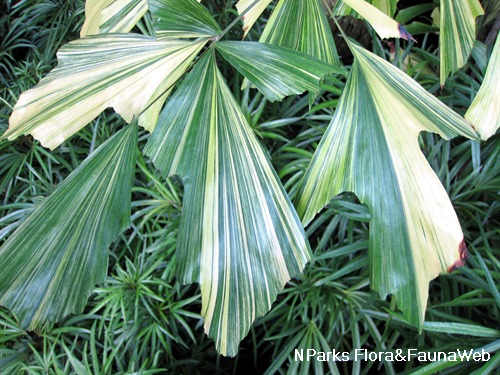
| Foliage | The fronds are bipinnately compound and are borne throughout the length of the stems. The petioles (leaf stalks) are 0.8–1.5 m long. The rachises (midrib of compound leaves) and rachillae (secondary axes of compound leaves) are 1–2.5 m long. The leaflets resemble fish tails with slightly jagged margins and short tips. |
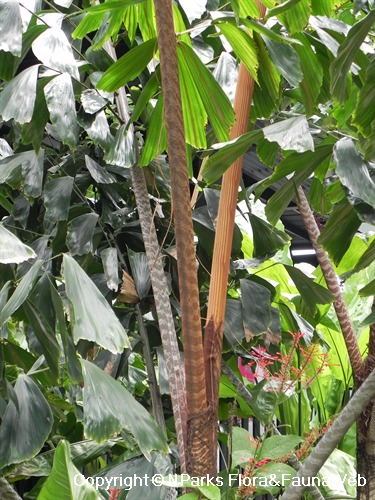
| Stems | The stems are slender, being 2–4 cm in diameter. Inflorescences are borne from the top of the stem and progress downwards, before the stem dies after flowering/fruiting. |
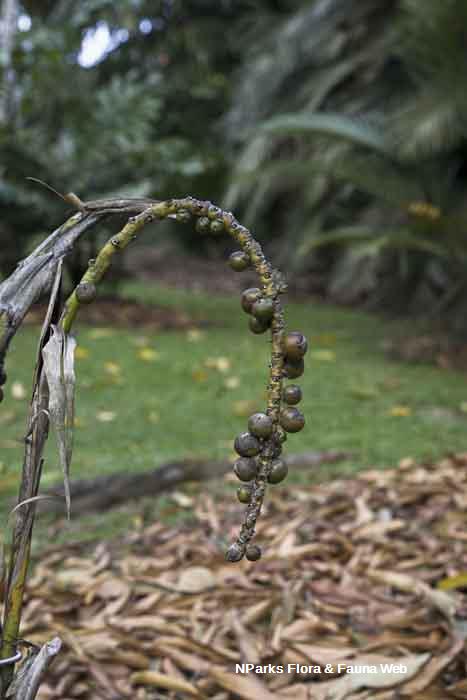
| Flowers | The inflorescence is interfoliar (emerging between the fronds) and subtended by several spathes or peduncular bracts. It is 1 m long and branches up to 1–3 rachillae (minor, secondary axes on inflorescences). Triads of one female flower (up to 8 mm) flanked by two larger male flowers (up to 17 mm) are arranged spirally throughout the rachillae. The petals are purple to maroon in both sexes, and male flowers bear 60–75 stamens. |
| Fruit | The fruit are brownish-purple globose drupes, up to 3.5 cm in diameter. |
| Habitat | It can be found in lowland to montane rainforests, often on limestone soil, from elevations of 0–1400 m above sea level. |
| Similar | This species might resemble the more common Caryota mitis but can be distinguished by its inflorescence with 1–3 rachillae, as compared to the 60 rachillae found in C. mitis. |
| Cultivation | It does well in well-drained, loamy soil and full sun. It can be propagated by seed. |
| Etymology | The genus Caryota is derived from Greek karuoôtis meaning "nut-like date". The specific epithet monostachya means "one spike", referring to the single unbranched spike. |
Landscaping Features
| Desirable Plant Features | Ornamental Form, Ornamental Foliage |
|---|---|
| Landscape Uses | Small Gardens, Parks & Gardens |
Plant Care and Propagation
| Light Preference | Full Sun, Semi-Shade |
|---|---|
| Water Preference | Moderate Water |
| Plant Growth Rate | Slow |
| Pest(s) | Chewing Insects |
| Propagation Method | Seed |
Foliar
| Foliage Retention | Evergreen |
|---|---|
| Mature Foliage Colour(s) | Green |
| Mature Foliage Texture(s) | Smooth |
| Foliar Modification | Flower/Fruit Bract |
| Foliar Type | Compound (Bipinnate) |
| Foliar Arrangement Along Stem | Spiral |
| Foliar Attachment to Stem | Petiolate |
| Foliar Shape(s) | Palm Fronds (Bipinnate) |
| Foliar Venation | Parallel |
| Foliar Margin | Serrulate |
| Leaf Area Index (LAI) for Green Plot Ratio | 4.0 (Palm - Cluster) |
Non - Foliar and Storage
| Trunk Type (Palm) | Clustering Habit, Aboveground |
|---|
Floral (Angiosperm)
| Flower & Plant Sexuality | Unisexual Flowers , Monoecious |
| Flower Colour(s) | Orange, Purple |
|---|
| Flower Grouping | Cluster / Inflorescence |
| Flower Location | Axillary |
| Flower Symmetry | Radial |
| Individual Flower Shape | Bowl-shaped |
| Inflorescence Type | Spike |
| Ovary Position | Superior / Hypogynous |
| Flowering Habit | Monocarpic |
Fruit, Seed and Spore
| Mature Fruit Colour(s) | Brown, Purple |
|---|---|
| Fruit Classification | Simple Fruit |
| Fruit Type | Fleshy Fruit , Drupe |
| Seed Quantity Per Fruit | Few (1-5) |
References
| References | Pei, S.J., Chen, S.Y., & Tong, S.Q. (1991). Arecaceae (Palmae.), Flora Reipublicae Popularis Sinicae (Vol. 13, Part 1), pp. 1–172. |
|---|
Image Repository
Others
| Master ID | 30920 |
|---|---|
| Species ID | 5301 |
| Flora Disclaimer | The information in this website has been compiled from reliable sources, such as reference works on medicinal plants. It is not a substitute for medical advice or treatment and NParks does not purport to provide any medical advice. Readers should always consult his/her physician before using or consuming a plant for medicinal purposes. |