







Back
Cyanastrum cordifolium Oliv.
| Family Name: | Tecophilaeaceae |
| Synonyms: | Schoenlandia gabonensis Cornu, Cyanastrum cordifolium var. compactum R.T.Clausen |
| Common Name: | Ground Cocoyam, ǹkàsị àlà, 蓝星莲 |
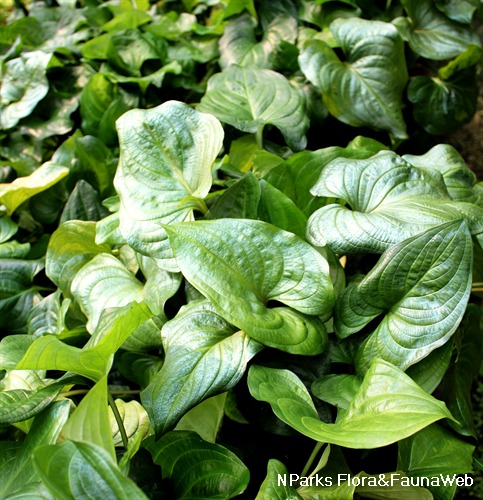
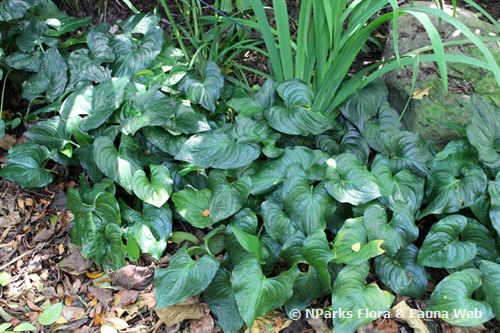
Cyanastrum cordifolium is a perennial herb with glossy, heart-shaped leaves, arising from underground stems called corms. The plant remains small and compact with a high tolerance of low light, making it an excellent houseplant for dimly lit corridors and rooms.


Name
Classifications and Characteristics
| Plant Division | Angiosperms (Flowering Seed Plants) (Monocotyledon) |
|---|---|
| Plant Growth Form | Herbaceous Plant |
| Lifespan (in Singapore) | Perennial |
Biogeography
| Native Distribution | Southern Nigeria, Cameroon, Equatorial Guinea, Gabon, Congo, Zaïre. |
|---|---|
| Native Habitat | Terrestrial (Primary Rainforest) |
| Preferred Climate Zone | Tropical |
| Local Conservation Status | Non-native (Horticultural / Cultivated Only) |
Description and Ethnobotany
| Growth Form | It is a perennial herb that grows up to 30 cm tall. |
|---|---|
| Roots | The roots are thick and fibrous, emerging from the corms. |
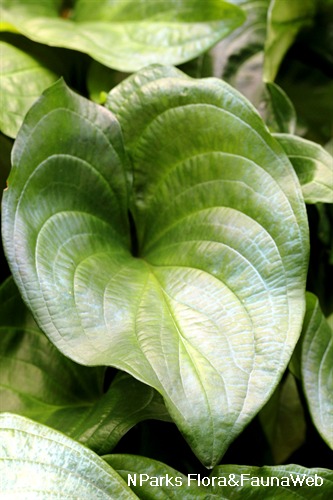
| Foliage | The leaves are heart-shaped, glossy with sunken veins, and up to 10 cm across. The petiole (leaf stalk) can reach 7 - 32 cm in height. The cataphyll (a protective scale-like leaf that precedes the leaf shoot or subtends an inflorescence) is pale green and up to 3 - 4 cm. |
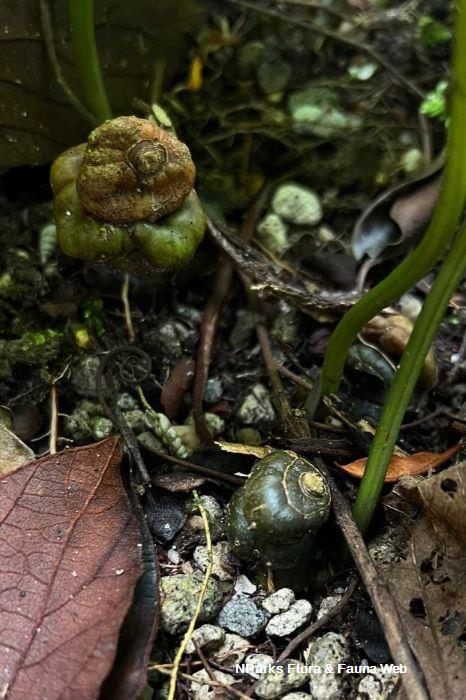
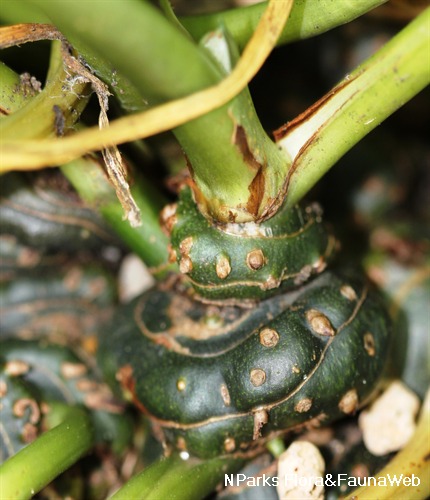
| Stems | The stem is an underground corm (thick, often round, modified stem), reaching 2 - 3 cm in diameter. The corm is dark green, depressed-globose, and covered in ring scars. Newer corms grow on top of the parent corms forming a chain of corms. |
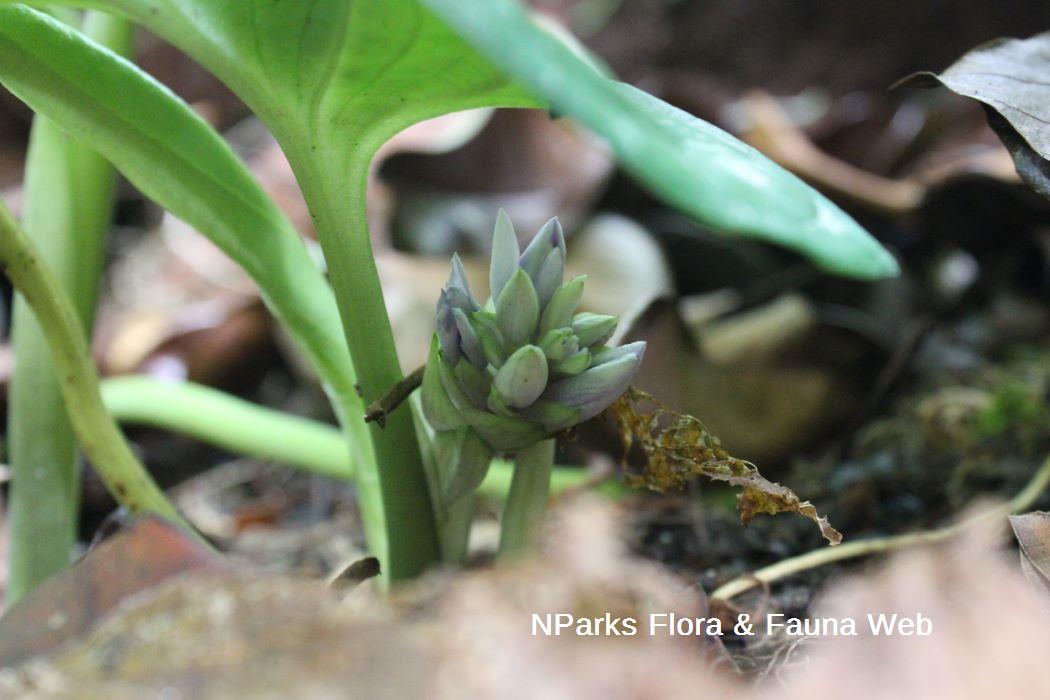
| Flowers | The inflorescence is a pseudo-raceme, borne on a short peduncle (central stalk on inflorescence). The bracts are obvate to lanceolate, pale-blue to bluish-green, persistent, and 2 cm long by 1 cm wide. The tepals are blue and 1 - 1.4 cm long. |
| Fruit | The fruit is a 3-lobed capsule, with each lobe holding a large, oval seed. |
| Habitat | It can be found on the floor of evergreen forests, from 0 - 1000 m above sea level. |
| Cultivation | It can be propagated by seed, corms, division, and leaf cutting. |
| Etymology | The genus Cyanastrum is derived from the Greek terms, kyanos, "blue", and astron, "star", possibily referring to colour and shape of the flowers. The specific epithet cordifolium means "heart-shaped leaf", referring to the leaves of this species. |
Landscaping Features
| Desirable Plant Features | Ornamental Foliage |
|---|---|
| Landscape Uses | Parks & Gardens, Small Gardens, Indoor Plant, Container Planting |
| Thematic Landscaping | Naturalistic Garden |
Fauna, Pollination and Dispersal
| Pollination Method(s) | Biotic (Fauna) |
|---|
Plant Care and Propagation
| Light Preference | Semi-Shade, Full Shade |
|---|---|
| Water Preference | Moderate Water |
| Plant Growth Rate | Moderate |
| Rootzone Tolerance | Moist Soils, Well-Drained Soils, Fertile Loamy Soils, Easy to Grow |
| Transplanting Tolerance | Good |
| Maintenance Requirements | Low |
| Pest(s) | Sucking Insects |
| Propagation Method | Seed, Storage Organ (Corm), Division, Leaf Cutting |
Foliar
| Foliage Retention | Evergreen |
|---|---|
| Mature Foliage Colour(s) | Green |
| Mature Foliage Texture(s) | Thin, Glossy / Shiny, Raised / Sunken Veins |
| Foliar Modification | Flower/Fruit Bract |
| Foliar Type | Simple / Unifoliate |
| Foliar Attachment to Stem | Petiolate |
| Foliar Shape(s) | Non-Palm Foliage (Cordate) |
| Foliar Margin | Entire |
| Foliar Apex - Tip | Acute |
| Foliar Base | Cordate |
| Leaf Area Index (LAI) for Green Plot Ratio | 3.5 (Shrub & Groundcover - Monocot) |
Floral (Angiosperm)
| Flower Colour(s) | Blue, Purple |
|---|---|
| Flower Texture(s) | Thin |
| Flower Grouping | Cluster / Inflorescence |
References
| References | Brummit, R.K., Banks, H., Johnson, M.A.T., Docherty, K.A., Jones, K., Chase, M.W. & Rudall, P.J. (1998). Taxonomy of Cyanastroideae (Tecophilaeaceae): A Multidisciplinary Approach. Kew Bulletin, Vol. 53, No. 4, pp. 769-803. |
|---|
Image Repository
Others
| Master ID | 30923 |
|---|---|
| Species ID | 5305 |