






Back
Dischidiopsis parasitica (Blanco) Merr.
| Family Name: | Apocynaceae |
| Synonyms: | Dischidiopsis philippinensis Schltr., Conchophyllum philippinense (Schltr.) Schltr., Marsdenia parasitica Blanco |
Name
Classifications and Characteristics
| Plant Growth Form | Climber, Epiphyte |
|---|---|
| Lifespan (in Singapore) | Perennial |
Biogeography
| Native Distribution | Philippines |
|---|---|
| Preferred Climate Zone | Tropical |
Description and Ethnobotany
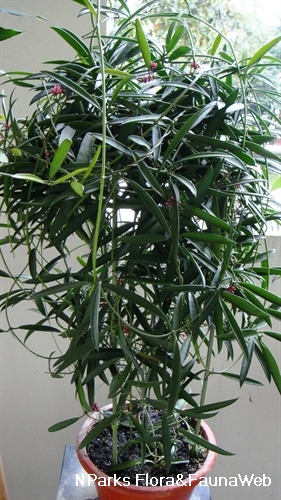
| Foliage | Leaves narrowly oblong - ovate, to 8cm long, dark green turning yellowish red if exposed to high light conditions. |
|---|---|
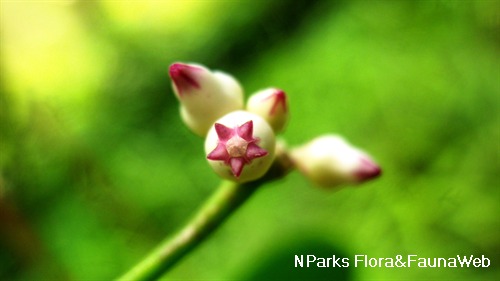
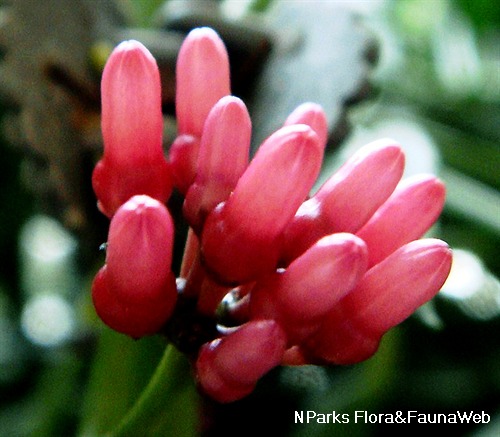
| Flowers | Flowers rose pink |
Landscaping Features
| Desirable Plant Features | Ornamental Flowers |
|---|---|
| Landscape Uses | Small Gardens, Indoor Plant, Suitable for Hanging Baskets |
| Usage Hazard - Cons Remarks | Avoid contact with milky/ white sap as it may cause skin irritation in certain individuals. Keep plants away from children and pets as sap could be toxic |
Fauna, Pollination and Dispersal
| Pollination Method(s) | Biotic (Fauna) |
|---|
Plant Care and Propagation
| Light Preference | Semi-Shade |
|---|---|
| Water Preference | Moderate Water |
| Rootzone Tolerance | Fertile Loamy Soils, Easy to Grow |
| Maintenance Requirements | Moderate |
| Pest(s) | Sucking Insects |
| Propagation Method | Stem Cutting |
Foliar
| Foliage Retention | Evergreen |
|---|---|
| Mature Foliage Colour(s) | Green, Red, Yellow / Golden |
| Mature Foliage Texture(s) | Smooth, Leathery, Thick |
Floral (Angiosperm)
| Flower Colour(s) | Pink, Red |
|---|---|
| Flower Texture(s) | Waxy |
| Flower Grouping | Cluster / Inflorescence |
| Flowering Period | Free-Flowering |
| Flower Lifespan on Plant | Several Days |
Image Repository
Others
| Master ID | 31045 |
|---|---|
| Species ID | 5432 |
| Flora Disclaimer | The information in this website has been compiled from reliable sources, such as reference works on medicinal plants. It is not a substitute for medical advice or treatment and NParks does not purport to provide any medical advice. Readers should always consult his/her physician before using or consuming a plant for medicinal purposes. |