








Back
Finlaysonia obovata Wall.
| Family Name: | Apocynaceae |
| Synonyms: | Finlaysonia maritima (Blume) Backer ex K. Heyne |
| Common Name: | Finlayson’s creeper |
Name
Classifications and Characteristics
| Plant Division | Angiosperms (Flowering Seed Plants) (Dicotyledon) |
|---|---|
| Plant Growth Form | Climber |
| Lifespan (in Singapore) | Perennial |
| Mode of Nutrition | Autotrophic |
| Plant Shape | Irregular |
Biogeography
| Native Distribution | From Bay of Bengal to the Moluccas and Singapore |
|---|---|
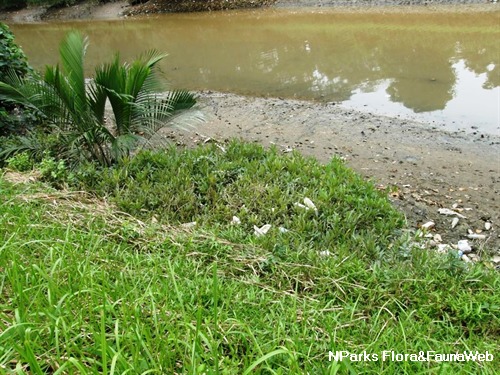
| Native Habitat | Shoreline (Mangrove Forest) |
| Preferred Climate Zone | Tropical |
| Local Conservation Status | Native to Singapore (Critically Endangered (CR)) |
Description and Ethnobotany
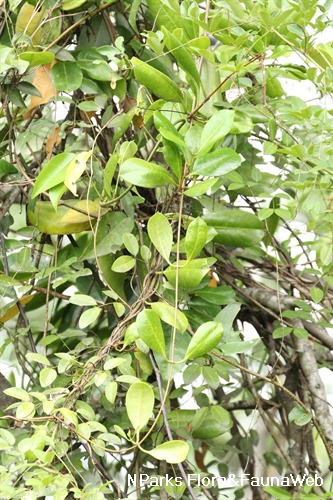
| Growth Form | It is a slender, woody climber with papery bark. White latex exudes from the injured plant parts. |
|---|---|
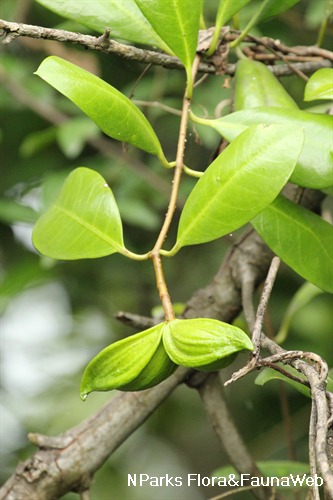
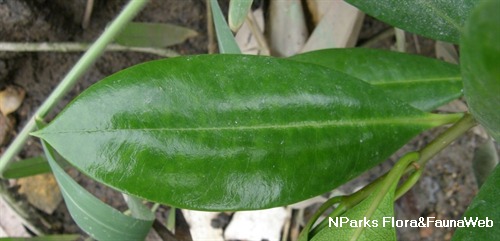
| Foliage | Its opposite, thickly stalked leaves have fleshy leaf blades that are usually drop-shaped, 5–13 by 2.5–6.4 cm, and borne on drooping branchlets. The leaf blades have wedge-shaped bases, and rounded, or very short, narrowed tips. |
| Flowers | Its fetid flowers are dull yellow with or without a purplish tinge in the centre and covered with white hair. The flowers are found on shortly-stalked, branched clusters up to 7.6 cm long at the leaf axils. |
| Fruit | Its ribbed fruits are fleshy green pods, and 7.6 by 5 cm, with hooked tips. Each fruit contains numerous brown seeds that are flat, oblong-drop-shaped, slightly covered with hair along the edges, with a short tuft of hair at one end, and about 2 cm long. |
| Habitat | It grows in mangrove forest fragments and on tidal riverbanks. It occurs locally in Sungei Mandai, Kranji, Seletar Camp Wet-Gap, Sungei Buloh Wetland Reserve, Sungei Berlayar, Khatib Bongsu, Pasir Ris Park mangrove forest, Pulau Ubin, and Pulau Unum. |
| Associated Fauna | Its flowers are probably pollinated by insects such as beetles or flies. |
| Cultivation | It can be propagated by seed. |
| Etymology | Latin Finlaysonia, commemorating George Finlayson (1790–1823), a surgeon and naturalist; Latin ob, reverse; Latin ovatus, egg-shaped, referring to the lamina of the leaf blade that is drop-shaped with a broad distal end and narrow proximal end |
| Ethnobotanical Uses | Edible Plant Parts : Edible Leaves Food (Fruit or Vegetable): The Maluku people are said to eat the leaves in salads. |
Landscaping Features
| Landscaping | It may be suitable for parks. |
|---|---|
| Desirable Plant Features | Ornamental Fruits |
| Landscape Uses | General, Parks & Gardens, Small Gardens, Coastal Plant, Beachfront / Shoreline |
Fauna, Pollination and Dispersal
| Pollination Method(s) | Biotic (Fauna) |
|---|---|
| Seed or Spore Dispersal | Abiotic (Water) |
Plant Care and Propagation
| Light Preference | Full Sun, Semi-Shade |
|---|---|
| Water Preference | Moderate Water |
| Plant Growth Rate | Slow |
| Rootzone Tolerance | Moist Soils, Saline Soils / Salt Spray |
| Propagation Method | Seed |
Foliar
| Foliage Retention | Evergreen |
|---|---|
| Mature Foliage Colour(s) | Green |
| Mature Foliage Texture(s) | Leathery |
| Foliar Type | Simple / Unifoliate |
| Foliar Arrangement Along Stem | Opposite |
| Foliar Attachment to Stem | Petiolate |
| Foliar Shape(s) | Non-Palm Foliage (Obovate) |
| Foliar Venation | Pinnate / Net |
| Foliar Margin | Entire |
| Foliar Apex - Tip | Rounded |
| Foliar Base | Cuneate |
Floral (Angiosperm)
| Flower Colour(s) | Cream / Off-White |
|---|---|
| Flower Texture(s) | Hairy / Hirsute |
| Flower Grouping | Cluster / Inflorescence |
| Flower Location | Axillary |
| Flower Symmetry | Radial |
| Individual Flower Shape | Stellate / Star-shaped |
Fruit, Seed and Spore
| Mature Fruit Colour(s) | Green |
|---|---|
| Fruit Type | Dehiscent Dry Fruit , Follicle |
Image Repository
Others
| Master ID | 31201 |
|---|---|
| Species ID | 5595 |
| Flora Disclaimer | The information in this website has been compiled from reliable sources, such as reference works on medicinal plants. It is not a substitute for medical advice or treatment and NParks does not purport to provide any medical advice. Readers should always consult his/her physician before using or consuming a plant for medicinal purposes. |