






Back
Eleutherine bulbosa (Mill.) Urb.
| Family Name: | Iridaceae |
| Synonyms: | Sisyrinchium bulbosum Mill., Eleutherine americana (Aubl.) Merr. ex K.Heyne, Eleutherine longifolia Gagnep.,Eleutherine plicata (Sw.) Klatt, Cipura plicata (Sw.) Griseb. |
| Common Name: | Bawang Dayak, Lagrimas de la Virgen, Tears of the Virgin, Dayak Onion, Bawang Belanda, Bawang Mekah, Bawang Tiwai |
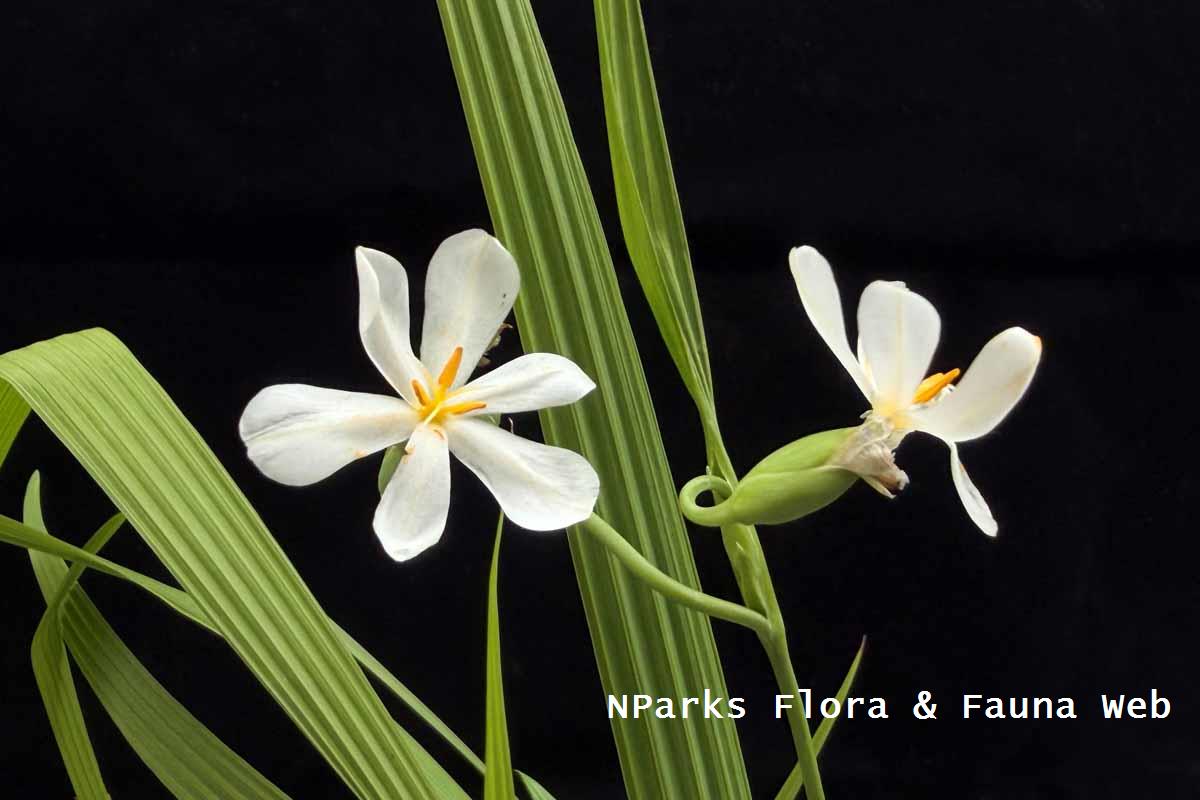
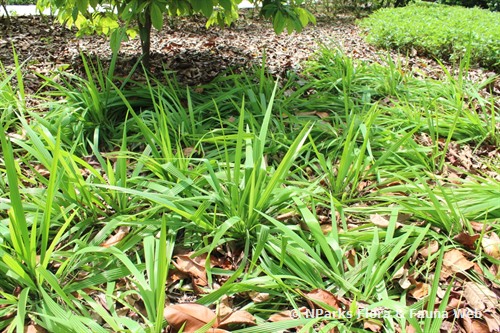
Eleutherine bulbosa, commonly known as Bawang Dayak and Lagrimas de la Virgen, is a clumping herbaceous plant from Central and South America that produces red bulbs, pleated leaves and white flowers that open at dusk for only three hours. The roots and bulbs of the plant have been used within and outside its native distribution for traditional medicine.


Name
Classifications and Characteristics
| Plant Division | Angiosperms (Flowering Seed Plants) (Monocotyledon) |
|---|---|
| Plant Growth Form | Herbaceous Plant |
| Lifespan (in Singapore) | Perennial |
| Mode of Nutrition | Autotrophic |
| Plant Shape | Grassy |
| Maximum Height | 0.5 m to 0.6 m |
Biogeography
| Native Distribution | Cuba, Haiti, Dominican Republic, Jamaica, Puerto Rico, Leeward Islands, Windward Islands, Colombia, Venezuela, Guyana, Suriname, French Guiana, Southeastern & West-Central Brazil, Ecuador, Peru, Bolivia, Paraguay, & Northwestern Argentina. |
|---|---|
| Native Habitat | Terrestrial |
| Preferred Climate Zone | Tropical |
| Local Conservation Status | Non-native (Horticultural / Cultivated Only) |
Description and Ethnobotany
| Growth Form | It is a bulbiferous herbaceous plant growing to 50–60 cm tall. |
|---|---|
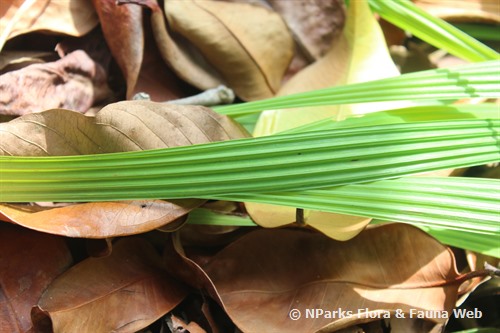
| Foliage | Its leaves are narrowly lance-shaped, smooth, green and pleated throughout their length. There are two types of leaves: radical leaves borne at the plant's base, which are 20–37 cm long × 0.8–1.5 cm wide, and cauline leaves borne on the flowering stem, which are 11–15 cm long. The leaves are arranged spirally, arising from the top of the bulb. |
| Flowers | The inflorescence is a rhipidium (a type of cyme in which lateral branches arise alternately on opposite sides, creating a characteristic zigzag pattern). The flowers open sequentially, one per day; each blooms in the evening and lasts only three hours. Flowers have been observed locally to open at 5 pm and close by 8 pm. Each flower has six white tepals (indistinguishable petals and sepals that resemble one another), up to 10–12 mm long, along with three stamens and a single pistil bearing three stigmas. |
| Fruit | The fruit is a globose capsule (a type of dry, dehiscent fruit). Most plants in cultivation are sterile, so fruiting specimens are rare. |
| Reproductive Parts - non-flowering plant | It produces red-brown underground bulbs. Cross-section of the bulbs reveals red and white rings. |
| Cultivation | It grows best in fertile, well-draining soil under bright, direct sunlight. Avoid waterlogging as it may rot the bulbs. It is propagated by division and bulbs. |
| Etymology | The genus Eleutherine may be derived from Greek eleuthera, "free". The specific epithet bulbosa refers to the presence of bulbs. |
| Ethnobotanical Uses | Medicinal: Traditional Medicinal Use In Bangladesh, Peru, Kalimantan & Sulawesi, Eleutherine bulbosa is used in traditional medicine to treat a wide variety of conditions, such as rheumatism, fever, diarrhoea, bloody stool, tumour, liver disease, haemorrhoids <1>. In Borneo, the indigenous Dayak people use the bulbs for diabetic treatment, stroke management, breast cancer, hypertension, and fertility problems, and for enhancing breast-milk production in woman <2>. It is important to note that some therapeutic effects from traditional medicinal uses of plants are not currently supported or verified by scientific research. |
Landscaping Features
| Desirable Plant Features | Ornamental Flowers |
|---|---|
| Landscape Uses | Parks & Gardens, Small Gardens, Container Planting |
| Thematic Landscaping | Economic Garden, Moonlight Garden |
Plant Care and Propagation
| Light Preference | Full Sun |
|---|---|
| Water Preference | Moderate Water |
| Plant Growth Rate | Moderate |
| Rootzone Tolerance | Moist Soils, Well-Drained Soils |
| Transplanting Tolerance | Good |
| Propagation Method | Division, Storage Organ (Bulb) |
Foliar
| Foliage Retention | Evergreen |
|---|---|
| Mature Foliage Colour(s) | Green |
| Mature Foliage Texture(s) | Smooth |
| Foliar Modification | Storage Organ |
| Foliar Type | Simple / Unifoliate |
| Foliar Arrangement Along Stem | Spiral |
| Foliar Attachment to Stem | Sessile |
| Foliar Shape(s) | Non-Palm Foliage (Lanceolate) |
| Foliar Venation | Parallel |
| Foliar Margin | Entire |
| Foliar Base | Clasping |
| Leaf Area Index (LAI) for Green Plot Ratio | 3.5 (Shrub & Groundcover - Monocot) |
Non - Foliar and Storage
| Root Type | Underground (Fibrous Root) |
|---|---|
| Specialised Storage Organ(s) | Underground (Bulb) |
Floral (Angiosperm)
| Flower & Plant Sexuality | Bisexual Flowers , Bisexual Flowers |
| Flower Colour(s) | White |
|---|
| Flower Texture(s) | Smooth |
| Flower Grouping | Cluster / Inflorescence |
| Flower Location | Axillary |
| Flower Symmetry | Radial |
| Individual Flower Shape | Stellate / Star-shaped |
| Inflorescence Type | Cyme |
| Ovary Position | Inferior / Epipgynous |
| Flowering Opening Time | Time-Independent |
| Flower Lifespan on Plant | Three hours |
| Flower Lifespan on Plant - Remarks | Flowers have been observed locally to open at 5 pm and close by 8 pm. |
| Flowering Habit | Polycarpic |
| Inflorescence Type Remarks | Rhipidium |
| Flower Size | 3 cm |
Fruit, Seed and Spore
| Fruit Classification | Simple Fruit |
|---|---|
| Fruit Type | Indehiscent Dry Fruit , Capsule |
References
| References | <1> Arbain, D., Sriwahyuni, K., Susanti, D., & Muhammad Taher. (2022). Genus Eleutherine: A review of its distribution, traditional uses, phytochemistry, biological activities and its interchangeable common names. South African Journal of Botany. 150. 731-743. ; <2>Kamarudin, A. A., Sayuti, N. H., Saad, N., Razak, N. A. A., & Esa, N. M. (2021). Eleutherine bulbosa (Mill.) Urb. Bulb: Review of the Pharmacological Activities and Its Prospects for Application. International journal of molecular sciences, 22(13), 6747. <3> Wiendi, N.M.A., Maulida, N. & Krisantini, K. (2021). Biology and bulb production of Eleutherine bulbosa (Iridaceae), a native species from Borneo, Indonesia. Ornam. Hortic. 27(2) |
|---|
Image Repository
Others
| Master ID | 31274 |
|---|---|
| Species ID | 5670 |
| Flora Disclaimer | The information in this website has been compiled from reliable sources, such as reference works on medicinal plants. It is not a substitute for medical advice or treatment and NParks does not purport to provide any medical advice. Readers should always consult his/her physician before using or consuming a plant for medicinal purposes. |