





Back
Themeda arguens (L.) Hack.
| Family Name: | Poaceae (Gramineae) |
| Synonyms: | Anthistiria arguens (L.) Willd., Themeda frondosa (R. Br.) Merr., Stipa arguens L. |
| Common Name: | Lesser Tassel Grass, Rumput Misai Adam, Christmas Grass |
Name
Classifications and Characteristics
| Plant Division | Angiosperms (Flowering Seed Plants) (Monocotyledon) |
|---|---|
| Plant Growth Form | Grass or Grass-like Plant |
| Lifespan (in Singapore) | Perennial |
| Mode of Nutrition | Autotrophic |
| Plant Shape | Grassy |
| Maximum Height | 0.2 m to 1.2 m |
Biogeography
| Native Distribution | Nicobar Islands, Andamans, Southeast Asia, and Australia |
|---|---|
| Native Habitat | Terrestrial |
| Preferred Climate Zone | Tropical |
| Local Conservation Status | Native to Singapore (Data Deficient (DD)) |
Description and Ethnobotany
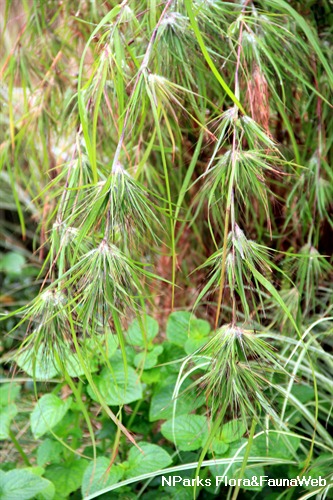
| Growth Form | Annual grass forming tufts or tight clusters which grow up to 1–3 m high. |
|---|---|
| Foliage | Narrowly linear leaves (5-30 cm long, 4-7 mm wide) form dense, fan-like clusters at the nodes. The base of the leaf is rounded, while the tip narrows to a long point (known as acuminate). Leaves are flat or folded along the midrib. The leaf margin is hairless or lined with long, white hairs along the lower half of the leaf. |
| Stems | Culms are erect and slender. |
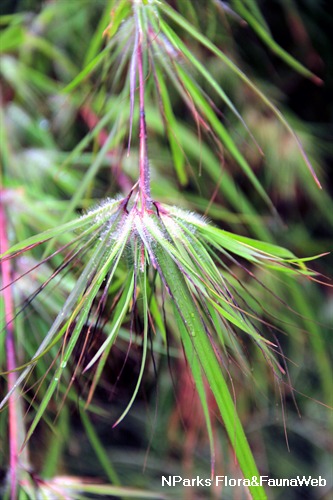
| Flowers | Compound inflorescence is composed of multiple racemes (a spike-like inflorescence with stalked spikelets). Each raceme produces 3 spikelets, only 1 of which is fertile and the rest are sterile. |
| Etymology | Genus Themeda is derived from an Arabic vernacular name, thaemed, which means a depression in which water remains after rain and drying up during summer. |
Plant Care and Propagation
| Light Preference | Full Sun |
|---|---|
| Water Preference | Moderate Water |
| Plant Growth Rate | Moderate |
References
| References | Davison, G.W.H., J.W.M. Gan, D. Huang, W.S. Hwang, S.K.Y. Lum & D.C.J. Yeo (Eds.). (2024). The Singapore Red Data Book: Red Lists of Singapore Biodiversity (3rd ed.). National Parks Board, Singapore. |
|---|
Image Repository
Others
| Master ID | 32085 |
|---|---|
| Species ID | 6491 |
| Flora Disclaimer | The information in this website has been compiled from reliable sources, such as reference works on medicinal plants. It is not a substitute for medical advice or treatment and NParks does not purport to provide any medical advice. Readers should always consult his/her physician before using or consuming a plant for medicinal purposes. |