






Back
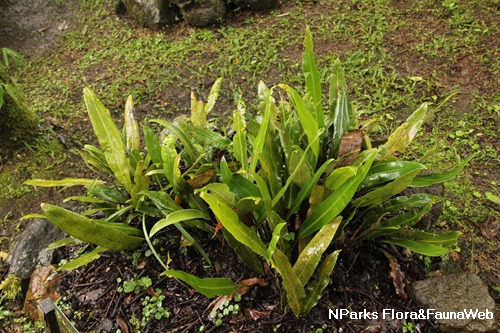
Elaphoglossum callifolium (Blume) T. Moore.
| Family Name: | Dryopteridaceae |
| Common Name: | Deer's tongue fern, 南海舌蕨, 锐头舌蕨 |
Name
Classifications and Characteristics
| Plant Division | Ferns & Lycophytes (Non-Seed Vascular Plants) (Fern) |
|---|---|
| Plant Growth Form | Herbaceous Plant |
| Lifespan (in Singapore) | Perennial |
| Mode of Nutrition | Autotrophic |
Biogeography
| Native Distribution | Philippines, Vietnam, China and Indonesia |
|---|---|
| Native Habitat | Terrestrial |
| Preferred Climate Zone | Tropical, Sub-Tropical / Monsoonal |
| Local Conservation Status | Non-native |
Description and Ethnobotany
| Roots | Creeping rhizome, massive, usually dorsiventral and bearing 2-ranked fronds with a branch bud at the base, young parts are usually protected by scales, scales measuring 10 mm by 1mm. |
|---|---|
| Foliage | Simple, entire fronds, usually coriaceous, often with a colourless thinner edge, costa usually prominent and grooved on upper surface. Sterile fronds measuring 35 cm by 6 cm to 48 cm by 8 cm, stipe usuallly shorter than fertile fronds. Fertile fronds measuring 25 cm by 4 cm. |
| Reproductive Parts - non-flowering plant | Spores with well-developed folded perispore. |
Landscaping Features
| Landscape Uses | General, Parks & Gardens, Small Gardens |
|---|
Fauna, Pollination and Dispersal
| Seed or Spore Dispersal | Abiotic |
|---|
Plant Care and Propagation
| Light Preference | Full Sun, Semi-Shade |
|---|---|
| Water Preference | Moderate Water |
| Rootzone Tolerance | Moist Soils |
| Propagation Method | Spore |
Foliar
| Foliage Retention | Evergreen |
|---|---|
| Mature Foliage Colour(s) | Green, Green - Light Green |
| Foliar Margin | Entire |
| Foliar Apex - Tip | Acuminate |
Image Repository
Others
| Master ID | 32167 |
|---|---|
| Species ID | 6573 |
| Flora Disclaimer | The information in this website has been compiled from reliable sources, such as reference works on medicinal plants. It is not a substitute for medical advice or treatment and NParks does not purport to provide any medical advice. Readers should always consult his/her physician before using or consuming a plant for medicinal purposes. |