




Back
Pityrogramma ochracea (C. Presl) Domin
| Family Name: | Pteridaceae |
| Synonyms: | Acrostichum perelegans, Acrostichum ballivianii |
Name
Classifications and Characteristics
| Plant Division | Ferns & Lycophytes (Non-Seed Vascular Plants) (Fern) |
|---|---|
| Plant Growth Form | Herbaceous Plant |
| Mode of Nutrition | Autotrophic |
Biogeography
| Native Distribution | Indonesia |
|---|---|
| Native Habitat | Terrestrial |
| Preferred Climate Zone | Tropical, Sub-Tropical / Monsoonal |
| Local Conservation Status | Non-native |
Description and Ethnobotany
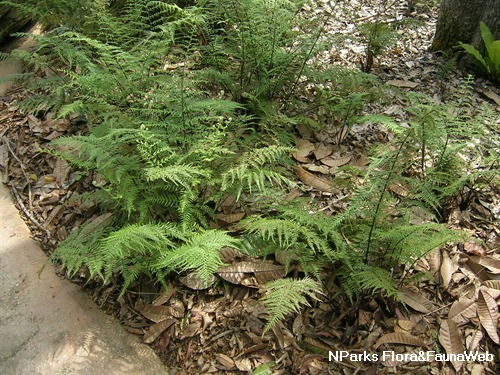
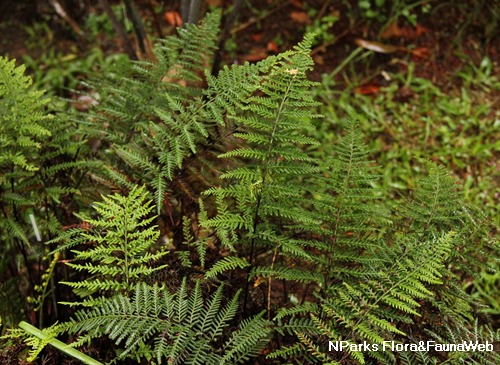
| Growth Form | Terrestrial ferns, erect and unbranched. |
|---|---|
| Foliage | Fronds monomorphic, closely spaced, 1-4 pinnate, texture leathery, measuring about 25 - 100 cm long. Stipe black to reddish-brown in colour. |
| Reproductive Parts - non-flowering plant | False indusia absent. Sporangia scattered along veins and contains 32 or 64 spores. Spores tan with dark brown ridges and globose in shape, outer covering of spore usually reticulate with equal flange. |
| Etymology | Genus name Pityrogramma means "scurf-lined" and referring to lower surface of fronds becoming obscured by rod-like scaly secretions. |
Landscaping Features
| Desirable Plant Features | Ornamental Foliage |
|---|---|
| Landscape Uses | Parks & Gardens, Small Gardens |
Fauna, Pollination and Dispersal
| Seed or Spore Dispersal | Abiotic |
|---|
Plant Care and Propagation
| Light Preference | Semi-Shade, Full Shade |
|---|---|
| Water Preference | Moderate Water |
| Rootzone Tolerance | Moist Soils, Fertile Loamy Soils |
| Propagation Method | Spore, Division |
Foliar
| Foliage Retention | Evergreen |
|---|---|
| Mature Foliage Colour(s) | Green |
Image Repository
Others
| Master ID | 32219 |
|---|---|
| Species ID | 6625 |
| Flora Disclaimer | The information in this website has been compiled from reliable sources, such as reference works on medicinal plants. It is not a substitute for medical advice or treatment and NParks does not purport to provide any medical advice. Readers should always consult his/her physician before using or consuming a plant for medicinal purposes. |