










Back
Brya ebenus (L.) DC.
| Family Name: | Fabaceae (Leguminosae) |
| Common Name: | Jamaican Ebony, Coccus Wood, Espino De Sabana |
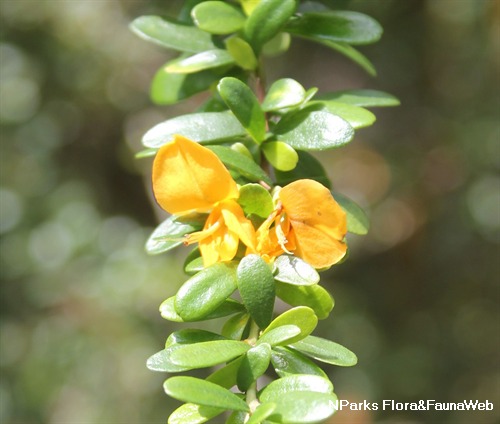
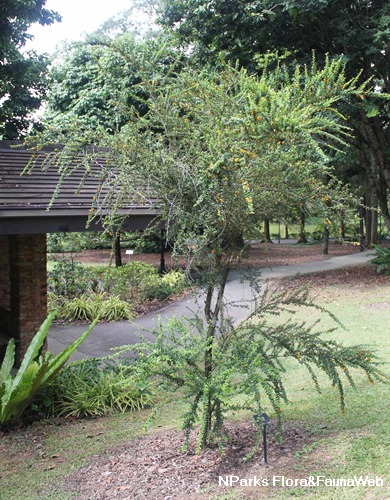
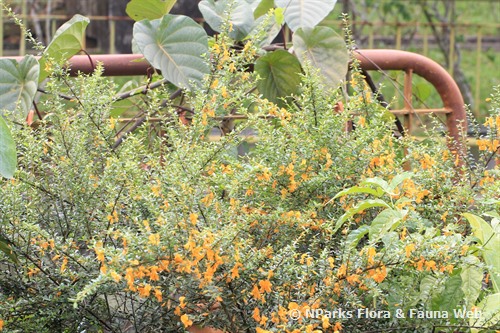
Brya ebenus is a shrub to a small tree that has decorative arching branches that form numerous yellow to orange flowers. This plant flowers best in full sun and well draining soil. It can be grown in a container or trained as a bonsai.
.jpg)
.jpg)
.jpg)
Name
Classifications and Characteristics
| Plant Division | Angiosperms (Flowering Seed Plants) (Dicotyledon) |
|---|---|
| Plant Growth Form | Tree, Shrub |
| Lifespan (in Singapore) | Perennial |
| Mode of Nutrition | Autotrophic |
| Plant Shape | Weeping / Pendulous |
| Maximum Height | 8 m |
Biogeography
| Native Distribution | West Indies (Jamaica, Cuba) |
|---|---|
| Native Habitat | Terrestrial (Grassland / Savannah/ Scrubland) |
| Preferred Climate Zone | Tropical, Sub-Tropical / Monsoonal |
| Local Conservation Status | Non-native (Horticultural / Cultivated Only) |
Description and Ethnobotany
| Growth Form | A tall shrub to a small tree that can grow up to 8 m tall. |
|---|---|
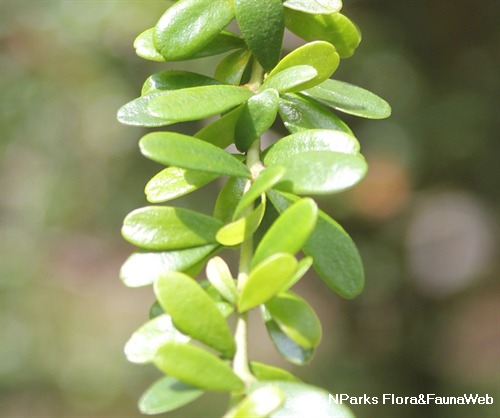
| Foliage | Leaves are dark green, odd-pinnate and arranged closely around the stems. Leaf blade is obovate, petiolated, glossy. Margin entire. |
| Stems | Brown, thorny. |
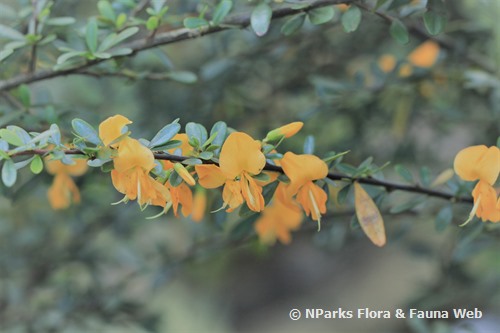
| Flowers | Flowers are yellow, pea-shaped, growing along the branches. |
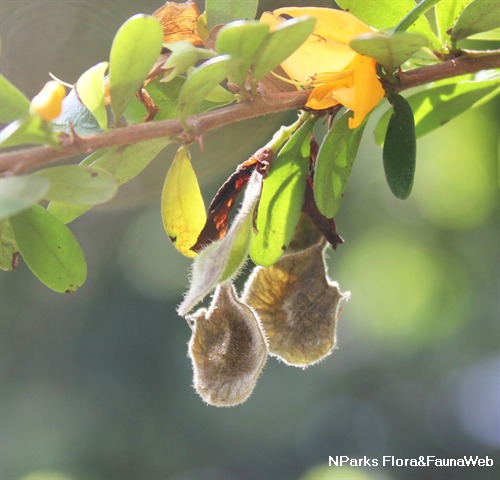
| Fruit | Thin pods. |
| Habitat | Grow abundantly in scrubland. |
| Cultivation | To collect seeds, allow fruit pods to dry on the plant before breaking open the pods to collect the seeds. Grow under full sun on well-drained soil. It is drought tolerant when established. |
| Etymology | The genus Brya means moss-flower. The specific epithet ebenus means ebony-black, which refers to the dark wood colour. |
| Ethnobotanical Uses | Timber & Products: Its trunk is a valuable timber known as coccus wood in the timber trade industry. Its wood is also used to make musical instruments such as flutes. |
Landscaping Features
| Landscaping | It is a great accent tree in any parks and gardens. It is also ideal as bonsai. It is drought-tolerant once established. It blooms after rain. |
|---|---|
| Desirable Plant Features | Ornamental Flowers |
| Landscape Uses | Suitable for Bonsai, Coastal Plant, General, Parks & Gardens |
| Usage Hazard - Cons | Spines/Thorns - Stem/Branch |
Fauna, Pollination and Dispersal
| Fauna Pollination Dispersal Associated Fauna | Bee-Attracting Plant |
|---|---|
| Pollination Method(s) | Biotic (Fauna) (Insects (Bee)) |
Plant Care and Propagation
| Light Preference | Full Sun |
|---|---|
| Water Preference | Moderate Water, Little Water |
| Plant Growth Rate | Moderate |
| Rootzone Tolerance | Well-Drained Soils, Drought Tolerant |
| Propagation Method | Seed |
Foliar
| Foliage Retention | Evergreen |
|---|---|
| Mature Foliage Colour(s) | Green |
| Mature Foliage Texture(s) | Glossy / Shiny, Smooth |
| Prominent Young Flush Colour(s) | Green |
| Young Flush Texture(s) | Glossy / Shiny, Smooth |
| Foliar Type | Compound (Odd-Pinnate) |
| Foliar Arrangement Along Stem | Alternate |
| Foliar Attachment to Stem | Petiolate |
| Foliar Shape(s) | Non-Palm Foliage (Obovate) |
| Foliar Margin | Entire |
| Foliar Apex - Tip | Retuse, Obtuse |
| Foliar Base | Acute |
Floral (Angiosperm)
| Flower & Plant Sexuality | Bisexual Flowers |
| Flower Colour(s) | Yellow / Golden |
|---|---|
| Flower Texture(s) | Smooth |
| Flower Grouping | Solitary |
| Flower Location | Axillary |
| Flower Symmetry | Bilateral |
| Individual Flower Shape | Papilionaceous / Pea-shaped |
| Flowering Period | After Rain |
| Flowering Opening Time | Daytime |
| Flowering Habit | Polycarpic |
Fruit, Seed and Spore
| Mature Fruit Colour(s) | Brown |
|---|---|
| Mature Fruit Texture(s) | Papery |
| Fruit Classification | Simple Fruit |
| Seed Quantity Per Fruit | Few (1-5) |
| Plant Sexuality (non-Angiosperm) | Monoecious |
Image Repository
Others
| Master ID | 32804 |
|---|---|
| Species ID | 7217 |
| Flora Disclaimer | The information in this website has been compiled from reliable sources, such as reference works on medicinal plants. It is not a substitute for medical advice or treatment and NParks does not purport to provide any medical advice. Readers should always consult his/her physician before using or consuming a plant for medicinal purposes. |