








Back
Cycnoches warscewiczii Rchb.f.
| Family Name: | Orchidaceae |
| Common Name: | Warscewicz's Cycnoches, Swan Orchid |
Name
Classifications and Characteristics
| Plant Division | Angiosperms (Flowering Seed Plants) (Monocotyledon) |
|---|---|
| Plant Growth Form | Epiphyte, Herbaceous Plant |
| Mode of Nutrition | Autotrophic |
Biogeography
| Native Distribution | Central Costa Rica to Colombia |
|---|---|
| Native Habitat | Terrestrial |
| Local Conservation Status | Non-native (Horticultural / Cultivated Only) |
Description and Ethnobotany
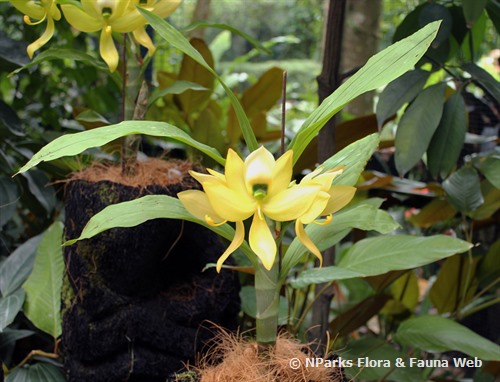
| Growth Form | A medium sized, sympodial orchid, which can grow up to 30 cm tall. |
|---|---|
| Foliage | Green elliptical leaves, plicate (folded like a zig-zag pattern), measuring up to 30 cm long. |
| Stems | Fleshy and thick, bulb-like stems called as pseudobulbs. New plant usually grows from the base of old pseudobulbs. |
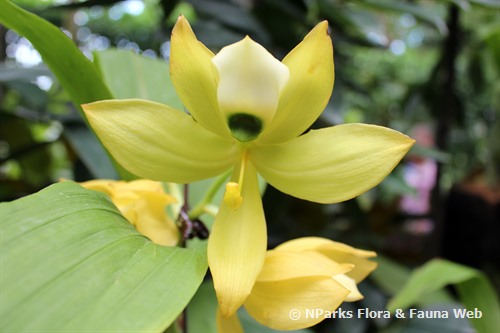
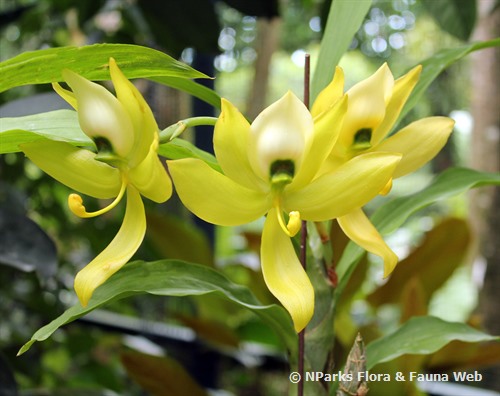
| Flowers | Flowers are arranged in a pendant-like inflorescence, borne on the leaf nodes of new pseudobulbs. Each flower is non-resupinate (lip is upside down, facing upward), green column (the fused stamen, style and stigma) resembles the neck and head of a swan, while the white lip resembles the swan body. |
| Habitat | This epiphyte is found on trees and rotten tree logs or stems, and sometimes grows as a terrestrial at an elevations of 700 - 1000 metres. |
| Cultivation | Place plant under bright indirect sunlight during flowering stage, feed with fertilizers during the growth stage. During its dormancy period, take out the plant and allow it to rest. Do not fertilize during its leafless stage (dormancy) until new growth appears. |
| Etymology | The genus Cycnoches is given as the flower resembles a swan's head. The specific epithet warscewiczii is named after Józef von Warszewicz, a Polish orchid collector. |
Landscaping Features
| Landscaping | The plant is planted for its interesting feature of flower resembling a swan. |
|---|---|
| Desirable Plant Features | Ornamental Flowers, Fragrant (Flowers) |
| Landscape Uses | Container Planting |
| Thematic Landscaping | Fragrant / Aromatherapy Garden |
Fauna, Pollination and Dispersal
| Pollination Method(s) | Biotic (Fauna) (Insects (Bee)) |
|---|
Plant Care and Propagation
| Light Preference | Semi-Shade |
|---|---|
| Water Preference | Moderate Water, Occasional Misting |
| Rootzone Tolerance | Moist Soils, Well-Drained Soils |
| Propagation Method | Division |
Foliar
| Foliage Retention | Deciduous |
|---|---|
| Mature Foliage Colour(s) | Green |
| Mature Foliage Texture(s) | Leathery |
| Prominent Young Flush Colour(s) | Green |
| Young Flush Texture(s) | Leathery |
| Foliar Type | Simple / Unifoliate |
| Foliar Shape(s) | Non-Palm Foliage (Elliptical) |
| Foliar Venation | Parallel |
| Foliar Margin | Entire |
| Foliar Apex - Tip | Acute |
Non - Foliar and Storage
| Stem Type & Modification | Herbaceous |
|---|
Floral (Angiosperm)
| Flower & Plant Sexuality | Unisexual Flowers , Dioecious |
| Flower Colour(s) | Yellow / Golden |
|---|
| Flower Grouping | Cluster / Inflorescence |
| Flower Location | Terminal |
| Flower Symmetry | Bilateral |
| Individual Flower Shape | Labiate / Lipped |
| Inflorescence Type | Raceme |
Image Repository
Others
| Master ID | 32986 |
|---|---|
| Species ID | 7400 |
| Flora Disclaimer | The information in this website has been compiled from reliable sources, such as reference works on medicinal plants. It is not a substitute for medical advice or treatment and NParks does not purport to provide any medical advice. Readers should always consult his/her physician before using or consuming a plant for medicinal purposes. |