




_lowres.jpg)
Back
Monoon lateriflorum (Blume) Miq.
| Family Name: | Annonaceae |
| Synonyms: | Polyalthia lateriflora (Blume) Kurz, Guatteria lateriflora Blume, Polyalthia orientalis P.T.Li, Guatteria pondok Miq., Polyalthia pondok (Miq.) Boerl. |
Monoon lateriflorum is a critically endangered tree in Singapore that can reach up to 20 m tall. Its flowers have yellow-green petals with a red flush at the base. The fruit comprises up to 20 cylindrical monocarps, which turn orange, red, or purplish red when mature.
Name
Classifications and Characteristics
| Plant Division | Angiosperms (Flowering Seed Plants) |
|---|---|
| Plant Growth Form | Tree |
| Lifespan (in Singapore) | Perennial |
| Mode of Nutrition | Autotrophic |
| Maximum Height | 20 m |
Biogeography
| Native Distribution | Andaman and Nicobar Islands, Myanmar, Thailand, Peninsular Malaysia, Singapore, Sumatra, Borneo, Java, Sulawesi. |
|---|---|
| Native Habitat | Terrestrial (Freshwater Swamp Forest, Primary Rainforest) |
| Preferred Climate Zone | Tropical |
| Local Conservation Status | Native to Singapore (Critically Endangered (CR)) |
Description and Ethnobotany
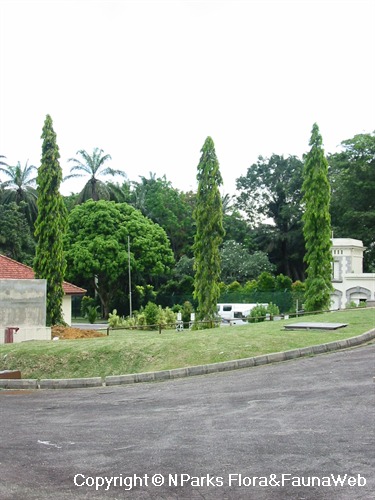
| Growth Form | It is a tree, up to 20 m tall, with blackish grey smooth bark. |
|---|---|
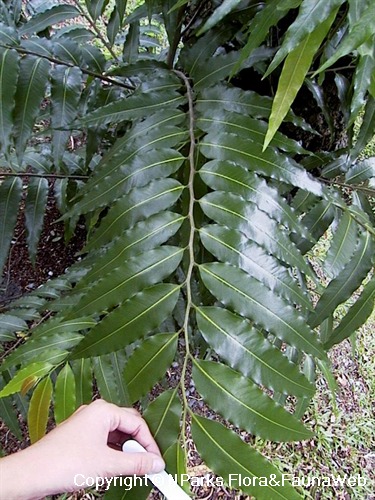
| Foliage | The leaves are elliptic or oblanceolate, measuring 20 – 40 cm long and 6.5 – 14 cm wide, and have a leathery texture (coriaceous). They are alternately arranged and each leaf has 16 – 20 pairs of lateral veins. The midrib is grooved on the upper surface and prominent on the underside of the leaf. The leaf tip is acute to rounded while the leaf base is obtuse to acute. The leaf stalk (petiole) is (0.5 –) 0.7 – 1 (– 1.2) cm long. |
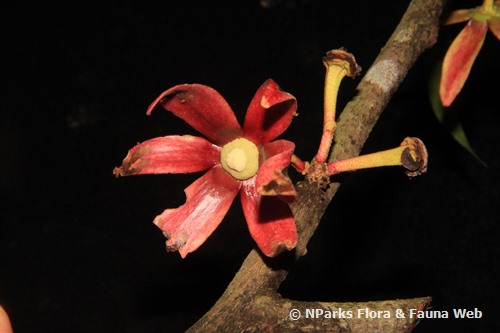
| Flowers | Flowers occur in clusters of 3 – 7 on leafless twigs, each borne on a short flower stalk, measuring 5 – 8 cm. Each flower has six petals arranged in two whorls of three. They are spreading, yellow-green with a red flush at the base. The outer and inner petals are similar with the outer petals measuring 4 – 6 cm long and 0.6 – 0.8 cm wide, and the inner petals measuring 5 – 7 cm long and 1 – 1.3 cm wide. The sepals are triangular. |
| Fruit | The fruit consists of 20 cylindrical monocarps, each measuring 4 – 4.5 cm long and 2.2 – 2.5 cm wide. The monocarps turn orange, red or purplish red when matured. The seeds are oblong, about 2 – 2.4 cm long and 1.2 – 1.4 cm wide, smooth and often shiny. |
| Habitat | It is found in rainforests and peat swamp forest, up to 1250 m altitude. |
| Associated Fauna | Flowers are pollinated by insects. |
| Cultivation | It can be propagated by seed. |
| Etymology | The genus epithet comprises of two parts: monos, in Greek, means alone while oon, in Greek, means egg, referring to the single ovule per carpel. The specific epithet comprises of two parts: lateris, in Latin, means side while flos, in Latin, means flower, referring to the presence of lateral flowers. |
| Ethnobotanical Uses | Timber & Products: It produces timber which is used for construction |
Landscaping Features
| Desirable Plant Features | Ornamental Flowers |
|---|
Fauna, Pollination and Dispersal
| Pollination Method(s) | Biotic (Fauna) |
|---|
Plant Care and Propagation
| Light Preference | Full Sun |
|---|---|
| Water Preference | Moderate Water |
| Plant Growth Rate | Moderate |
Non - Foliar and Storage
| Mature Bark Texture | Smooth |
|---|---|
| Root Type | Underground |
Floral (Angiosperm)
| Flower & Plant Sexuality | Bisexual Flowers |
| Flower Colour(s) | Green, Yellow / Golden, Red |
|---|---|
| Flower Grouping | Cluster / Inflorescence |
| Flower Location | Axillary |
Fruit, Seed and Spore
| Mature Fruit Colour(s) | Red, Purple, Orange |
|---|
References
| References | Johnson, D.M. & Murray, N.A. 2022. Annonaceae. In: K.Chayamarit & H. Balslev (eds), Flora of Thailand 16: 1–332. The Forest Herbarium, Bangkok. Sosef, M.SM., Hong, L.T., and Prawirohatmodjo, S. (Editors). 1998. Plant Resources of South-East Asia Volume 5 (3). Timber Trees: Lesser known timbers. Leiden: Prosea Foundation. 859 pages. Turner, I.M. 2014. Annonaceae. In: Soepadmo, E., Saw, L.G., Chung, R.C.K. & Kiew, R. (eds) Tree Flora of Sabah and Sarawak 8: 1–200. Kepong, Malaysia: Forest Research Institute Malaysia. |
|---|
Image Repository
Others
| Master ID | 33716 |
|---|---|
| Species ID | 8130 |
| Flora Disclaimer | The information in this website has been compiled from reliable sources, such as reference works on medicinal plants. It is not a substitute for medical advice or treatment and NParks does not purport to provide any medical advice. Readers should always consult his/her physician before using or consuming a plant for medicinal purposes. |