





Back
Embelia ribes Burm.f.
| Family Name: | Primulaceae |
| Synonyms: | Antidesma ribes (Burm.f.) Raeusch., Ribesiodes ribes (Burm.f.) Kuntze, Samara ribes (Burm.f.) Benth. & Hook.f. ex Kurz |
| Common Name: | False Black Pepper, White-flowered Embelia, Vidanga, Akar Sulur Kerang, 白花酸藤果 |
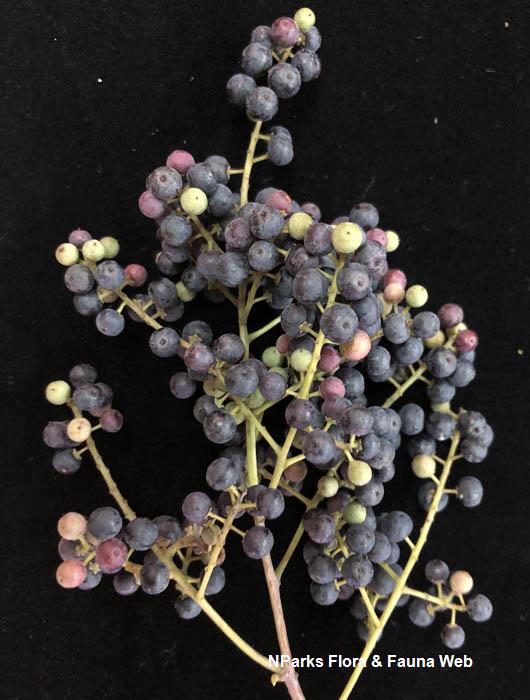
Embelia ribes is a woody climber with red globose fruit that becomes wrinkled when dry. It has clusters of small greenish or white flowers and papery to leathery leaves.

Name
Classifications and Characteristics
| Plant Division | Angiosperms (Flowering Seed Plants) (Dicotyledon) |
|---|---|
| Plant Growth Form | Climber |
| Lifespan (in Singapore) | Perennial |
| Mode of Nutrition | Autotrophic |
Biogeography
| Native Distribution | Assam, Bangladesh, Borneo, Cambodia, South-Central and Southeastern China, East Himalaya, Hainan, India, Java, Laos, Peninsular Malaysia, Myanmar, Nicobar Islands, Philippines, Sri Lanka, Sulawesi, Sumatra, Thailand, Tibet, and Vietnam |
|---|---|
| Native Habitat | Terrestrial |
| Local Conservation Status | Native to Singapore (Least Concern (LC)) |
Description and Ethnobotany
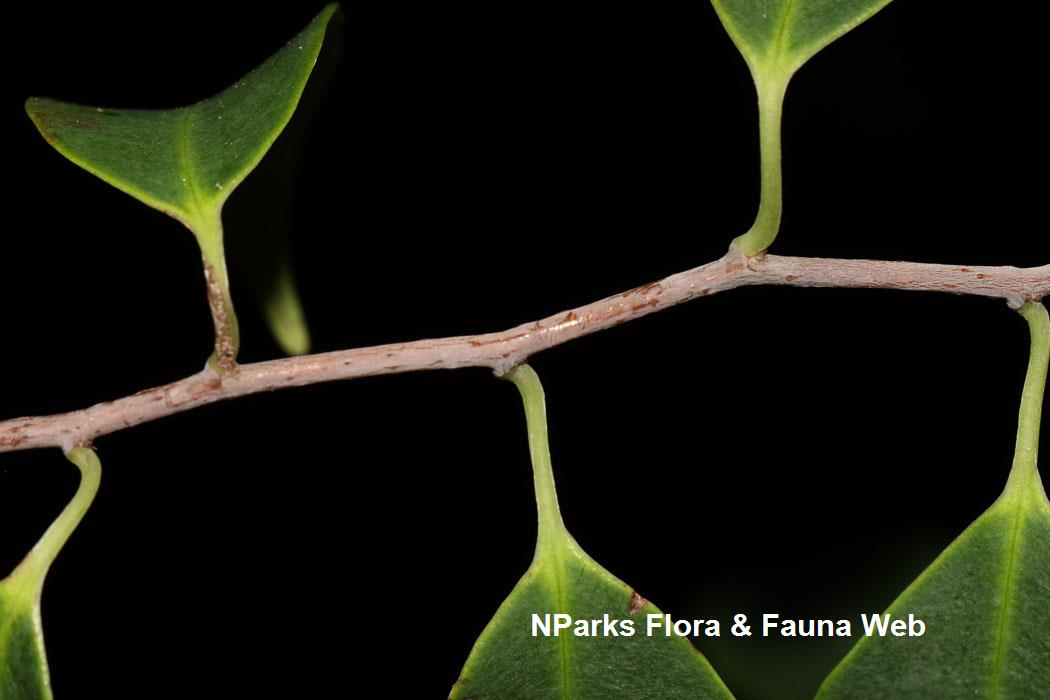
| Growth Form | It is a climber with angled branchlets. |
|---|---|
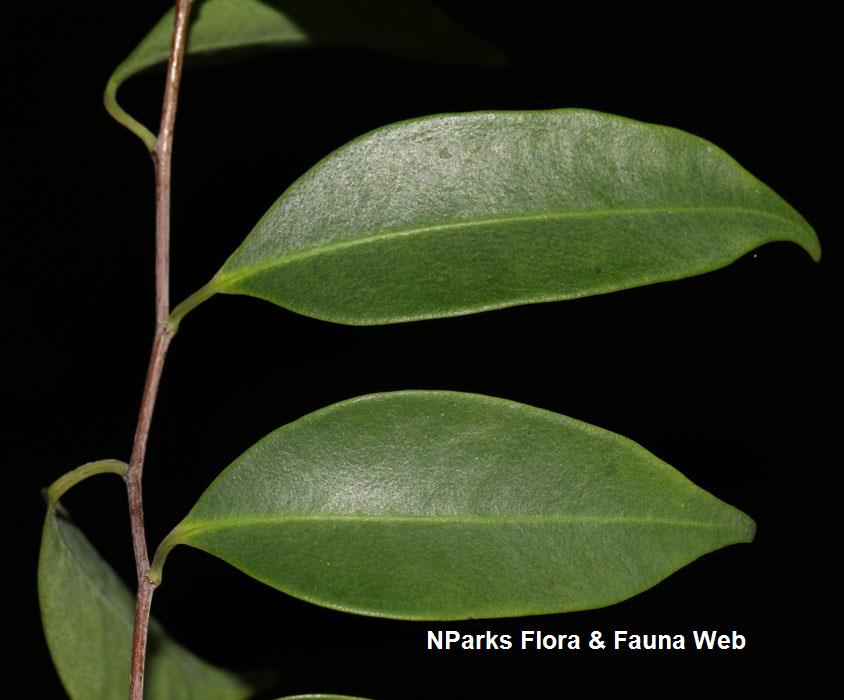
| Foliage | Leaves are elliptic, oblong or narrowly obovate, measuring about 5 - 8 cm long and 3 - 3.5 cm wide. The leaf texture is papery to leathery, has cuneate or rounded base, acuminate tip and entire margin (leaf edges). |
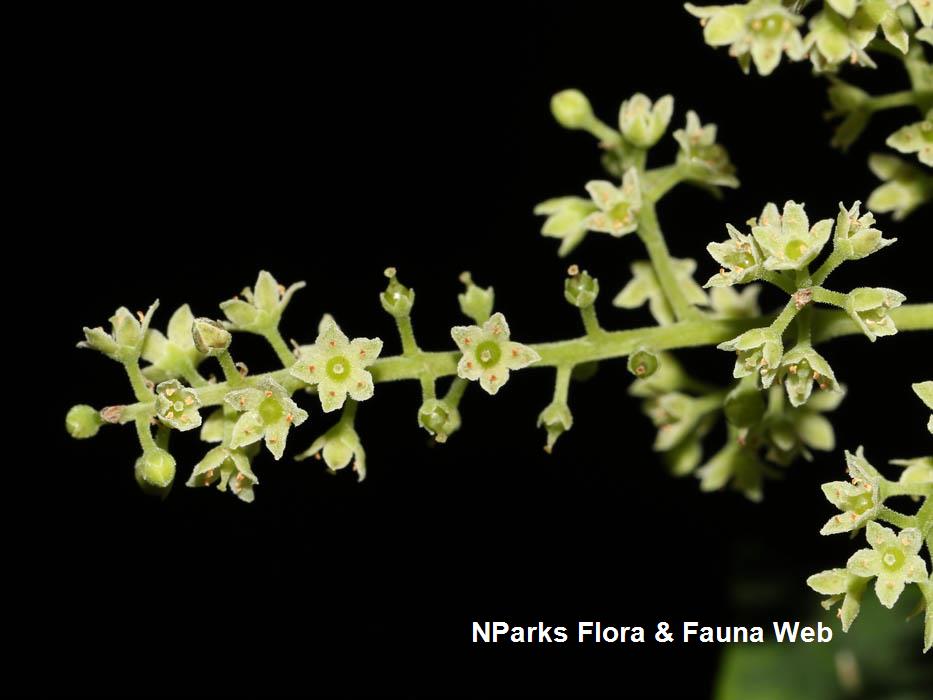
| Flowers | The greenish or white flowers are borne in paniculate clusters located on the terminal of the stem. The inflorescence is about 10 - 15 cm long. The flower petals are papery, elliptic or oblong-shaped. |
| Fruit | Fruit is red or scarlet, globose or ovoid shaped, measuring 3-4 mm in diameter. The fruit is smooth when young, becoming wrinkled when dry, with densely black punctate (marked with small dots or depression). |
| Habitat | It is found growing at 100 - 2000 m elevation, climbing on tall trees in mixed forests, bushes, scrub, on well-drained soils, sand and sandy loam. |
| Etymology | The genus Embelia is from a Cingalese vernacular name. The specific epithet ribes is derived from the Persian name ribas, which means acid-tasting. |
| Ethnobotanical Uses | Medicinal: Scientific Evidence of Medicinal Properties Based on clinical trials where the effect of this species was studied on animal, it has these medicinal properties: antidiabetic <1>, antioxidant, wound-healing, antihyperlipidemic and analgesic <3>.
Traditional Medicinal Uses In India, this species is used in different ayurvedic formulations for urinary diseases, leprosy and skin diseases, dementia and worm infestations <2>
It is important to note that some therapeutic effects from traditional medicinal uses of plants are currently not supported or verified by scientific research. |
Plant Care and Propagation
| Light Preference | Semi-Shade |
|---|---|
| Water Preference | Moderate Water |
| Plant Growth Rate | Fast |
| Rootzone Tolerance | Moist Soils, Fertile Loamy Soils |
| Propagation Method | Seed |
Foliar
| Foliage Retention | Evergreen |
|---|---|
| Mature Foliage Colour(s) | Green |
| Mature Foliage Texture(s) | Leathery, Papery |
| Prominent Young Flush Colour(s) | Green |
| Young Flush Texture(s) | Leathery, Papery |
| Foliar Type | Simple / Unifoliate |
| Foliar Arrangement Along Stem | Alternate |
| Foliar Attachment to Stem | Petiolate |
| Foliar Shape(s) | Non-Palm Foliage (Elliptical, Oblong) |
| Foliar Venation | Pinnate / Net |
| Foliar Margin | Entire |
| Foliar Apex - Tip | Acuminate |
| Foliar Base | Cuneate, Rounded / Obtuse |
Floral (Angiosperm)
| Flower & Plant Sexuality | Bisexual Flowers |
| Flower Colour(s) | Green - Light Green, White |
|---|---|
| Flower Grouping | Cluster / Inflorescence |
| Flower Location | Terminal |
| Flower Symmetry | Radial |
| Individual Flower Shape | Stellate / Star-shaped |
| Inflorescence Type | Panicle |
Fruit, Seed and Spore
| Mature Fruit Colour(s) | Black |
|---|---|
| Mature Fruit Texture(s) | Wrinkled |
References
| References | <1> Mahendran, S., Badami, S. & Maithili, V. (2011). Evaluation of antidiabetic effect of embelin from Embelia ribes in alloxan induced diabetes in rats. Biomedicine & Preventive Nutrition Vol 1(1): 25-31. <2> Sudhakaran, M.V. (2015). Botanical pharmacognosy of the fruit of Embelia ribes Burm.f. J Pharmacogn. Nat. Prod 1:103 <3> Vaishnavi, M.W., Vaishnavi, B., Vaishali, K., & Shital, R. (2024). Review on Embelia ribes and its pharmacological activity. Int. J. of Pharm. Sci., Vol 2, Issue 4: 1312-1319. |
|---|
Image Repository
Others
| Master ID | 34004 |
|---|---|
| Species ID | 8420 |
| Flora Disclaimer | The information in this website has been compiled from reliable sources, such as reference works on medicinal plants. It is not a substitute for medical advice or treatment and NParks does not purport to provide any medical advice. Readers should always consult his/her physician before using or consuming a plant for medicinal purposes. |