



Back
Morinda elliptica (Hook.f.) Ridl.
| Family Name: | Rubiaceae |
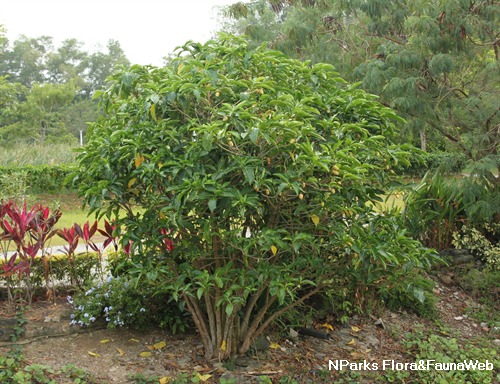
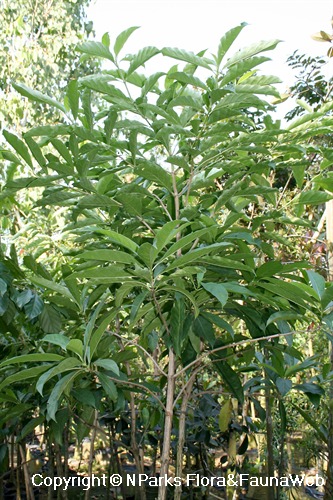
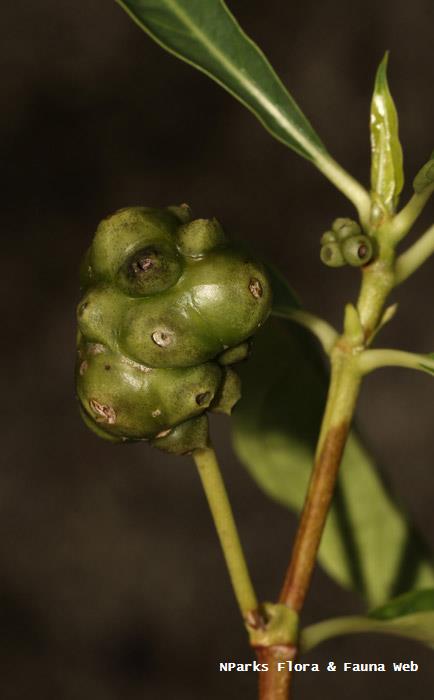
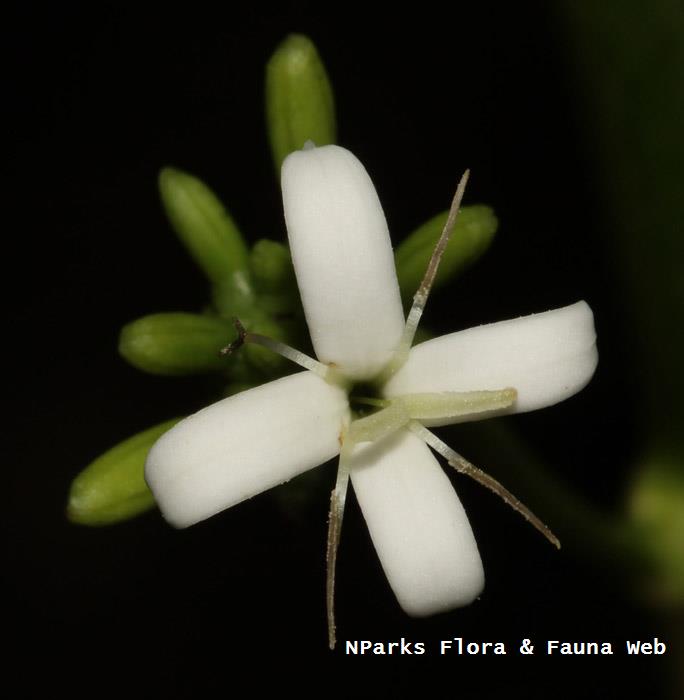
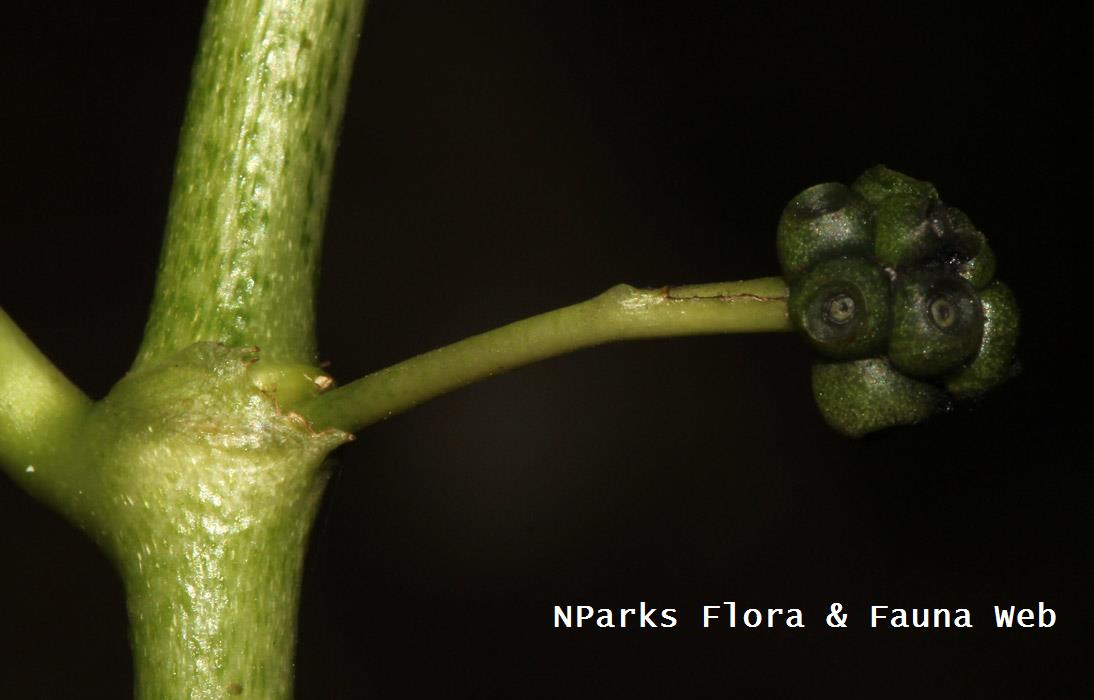
Morinda elliptica is an endangered tree in Singapore that can reach up to 16 m tall. It bears white, tubular flowers and produces fruiting heads that resemble mulberries, ripening from green to black.
Name
Classifications and Characteristics
| Plant Division | Angiosperms (Flowering Seed Plants) |
|---|---|
| Plant Growth Form | Tree |
| Lifespan (in Singapore) | Perennial |
| Mode of Nutrition | Autotrophic |
| Maximum Height | 16 m |
Biogeography
| Native Distribution | Myanmar, Thailand, Peninsular Malaysia, Singapore |
|---|---|
| Native Habitat | Terrestrial (Secondary Rainforest, Disturbed Area / Open Ground) |
| Preferred Climate Zone | Tropical |
| Local Conservation Status | Native to Singapore (Endangered (EN)) |
Description and Ethnobotany
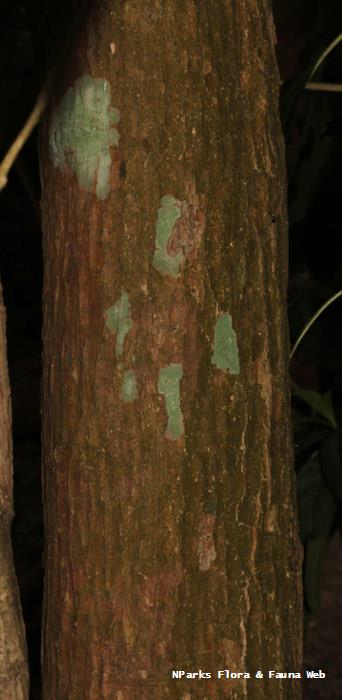
| Growth Form | It is a tree that can grow up to 16 m tall, with grey-brown bark that is regularly and narrowly fissured. |
|---|---|
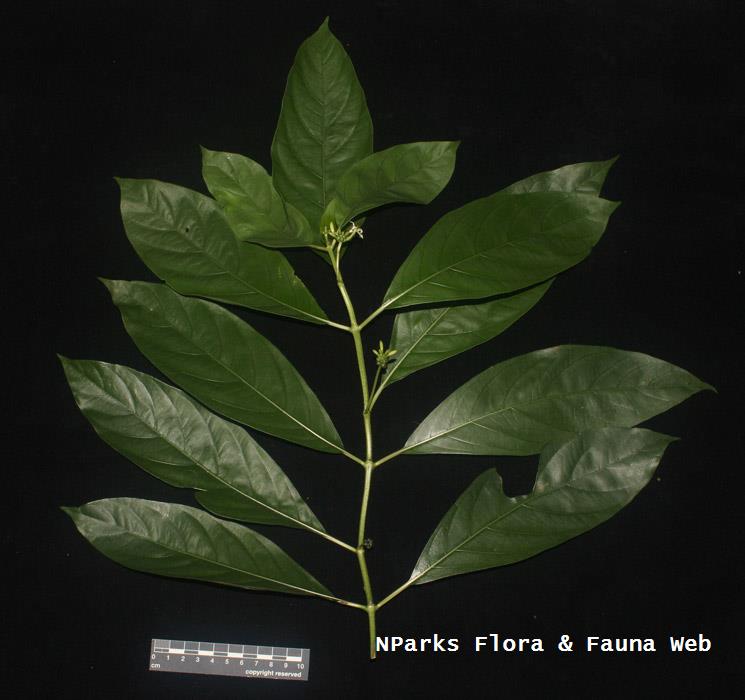
| Foliage | The leaves are narrowly to broadly elliptic (9.2 – 19 cm long and 3.8 – 7.6 cm wide), papery to slightly leathery, and in opposite arrangement. The leaf tip is acute to tapering (acuminate) while the leaf base is wedged-shaped (cuneate). Each leaf has 6 – 10 (-11) pairs of lateral veins. The stipule is broadly triangular and the leaf stalk (petiole) is about 0.6 – 2 cm long. Hairy domatia may sometimes be present in the axils on the lower leaf surface. |
| Flowers | The inflorescence is 0.5 – 1.1 cm wide with flowering stalk (peduncle) measuring 2 – 5.5 cm long. The flowers are tubular (about 0.5 – 0.9 cm long) and have 4 or 5 white petals. It is heterostylous, producing flowers with styles of different lengths. |
| Fruit | The fruiting heads are slightly globose to ovoid, measuring 1.6–2 cm long, and ripen from green to black. |
| Habitat | It is found in lowland secondary forests and open areas. |
| Associated Fauna | Flowers are pollinated by insects. |
| Cultivation | It can be propagated by seed. |
| Etymology | The genus epithet comprises of two parts: Morus, in Latin, means mulberry while indicus, in Latin, means of India or the Indies. The specific epithet, in Latin, means elliptic, referring to the leaf shape. |
Fauna, Pollination and Dispersal
| Pollination Method(s) | Biotic (Fauna) |
|---|---|
| Seed or Spore Dispersal | Biotic (Fauna) |
Plant Care and Propagation
| Light Preference | Full Sun |
|---|---|
| Water Preference | Moderate Water |
| Plant Growth Rate | Fast to Moderate |
References
| References | Wong, K.M., Turner, I.M., Wang, R.J., Harwood, R., Seah, W.W., Ng, X.Y., Lim, R.C.J., Lua, H.K. & Mahyuni, R. (2019). Rubiaceae. In: Middleton, D.J., Leong-Škorničková, J. & Lindsay, S. (ed.) Flora of Singapore, vol. 13, pp. 1–358. Singapore: National Parks Board. |
|---|
Image Repository
Others
| Master ID | 34123 |
|---|---|
| Species ID | 8536 |
| Flora Disclaimer | The information in this website has been compiled from reliable sources, such as reference works on medicinal plants. It is not a substitute for medical advice or treatment and NParks does not purport to provide any medical advice. Readers should always consult his/her physician before using or consuming a plant for medicinal purposes. |