





Back
Pholidocarpus ihur (Giseke) Blume
| Family Name: | Arecaceae (Palmae) |
| Synonyms: | Borassus ihur Giseke, Livistona diepenhorstii Hassk., Pholidocarpus diepenhorstii (Hassk.) Burret |
| Common Name: | Matayangan Palm, Woka Hutan, Ihur, Ibul |
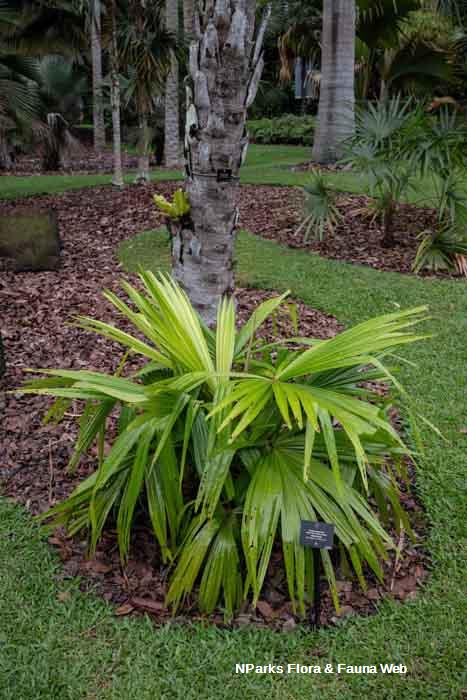
Pholidocarpus ihur, or also known as Matayangan Palm, is a rare, robust, solitary palm that can be found in Sulawesi and the Maluku Islands. It produces fan-shaped leaves with spiny leaf stalks and brown, corky, warty fruits.
Name
Classifications and Characteristics
| Plant Division | Angiosperms (Flowering Seed Plants) |
|---|---|
| Plant Growth Form | Palm |
| Lifespan (in Singapore) | Perennial |
| Mode of Nutrition | Autotrophic |
| Maximum Height | 20 m to 30 m |
Biogeography
| Native Distribution | Sulawesi & Maluku Islands |
|---|---|
| Native Habitat | Terrestrial (Primary Rainforest, Freshwater Swamp Forest) |
| Preferred Climate Zone | Tropical |
| Local Conservation Status | Non-native (Horticultural / Cultivated Only) |
Description and Ethnobotany
| Growth Form | It is a robust, solitary palm, reaching 20–30 m in height. |
|---|---|
| Foliage | The fronds are costapalmate (a type of palmately compound leaf in palms in which the petiole extends into the leaf blade, known as the costa). The petiole (leaf stalk) can reach 1–3 m long with two bright yellow longitudinal lines and stout marginal spines. The spines in younger plants are much bigger than those in older, mature plants. The leaf blade is deeply divided into 3–4 fold segments, which are further divided by shallower splits into single-fold segments. These single-fold segments are V-shaped in cross-section. |
| Stems | The solitary stem can reach 40 cm in diameter and has inconspicuous leaf scars. |
| Flowers | The inflorescence is an arching, interfoliar panicle emerging between the fronds, reaching up to 1.5 m in length, and subtended by a spathe or peduncular bract. It branches up to 3 orders with slender rachillae (minor, secondary axes on inflorescences). The yellow flowers are unisexual and sessile (stalkless). |
| Fruit | The fruit is a globose drupe (a fleshy fruit with thin skin and a single central seed), up to 6 cm in diameter, with brown, corky, warty scales. |
| Habitat | It can be found in lowland rainforests, often in wet, swampy areas. |
| Cultivation | It grows best in fertile, moist soil, in full sun, and requires frequent watering. It can be propagated by seeds. |
| Etymology | The genus Pholidocarpus is derived from Greek pholis, "scale" and karpos, "fruit", referring to the corky, warty scales of the fruit surface. The specific epithet ihur is from the Ambon vernacular name for the palm. |
| Ethnobotanical Uses | Timber & Products: In Indonesia, the wood is hard and is sometimes used as timber. Others: In Indonesia, the stem is sometimes used for sago extraction, but its quality appears inferior. The leaves may be used for thatch, wrapping and water containers in Indonesia. |
Landscaping Features
| Desirable Plant Features | Ornamental Form |
|---|---|
| Landscape Uses | Parks & Gardens |
| Usage Hazard - Cons | Spines/Thorns - Leaf |
| Usage Hazard - Cons Remarks | Spines/Thorns - Leaf: The margin of the petiole is lined with stout spines. |
Fauna, Pollination and Dispersal
| Pollination Method(s) | Biotic (Fauna) (Insects (Bee)) |
|---|
Plant Care and Propagation
| Light Preference | Full Sun |
|---|---|
| Water Preference | Lots of Water |
| Plant Growth Rate | Moderate |
| Rootzone Tolerance | Waterlogged Soils, Moist Soils |
| Propagation Method | Seed |
Foliar
| Foliage Retention | Evergreen |
|---|---|
| Mature Foliage Colour(s) | Green, Yellow / Golden |
| Mature Foliage Texture(s) | Spiny / Bristly / Stinging |
| Foliar Type | Compound (Palmate) |
| Foliar Arrangement Along Stem | Spiral |
| Foliar Attachment to Stem | Petiolate |
| Foliar Shape(s) | Palm Fronds (Fan / Costapalmate) |
| Foliar Venation | Parallel |
| Foliar Margin | Entire |
| Leaf Area Index (LAI) for Green Plot Ratio | 2.5 (Palm - Solitary) |
Non - Foliar and Storage
| Trunk Type (Palm) | Aboveground, Solitary Habit |
|---|---|
| Root Type | Underground (Fibrous Root) |
Floral (Angiosperm)
| Flower & Plant Sexuality | Unisexual Flowers , Monoecious |
| Flower Colour(s) | Yellow / Golden |
|---|
| Flower Grouping | Cluster / Inflorescence |
| Flower Location | Axillary |
| Flower Symmetry | Radial |
| Inflorescence Type | Panicle |
| Ovary Position | Superior / Hypogynous |
| Flowering Habit | Polycarpic |
Fruit, Seed and Spore
| Mature Fruit Colour(s) | Brown |
|---|---|
| Mature Fruit Texture(s) | Rough, Scaly |
| Fruit Classification | Simple Fruit |
| Fruit Type | |
| Seed Quantity Per Fruit | Few (1-5) |
References
| References | Groen, L.E., Siemonsma, J.S. & Jansen, P.C.M. (1996). Pholidocarpus ihur (Giseke) Blume. In: Flach, M. & Rumawas, F. (Editors): Plant Resources of South-East Asia No 9: Plants yielding non-seed carbohydrates. PROSEA Foundation, Bogor, Indonesia. Henderson, A. (2019). An Introduction to the Palms of Sulawesi. Palms, Vol. 63(1); 31-41. |
|---|
Image Repository
Others
| Master ID | 34364 |
|---|---|
| Species ID | 8777 |
| Flora Disclaimer | The information in this website has been compiled from reliable sources, such as reference works on medicinal plants. It is not a substitute for medical advice or treatment and NParks does not purport to provide any medical advice. Readers should always consult his/her physician before using or consuming a plant for medicinal purposes. |