




Back
Oncosperma fasciculatum Thwaites
| Family Name: | Arecaceae (Palmae) |
| Common Name: | Katu Kitul, Ceylon Nibong Palm |
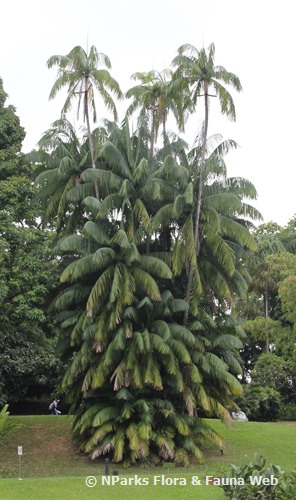
Oncosperma fasciculatum is a prickly, emergent clustering palm endemic to the rainforests of Sri Lanka. It is the only species of its genus found outside of Southeast Asia and can be distinguished from the other species by its plumose compound leaves.


Name
Classifications and Characteristics
| Plant Division | Angiosperms (Flowering Seed Plants) (Monocotyledon) |
|---|---|
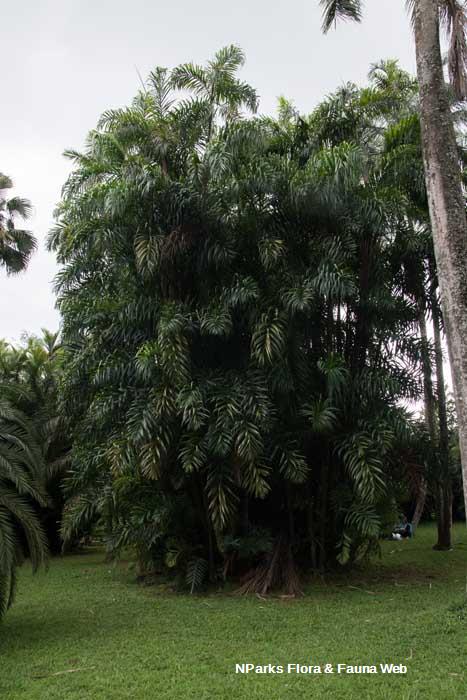
| Plant Growth Form | Palm (Clustered Habit) |
| Lifespan (in Singapore) | Perennial |
| Mode of Nutrition | Autotrophic |
| Plant Shape | Fountain (Palm-like) |
| Maximum Height | 8 m to 15 m |
Biogeography
| Native Distribution | Sri Lanka |
|---|---|
| Native Habitat | Terrestrial (Primary Rainforest) |
| Preferred Climate Zone | Tropical, Highland / Montane |
| Local Conservation Status | Non-native (Horticultural / Cultivated Only) |
Description and Ethnobotany
| Growth Form | It is a prickly, emergent clustering palm with a single well-developed stem that can grow up to 20 m in height, surrounded by several thinner stems. |
|---|---|
| Crown | Each crown holds up to 10–12 fronds. |
| Foliage | The fronds are long, up to 3 m in length, and even-pinnately compound with 55 leaflets on either side of the rachis (the midrib on compound leaves). The petiole (leaf stalk) is loosely covered in black, flattened, needle-like prickles. The leaflet is lanceolate, with a pointed, drooping tip, and is covered with brown scales beneath. The leaflets are irregularly arranged, spreading in different planes. |
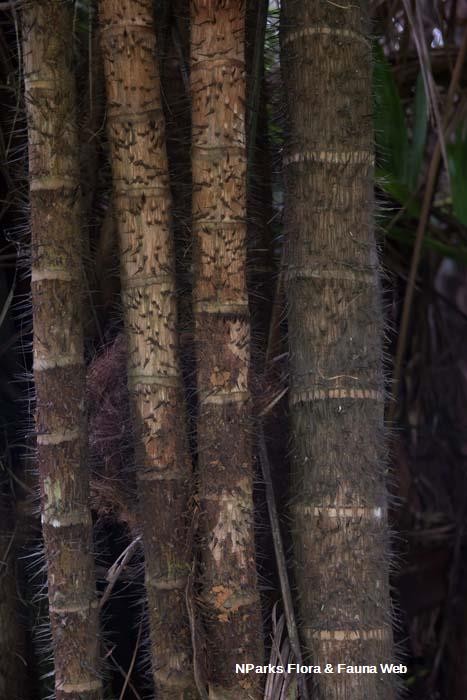
| Stems | The stems (or loosely called trunks) can reach 20 m in height and 15 cm in diameter, with a thickened base, prominent leaf scars, and are covered in black, flattened, needle-like prickles. A single stem is usually well developed, with other thinner stems clustering tightly at the base. The stems can occasionally branch above ground. |
| Crown Shaft | The crown shaft is greyish to brown (pinkish in juveniles) and covered in black, flattened, needle-like prickles. |
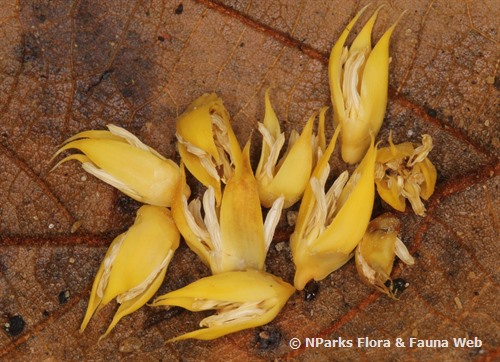
| Flowers | The inflorescence is an infrafoliar panicle, emerging below the fronds and crown shaft, and subtended by a green, sparsely scaly spathe or peduncular bract. It branches up to 2 orders with slender, drooping white rachillae (minor, secondary axes on inflorescences). The white flowers are unisexual, arranged in threes (one female with two flanking males) throughout the length of the rachillae. The prickles are absent on the spathe and the inflorescence. |
| Fruit | The fruits are globose drupes (fleshy fruits with thin skin and a single central seed), up to 1.2 cm in diameter, ripening to purple-black. |
| Others - Plant Morphology | The prickles are flat, needle-like and black. These prickles are arranged in whorls and clusters on the stems, crown shaft and petioles, particularly on younger plants. |
| Habitat | It can be found in lowland to montane rainforests, often on steep, rocky slopes in ravines, at elevations of 0–1500 m above sea level. |
| Similar | This species can be distinguished from other Oncosperma species by its irregularly arranged leaflets that spread in different planes and the occasional aboveground branching of its stems. |
| Taxonomy | Oncosperma fasciculatum is the only Oncosperma species that can be naturally found outside of Southeast Asia. |
| Cultivation | It grows best in fertile, well-draining soil in full sun or semi-shade with moderate watering. Avoid the long, needle-like prickles when handling or pruning the plant. It can be propagated by seeds. |
| Etymology | The genus Oncosperma is derived from Greel oncos, "humped/swollen" and sperma, "seed", referring to the form of the seed. The specific epithet fasiculatum means "clustered in a bundle," possibly referring to the tight clustering habit of the palm or the arrangement of leaflets along the midrib. |
| Ethnobotanical Uses | Others: In Sri Lanka, the palm hearts are eaten. |
Landscaping Features
| Desirable Plant Features | Ornamental Form |
|---|---|
| Landscape Uses | Parks & Gardens |
| Thematic Landscaping | Naturalistic Garden |
| Usage Hazard - Cons | Spines/Thorns - Leaf, Spines/Thorns - Trunk |
| Usage Hazard - Cons Remarks | Spines/Thorns - Leaf & Trunk: Black, flattened, needle-like prickles are present on trunks, crown shafts and petioles. |
Fauna, Pollination and Dispersal
| Pollination Method(s) | Biotic (Fauna) |
|---|
Plant Care and Propagation
| Light Preference | Full Sun, Semi-Shade |
|---|---|
| Water Preference | Moderate Water |
| Plant Growth Rate | Moderate |
| Rootzone Tolerance | Moist Soils, Well-Drained Soils, Poor Infertile Soils |
| Propagation Method | Seed |
Foliar
| Foliage Retention | Evergreen |
|---|---|
| Mature Foliage Colour(s) | Green |
| Mature Foliage Texture(s) | Smooth, Spiny / Bristly / Stinging |
| Foliar Modification | Flower/Fruit Bract |
| Foliar Type | Compound (Even-Pinnate) |
| Foliar Arrangement Along Stem | Spiral |
| Foliar Attachment to Stem | Petiolate |
| Foliar Shape(s) | Palm Fronds (Pinnate / Feather) |
| Foliar Venation | Parallel |
| Foliar Margin | Entire |
| Foliar Apex - Tip | Acute |
| Foliar Base | Clasping |
| Leaf Area Index (LAI) for Green Plot Ratio | 4.0 (Palm - Cluster) |
Non - Foliar and Storage
| Trunk Type (Palm) | Aboveground, Clustering Habit |
|---|---|
| Mature Bark Texture | Armed / Thorny |
| Root Type | Underground (Fibrous Root) |
Floral (Angiosperm)
| Flower & Plant Sexuality | Unisexual Flowers , Monoecious |
| Flower Colour(s) | White |
|---|
| Flower Grouping | Cluster / Inflorescence |
| Flower Location | Axillary |
| Flower Symmetry | Radial |
| Inflorescence Type | Panicle |
| Ovary Position | Superior / Hypogynous |
| Flowering Habit | Polycarpic |
Fruit, Seed and Spore
| Mature Fruit Colour(s) | Purple, Black |
|---|---|
| Mature Fruit Texture(s) | Smooth |
| Fruit Classification | Simple Fruit |
| Fruit Type | |
| Seed Quantity Per Fruit | Few (1-5) |
References
| References | Henderson, A. (2009). Palms of Southern Asia (Princeton Field Guides). Princeton: Princeton University Press. pp 138-139. |
|---|
Image Repository
Others
| Master ID | 34461 |
|---|---|
| Species ID | 8874 |
| Flora Disclaimer | The information in this website has been compiled from reliable sources, such as reference works on medicinal plants. It is not a substitute for medical advice or treatment and NParks does not purport to provide any medical advice. Readers should always consult his/her physician before using or consuming a plant for medicinal purposes. |