





Back
Popowia fusca King
| Family Name: | Annonaceae |
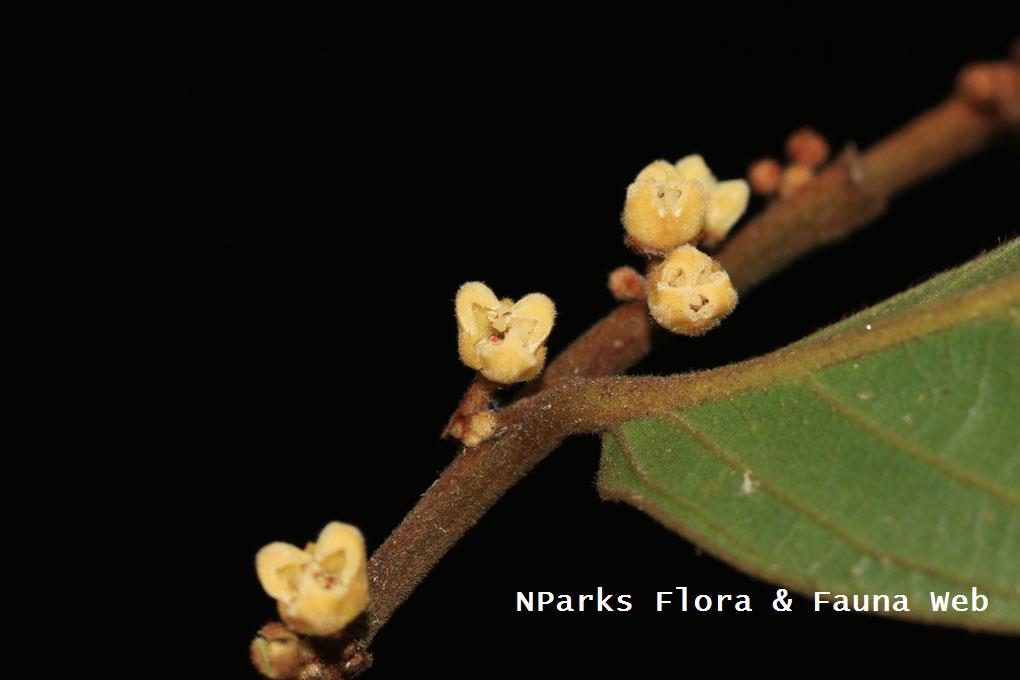
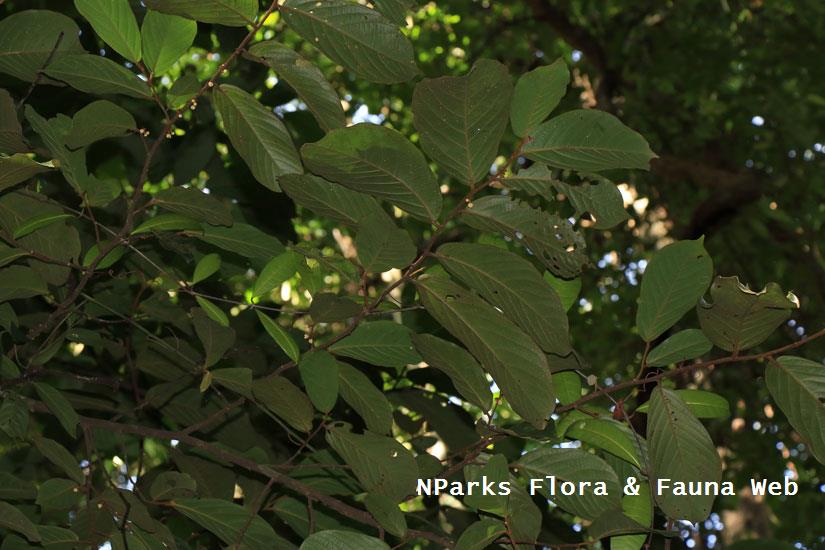
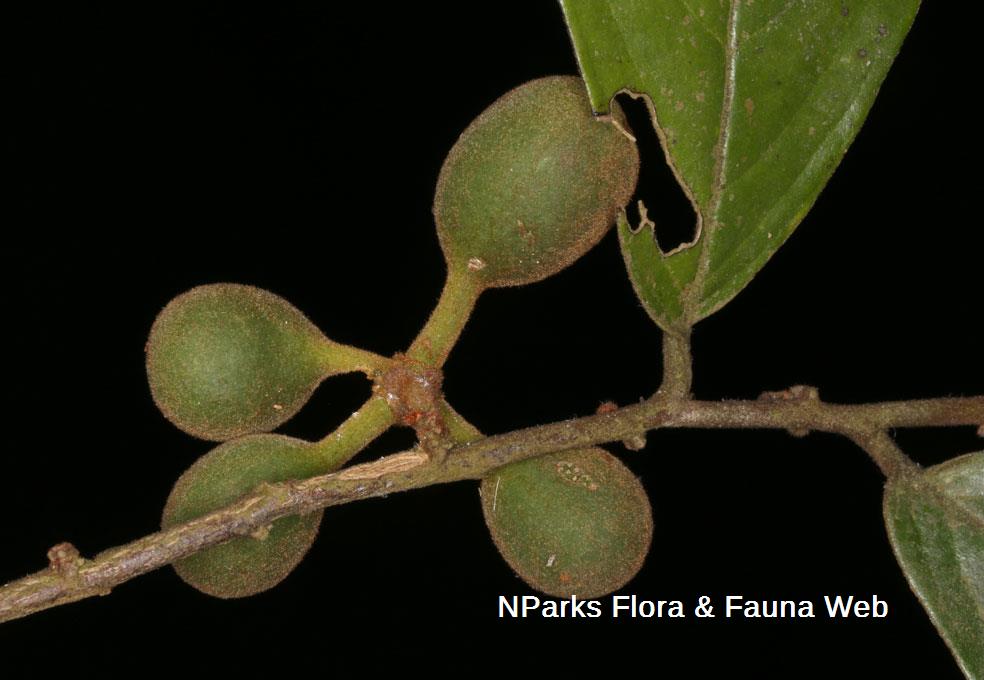
Popowia fusca is a medium sized tree native to Singapore. Growing to 15 m tall, it has broadly oblong leaves with 8 to 11 pairs of curving lateral veins. Both sides of the foliage, midrib, petiole and branchlets are covered in brown tomentose. Flowers are foul-smelling, cream-coloured made up of 3 small, spreading outer petal and 3 large inner petals that curve inwards. The fruit is a cluster of 1 - 4 round fruitlet, each with a single seed.
Name
Classifications and Characteristics
| Plant Division | Angiosperms (Flowering Seed Plants) (Dicotyledon) |
|---|---|
| Plant Growth Form | Tree (Small (6m-15m)) |
| Maximum Height | 15 m |
Biogeography
| Native Distribution | Thailand, Peninsular Malaysia, Singapore |
|---|---|
| Native Habitat | Terrestrial (Primary Rainforest, Secondary Rainforest) |
| Preferred Climate Zone | Tropical |
| Local Conservation Status | Native to Singapore (Vulnerable (VU)) |
Description and Ethnobotany
| Growth Form | It is a medium-sized tree that can grow between 5-15 m tall. |
|---|---|
| Foliage | Leaves are slightly leathery, broadly oval shaped, 8 to 11 pairs of curving lateral veins. Brown, short, velvety hairs found on both sides of the foliage, midrib, petiole and branchlets. |
| Flowers | Flowers are foul-smelling, 6-petalled, covered in short, velvety hairs clustered along the axils underneath the foliage. The flower consist of 3 small, spreading outer petals and 3 larger, concave, inner petals. They are cream-coloured, broadly oval, thick, fleshy with its tips curved inwards. |
| Fruit | The fruit is single-seeded, round, green, berry-like in groups of 1 - 4, covered with a brown gloss measuring 1.5 - 2 cm long, 1 cm wide. The seed is ridged and knobby. |
| Habitat | Occurs in dense bamboo forests, lowland mixed forests up to 150 m in altitude. |
| Cultivation | It can be propagated by seed. <1 & 2> |
Landscaping Features
| Usage Hazard - Cons | Pungent Scent - Flowers |
|---|
Plant Care and Propagation
| Light Preference | Semi-Shade |
|---|---|
| Water Preference | Moderate Water |
| Plant Growth Rate | Moderate |
| Rootzone Tolerance | Fertile Loamy Soils, Moist Soils, Well-Drained Soils |
| Propagation Method | Seed |
Foliar
| Foliage Retention | Evergreen |
|---|---|
| Mature Foliage Texture(s) | Velvety / Furry / Tomentose |
| Foliar Type | Simple / Unifoliate |
| Foliar Arrangement Along Stem | Alternate |
| Foliar Attachment to Stem | Petiolate |
| Foliar Shape(s) | Non-Palm Foliage (Oval, Oblong) |
| Foliar Venation | Reticulate |
| Foliar Margin | Entire |
| Foliar Apex - Tip | Acute, Obtuse |
| Foliar Base | Rounded / Obtuse, Oblique / Asymmetrical |
Non - Foliar and Storage
| Stem Type & Modification | Woody |
|---|---|
| Root Type | Underground |
Floral (Angiosperm)
| Flower & Plant Sexuality | Bisexual Flowers , Bisexual Flowers |
| Flower Colour(s) | Cream / Off-White |
|---|
| Flower Texture(s) | Velvety / Furry / Tomentose |
| Flower Grouping | Cluster / Inflorescence |
| Flower Location | Axillary |
| Flower Symmetry | Radial |
| Flowering Habit | Polycarpic |
Fruit, Seed and Spore
| Mature Fruit Colour(s) | Green |
|---|---|
| Fruit Classification | Multiple Fruit |
| Fruit Type | Fleshy Fruit |
| Seed Quantity Per Fruit | Few (1-5) |
References
| References | <1> Ridley, H.N. et. al (1967). The Flora of Malay Peninsula, vol. 1. London: L. Reeve & Co., Ltd. pp. 76-77. <2> Sinclair, J. (1955). A Revision of the Malayan Annonaceae, Gardens' Bulletin Singapore 14(2): 471-472. |
|---|
Image Repository
Others
| Master ID | 34474 |
|---|---|
| Species ID | 8887 |
| Flora Disclaimer | The information in this website has been compiled from reliable sources, such as reference works on medicinal plants. It is not a substitute for medical advice or treatment and NParks does not purport to provide any medical advice. Readers should always consult his/her physician before using or consuming a plant for medicinal purposes. |