



.jpg)
Back
Aporosa lunata (Miq.) Kurz
| Family Name: | Phyllanthaceae |
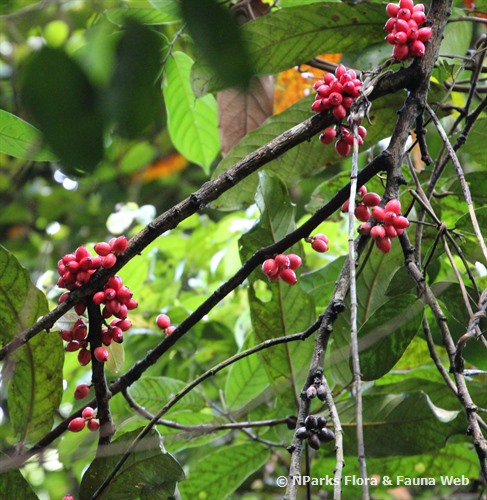
Aporosa lunata is a medium sized tree native to Singapore. Growing to 27 m tall, leaves are thick, narrowly elliptic to obovate, bullate with sparse hairs on the underside and sickle-shaped stipules found at the axils. Flowers are dioecious, borne on a brush like inflorescence found along the axils or below the foliage. The fruit is a dry, oval to flask-shaped capsule that splits upon maturity to reveal 3 bright red, elliptic seeds.
.jpg)
.jpg)
.jpg)
.jpg)
.jpg)
Name
Classifications and Characteristics
| Plant Division | Angiosperms (Flowering Seed Plants) (Dicotyledon) |
|---|---|
| Plant Growth Form | Tree (Medium (16m-30m)) |
| Maximum Height | 27 m |
Biogeography
| Native Distribution | Malesia: Peninsular Thailand, Peninsular Malaysia, Singapore, Sumatra, Java, Borneo |
|---|---|
| Native Habitat | Terrestrial (Primary Rainforest, Secondary Rainforest) |
| Preferred Climate Zone | Tropical |
| Local Conservation Status | Native to Singapore (Critically Endangered (CR)) |
Description and Ethnobotany
| Growth Form | It is a medium-sized tree that can grow to 27 m tall, with thin trunk of up to 29 cm wide, buttresses present. |
|---|---|
| Foliage | Stipules are sickle-shaped found along the axils, 6-9mm long by 11-15mm wide. Leaves are held by a hairy petiole of 6-20 mm long with a swollen base. Leaves are thick, shiny, narrowly elliptic to spoon-shaped measuring 9.5 - 43 cm long by 3.5 - 13 cm wide. Black disc-like glands found along the leaf margins. Veinlets of 10-14 pairs are sunken in from above as such the foliage bulges out. Sparse hairs found along the midrib and underside of the leaves. |
| Flowers | Flowers are dioecious where the female and male flowers are produced separate individuals. Borne on a brush-like inflorescence, flowers are covered in hairs, found along the axils or just below the foliage. The female inflorescence measuring 15 - 33 mm long and 2-3 mm wide in bundles of 3 - 6, comprises of up to 10 flowers each. The male inflorescence measures at 7 - 45mm long, 1 - 1.2 mm wide, in bundles of 2 - 5 with up to 15 flowers. Female flowers are 1.5 - 2.5 mm long while male flower is 2 - 3 mm long. |
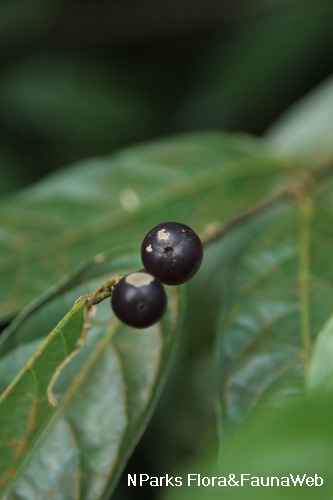
| Fruit | The fruit is a dry, oval to flask-shaped capsule measuring 10 - 16 mm long by 9 - 14mm wide. Upon maturity, it turns from yellow to red, spilt to reveal 3 bright red, elliptic seeds of 8 - 9 mm long. |
| Habitat | Occurs in primary, secondary, lowland forest, on hillside, ridges, along river banks, in flat, hilly and moist land up to altitude of 1300 m. |
| Cultivation | It can be propagated by seed. <1 & 2> |
Plant Care and Propagation
| Light Preference | Full Sun |
|---|---|
| Water Preference | Moderate Water |
| Plant Growth Rate | Moderate |
| Rootzone Tolerance | Fertile Loamy Soils, Well-Drained Soils |
| Propagation Method | Seed |
Foliar
| Foliage Retention | Evergreen |
|---|---|
| Mature Foliage Colour(s) | Green |
| Mature Foliage Texture(s) | Bulging in between Veins |
| Foliar Modification | Stipule |
| Foliar Type | Simple / Unifoliate |
| Foliar Arrangement Along Stem | Alternate |
| Foliar Attachment to Stem | Petiolate |
| Foliar Shape(s) | |
| Foliar Venation | Reticulate |
| Foliar Margin | Entire - Wavy / Undulate |
| Foliar Apex - Tip | Acuminate |
| Foliar Base | Oblique / Asymmetrical, Rounded / Obtuse, Cordate |
Non - Foliar and Storage
| Stem Type & Modification | Woody |
|---|
Floral (Angiosperm)
| Flower & Plant Sexuality | Unisexual Flowers , Dioecious |
| Flower Colour(s) | Cream / Off-White, Green |
|---|
| Flower Grouping | Cluster / Inflorescence |
| Flower Location | Axillary |
| Flower Symmetry | Radial |
| Inflorescence Type | Cyme |
| Flowering Habit | Polycarpic |
Fruit, Seed and Spore
| Mature Fruit Colour(s) | Brown |
|---|---|
| Fruit Classification | Simple Fruit |
| Fruit Type | Dehiscent Dry Fruit , Capsule |
| Mature Seed Colour(s) | Red |
| Seed Quantity Per Fruit | Few (1-5) |
References
| References | <1> Ridley, H.N. et. al (1924). The flora of Malay Peninsula, vol. 3. London: L. Reeve & Co., Ltd. pp. 237. <2> Schot, A.M. (2004). Systematics of Aporosa (Euphorbiaceae). Blumea Supplement 17:281-283. |
|---|
Image Repository
Others
| Master ID | 34482 |
|---|---|
| Species ID | 8895 |
| Flora Disclaimer | The information in this website has been compiled from reliable sources, such as reference works on medicinal plants. It is not a substitute for medical advice or treatment and NParks does not purport to provide any medical advice. Readers should always consult his/her physician before using or consuming a plant for medicinal purposes. |