






Back
Drepananthus ridleyi (King) Survesw. & R.M.K.Saunders
| Family Name: | Annonaceae |
| Synonyms: | Cyathocalyx ridleyi (King) J.Sinclair, Xylopia ridleyi King |
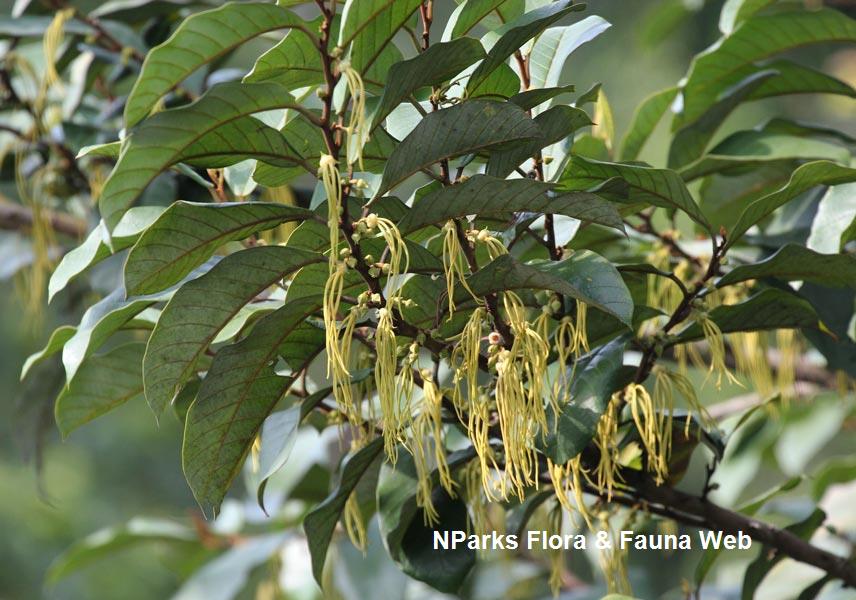
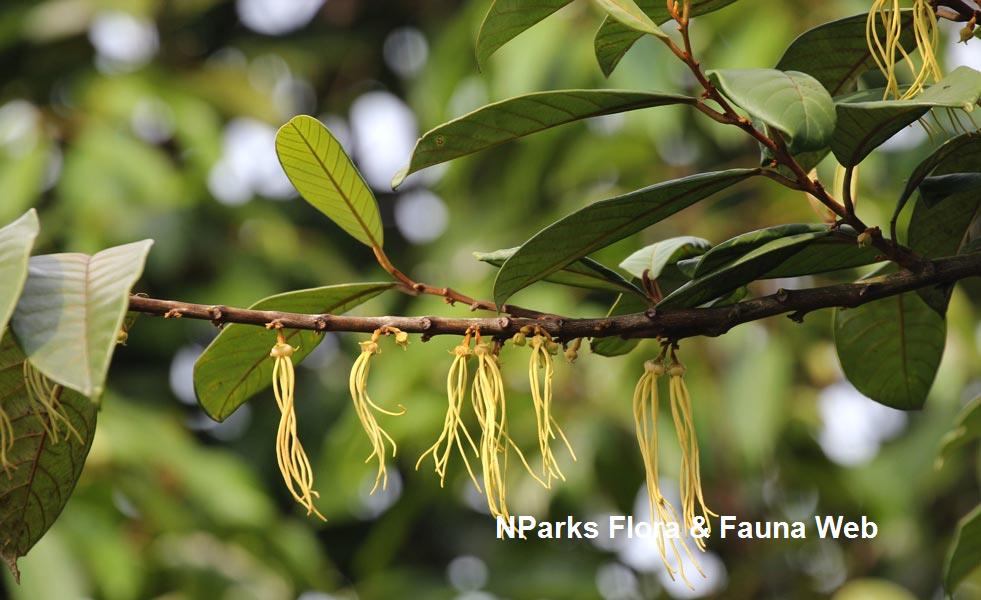
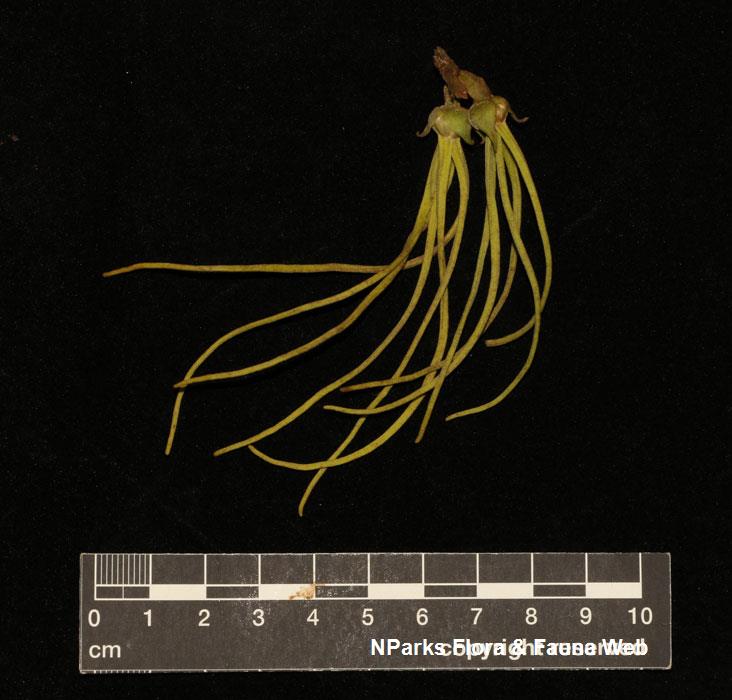
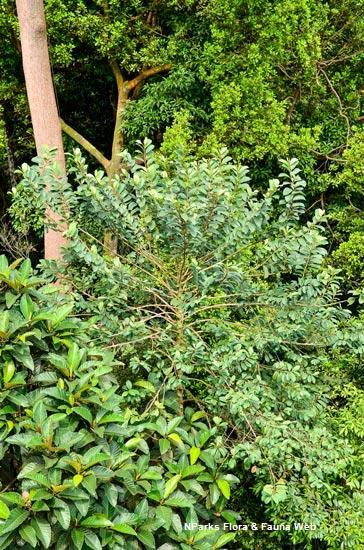
Drepananthus ridleyi is an endangered tree in Singapore that can reach up to 25 m tall. Its flowers have thread-like petals, and the fruit consists of 10 cylindrical monocarps, each containing 2–5 seeds.
Name
Classifications and Characteristics
| Plant Division | Angiosperms (Flowering Seed Plants) |
|---|---|
| Plant Growth Form | Tree |
| Lifespan (in Singapore) | Perennial |
| Mode of Nutrition | Autotrophic |
| Maximum Height | 25 m |
Biogeography
| Native Distribution | Peninsular Malaysia and Borneo. |
|---|---|
| Native Habitat | Terrestrial (Secondary Rainforest, Freshwater Swamp Forest) |
| Preferred Climate Zone | Tropical |
| Local Conservation Status | Native to Singapore (Endangered (EN)) |
Description and Ethnobotany
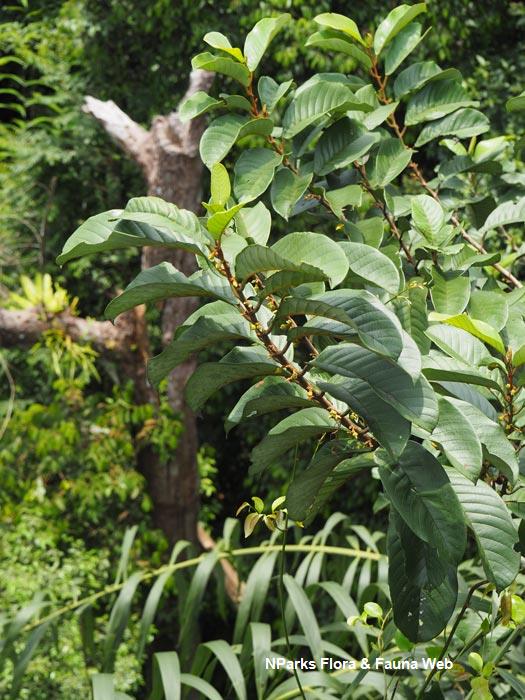
| Growth Form | It is a tree, up to 25 m tall. |
|---|---|
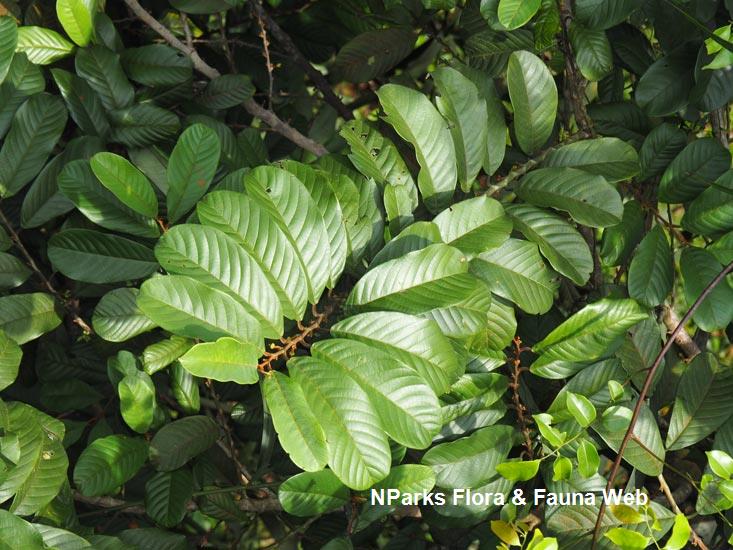
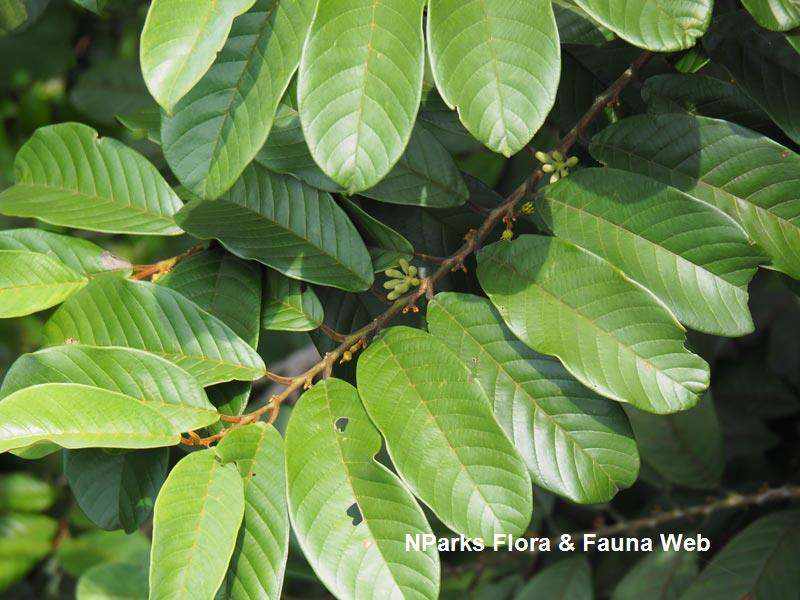
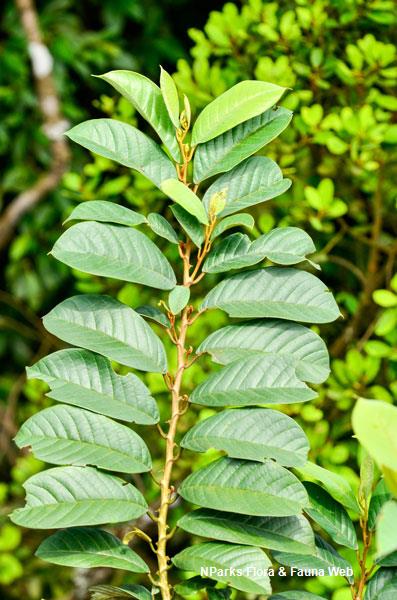
| Foliage | The leaves are ovate to ovate-lanceolate, measuring 7.5 – 21.5 cm long and 4 – 11.5 cm wide. They are alternately arranged and each leaf has 10 – 13 pairs of lateral veins. The petiole is 1.5 – 2.5 cm long. |
| Flowers | Flower is borne on a short flower stalk, measuring 0.6 – 0.9 cm. Each flower comprises of six petals arranged in two whorls of three. The outer petals are narrowly linear or thread-like (measuring up to 7 cm long and 0.1 – 0.2 mm wide) and are densely covered with short hair. The sepals are triangular. |
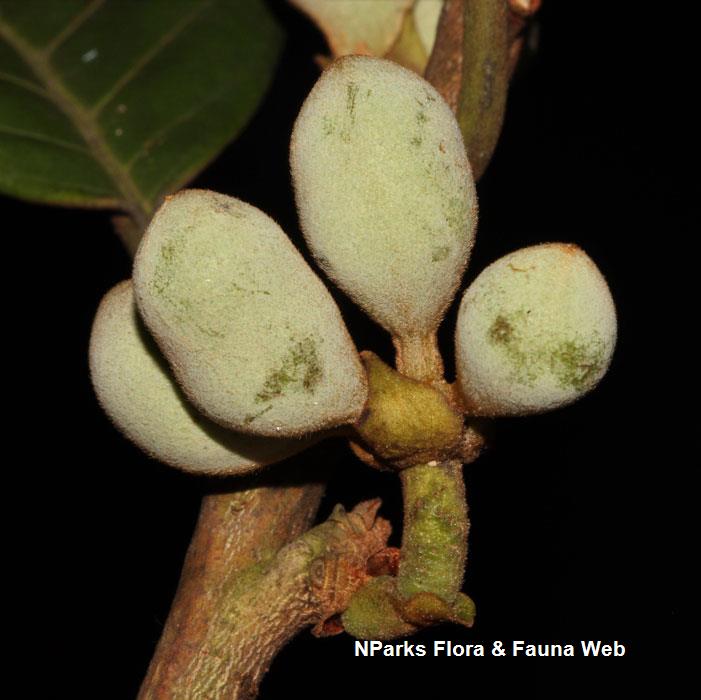
| Fruit | The fruit consists of 10 cylindrical monocarps, each measuring up to 2.5 cm long and up to 1 cm diameter. Each monocarp contains 2 – 5 seeds within. The seeds are about 1 cm long and 0.8 cm diameter, smooth and becoming red-brown when dry. |
| Habitat | It is found in heath and peat swamp forests. |
| Associated Fauna | Flowers are pollinated by insects |
| Cultivation | It can be propagated by seed. |
| Etymology | The genus epithet comprises of two parts: drepanos, in Greek, means sickle-shaped, while anthos, in Greek, means flower, referring to the shape of the petals. The specific epithet commemorates Henry Nicholas Ridley (1855-1956), first director of the Singapore Botanic Gardens from 1888 to 1912. |
Landscaping Features
| Desirable Plant Features | Ornamental Flowers |
|---|---|
| Landscape Uses | Reforestation, Parks & Gardens |
Fauna, Pollination and Dispersal
| Pollination Method(s) | Biotic (Fauna) |
|---|---|
| Seed or Spore Dispersal | Biotic (Fauna) |
Plant Care and Propagation
| Light Preference | Full Sun |
|---|---|
| Water Preference | Moderate Water |
| Plant Growth Rate | Moderate |
Foliar
| Foliage Retention | Evergreen |
|---|---|
| Mature Foliage Colour(s) | Green |
| Foliar Type | Simple / Unifoliate |
| Foliar Arrangement Along Stem | Alternate |
| Foliar Attachment to Stem | Petiolate |
| Foliar Margin | Entire |
Non - Foliar and Storage
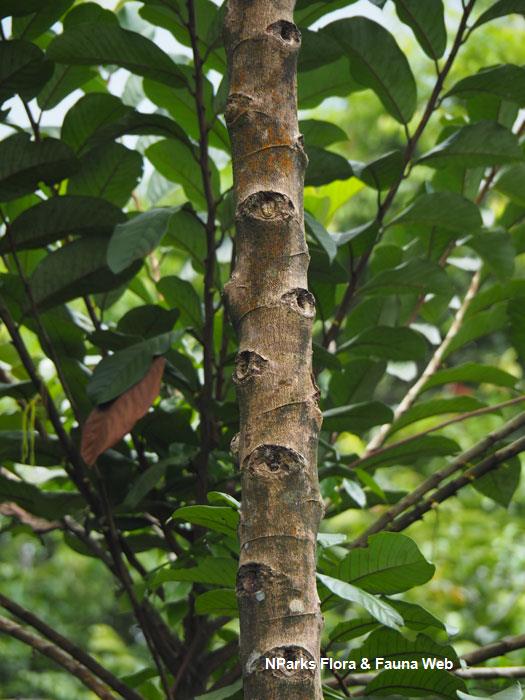
| Trunk Type (Non Palm) | Woody |
|---|---|
| Root Type | Underground |
Floral (Angiosperm)
| Flower & Plant Sexuality | Bisexual Flowers |
References
| References | Turner, I.M. (2014). Annonaceae. In: Soepadmo, E., Saw, L.G., Chung, R.C.K. & Kiew, R. (eds) Tree Flora of Sabah and Sarawak 8: 1–200. Kepong, Malaysia: Forest Research Institute Malaysia. |
|---|
Image Repository
Others
| Master ID | 34507 |
|---|---|
| Species ID | 8920 |
| Flora Disclaimer | The information in this website has been compiled from reliable sources, such as reference works on medicinal plants. It is not a substitute for medical advice or treatment and NParks does not purport to provide any medical advice. Readers should always consult his/her physician before using or consuming a plant for medicinal purposes. |