




Back
Bidens aurea 'Pretty in Pink'
| Family Name: | Asteraceae (Compositae) |
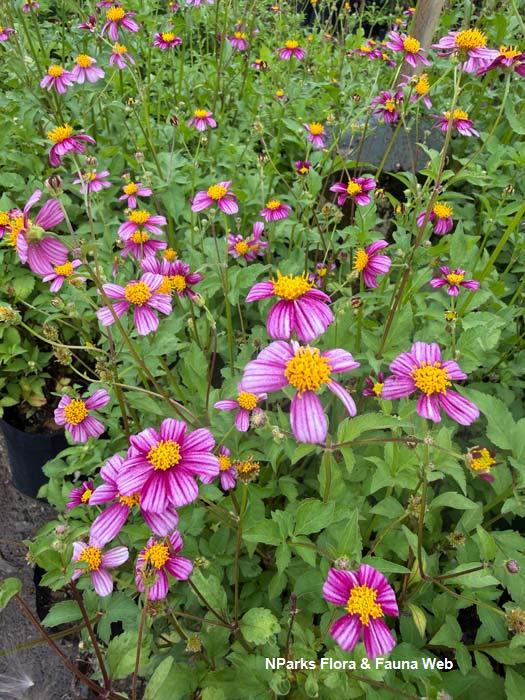
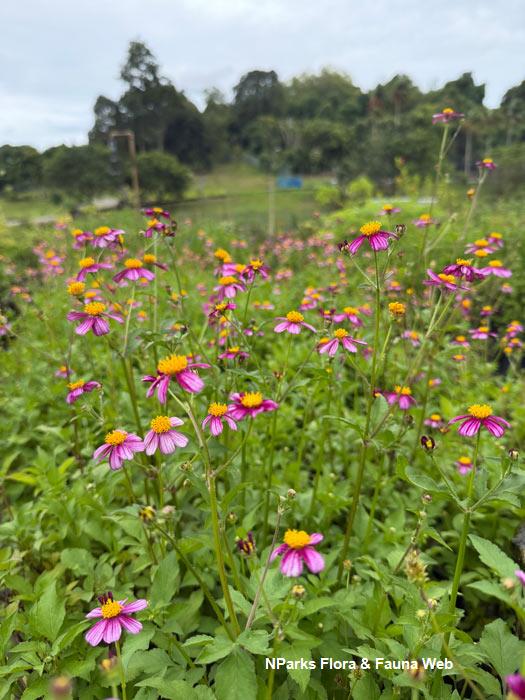
Bidens aurea 'Pretty in Pink' is an upright herbaceous plant that reaches up to 30 cm in height. It is free flowering and produces daisy-like flowers with deep pink petals bearing purple stripes and golden centres. In Singapore, this plant thrives as a long-lived perennial and serves as an excellent nectar source for butterflies. This low-maintenance, heat-tolerant species can withstand brief dry periods and adapts well to containers, borders, and rock gardens.

Name
Classifications and Characteristics
| Plant Division | Angiosperms (Flowering Seed Plants) (Dicotyledon) |
|---|---|
| Plant Growth Form | Herbaceous Plant |
| Lifespan (in Singapore) | Perennial |
| Mode of Nutrition | Autotrophic |
| Plant Shape | Compact, Rounded |
| Maximum Height | 25 cm to 30 cm |
| Maximum Plant Spread / Crown Width | 30 cm to 35 cm |
Biogeography
| Local Conservation Status | Non-native (Horticultural / Cultivated Only) |
|---|
Description and Ethnobotany
| Growth Form | Herbaceous plant is upright or spreading and up to 30 cm tall. |
|---|---|
| Crown | Stems are well-branched forming a compact, dense mound. |
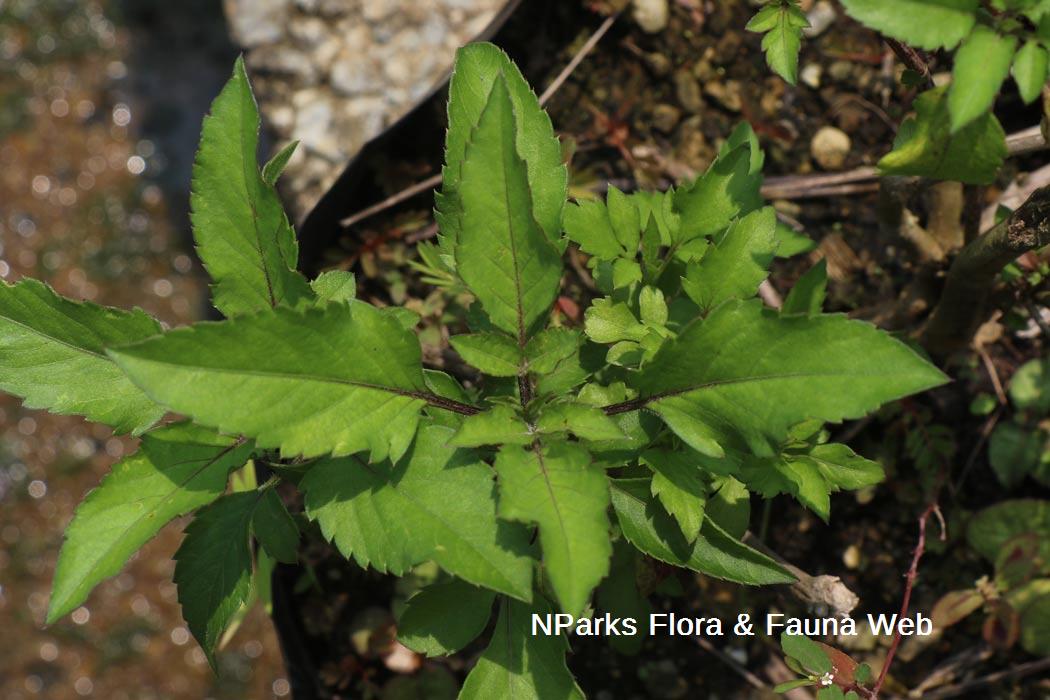
| Foliage | Lower leaves are often simple and lance-shaped, while upper leaves may be deeply lobed or trifoliate. Stalked leaves have toothed margin and opposite arrangement with adjacent pairs perpendicular to one another. |
| Flowers | Daisy-like flowers are deep pink with purple stripes and golden centre. |
| Fruit | The dry, indehiscent fruit is an achene. This cultivar does not appear to produce viable seed. |
| Associated Fauna | The flower nectar attracts butterflies in Singapore. In the United States of America, it was observed to be pollinated by bees and syrphid flies <1>. |
| Taxonomy | 'Pretty in Pink Imp.' is a name trademarked by plant breeder Danziger but it is often used as a cultivar name. The trademark name is associated with the scientific name Bidens ferulifolia which is a synonym of Bidens aurea. <2> |
| Cultivation | This cultivar grows best and produces the most flowers under full sun in moist, well-drained soils. |
Landscaping Features
| Desirable Plant Features | Ornamental Flowers |
|---|---|
| Landscape Uses | Container Planting, Flowerbed / Border |
| Thematic Landscaping | Bird & Wildlife Garden |
Fauna, Pollination and Dispersal
| Fauna Pollination Dispersal Associated Fauna | Butterfly-Attracting Plant (, Flower Nectar) |
|---|---|
| Pollination Method(s) | Biotic (Fauna) (, Insects (Butterfly, Moth)) |
Plant Care and Propagation
| Light Preference | Full Sun |
|---|---|
| Water Preference | Little Water |
| Plant Growth Rate | Fast to Moderate |
| Rootzone Tolerance | Moist Soils, Well-Drained Soils, Easy to Grow |
| Planting Remarks | Provide good air flow. |
| Potential Problems | Regularly check for aphids and thrips. |
| Pest(s) | Sucking Insects |
| Propagation Method | Seed, Stem Cutting |
Foliar
| Mature Foliage Colour(s) | Green |
|---|---|
| Mature Foliage Texture(s) | Smooth |
| Foliar Type | Compound (Trifoliate), Simple / Unifoliate |
| Foliar Arrangement Along Stem | Opposite |
| Foliar Attachment to Stem | Petiolate |
| Foliar Shape(s) | Non-Palm Foliage (Lanceolate) |
| Foliar Venation | Pinnate / Net |
| Foliar Margin | Serrate / Toothed |
| Foliar Apex - Tip | Acuminate, Acute |
| Foliar Base | Rounded / Obtuse |
| Typical Foliar Area | Microphyll ( 2.25cm2 - 20.25 cm2 ) |
Floral (Angiosperm)
| Flower & Plant Sexuality | Bisexual Flowers |
| Flower Colour(s) | Pink, Yellow / Golden |
|---|---|
| Flower Texture(s) | Smooth |
| Flower Grouping | Cluster / Inflorescence |
| Flower Location | Terminal |
| Flower Symmetry | Radial |
| Individual Flower Shape | Ligulate / Strap-shaped |
| Inflorescence Type | Compound Head / Capitulum |
Fruit, Seed and Spore
| Mature Fruit Colour(s) | Black, Brown |
|---|---|
| Mature Fruit Texture(s) | Smooth |
| Fruit Classification | Simple Fruit |
| Fruit Type |
References
| References | <1> Browning (2023). Browning, A., Smitley, D., Studyvin, J., Runkle, E.S., Huang, Z.Y. & Hotchkiss, E. (2023). Variation in pollinator visitation among garden cultivars of marigold, portulaca, and bidens. Journal of Economic Entomology 116(3): 872–881. <2> Govaerts, R. (continuously updated). Plants of the World Online. https://powo.science.kew.org/taxon/urn:lsid:ipni.org:names:32316-2. Accessed 2 Apr. 2026.
|
|---|
Image Repository
Others
| Master ID | 34532 |
|---|---|
| Species ID | 8945 |
| Flora Disclaimer | The information in this website has been compiled from reliable sources, such as reference works on medicinal plants. It is not a substitute for medical advice or treatment and NParks does not purport to provide any medical advice. Readers should always consult his/her physician before using or consuming a plant for medicinal purposes. |