





Back
Petersianthus quadrialatus (Merr.) Merr.
| Family Name: | Lecythidaceae |
| Common Name: | Philippine Rosewood, Toog |
Petersianthus quadrialatus, also known as Philippine Rosewood, is a tree endemic to the Philippines. Growing up to 35 m tall, it produces small white flowers and winged fruits. Its seeds are eaten in the Philippines and are said to taste like peanuts. Its timber is used for construction as well as for making veneer, plywood and paper.
Name
Classifications and Characteristics
| Plant Division | Angiosperms (Flowering Seed Plants) |
|---|---|
| Plant Growth Form | Tree |
| Lifespan (in Singapore) | Perennial |
| Mode of Nutrition | Autotrophic |
| Maximum Height | 35 m |
Biogeography
| Native Distribution | The Philippines |
|---|---|
| Native Habitat | Terrestrial |
| Preferred Climate Zone | Tropical |
| Local Conservation Status | Non-native |
Description and Ethnobotany
| Growth Form | It is a tree, up to 35 m tall, with buttresses, up to 2 m tall. The trunk can reach up to 1.8 m diameter. |
|---|---|
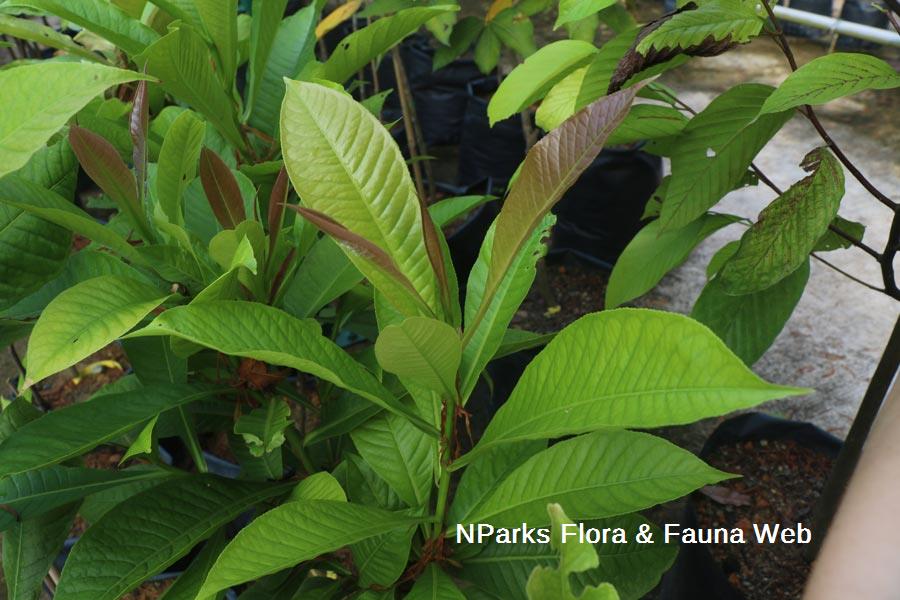
| Foliage | The leaves are obovate to elliptic, measuring 20 – 32 cm long and 7 – 9 cm wide, and have a leathery texture. Each leaf has about 8 pairs of lateral veins. Both the lateral veins and midrib are prominent on the underside of the leaf. The leaf tip is tapering (acuminate), up to 1 cm long, while the leaf base is wedge-shaped (attenuate). The leaf margin finely toothed (crenulate) and the leaf stalk (petiole) is absent (sessile). |
| Flowers | The flowers occur in a cluster (paniculate corymbose) at the terminal end of the branches. Each inflorescence is up to 15 cm long. The flowers are small (about 2.5 cm long and 1.5 cm wide) and white. Each flower has numerous stamens, four petals, and one style (up to 2.5 cm long). |
| Fruit | The fruit is ellipsoid or suborbicular (2-3 cm long) and winged. |
| Habitat | It is found in rainforests. |
| Associated Flora | Flowers are pollinated by insects. |
| Cultivation | It can be propagated by seed. |
| Ethnobotanical Uses | Edible Plant Parts : Edible Seeds Timber & Products: The timber is used in the construction of bridges and beams, as well as for piling, veneer, plywood, and paper production. Others: In the Philippines, the seeds are reportedly edible and are said to taste like peanuts. |
Fauna, Pollination and Dispersal
| Pollination Method(s) | Biotic (Fauna) |
|---|
Plant Care and Propagation
| Light Preference | Full Sun |
|---|---|
| Water Preference | Moderate Water |
| Plant Growth Rate | Moderate |
Foliar
| Mature Foliage Colour(s) | Green |
|---|---|
| Mature Foliage Texture(s) | Leathery |
| Foliar Type | Simple / Unifoliate |
| Foliar Attachment to Stem | Sessile |
| Foliar Margin | Crenulate |
| Foliar Apex - Tip | Acuminate |
| Foliar Base | Attenuate |
References
| References | Prance, G.T. & Kartawinata, E.K. (2013). Lecythidaceae. In: Nooteboom, H.P. & van Welzen, P.C. (ed.) Flora Malesiana, ser. 1, vol. 21, pp. 1–118. Leiden: Naturalis Biodiversity Center. Sosef, M.SM., Hong, L.T., and Prawirohatmodjo, S. (Editors). 1998. Plant Resources of South-East Asia Volume 5 (3). Timber Trees: Lesser known timbers. Leiden: Prosea Foundation. 859 pages. |
|---|
Image Repository
Others
| Master ID | 34557 |
|---|---|
| Species ID | 8970 |
| Flora Disclaimer | The information in this website has been compiled from reliable sources, such as reference works on medicinal plants. It is not a substitute for medical advice or treatment and NParks does not purport to provide any medical advice. Readers should always consult his/her physician before using or consuming a plant for medicinal purposes. |