




Back
Claderia leontocampus Niissalo
| Family Name: | Orchidaceae |
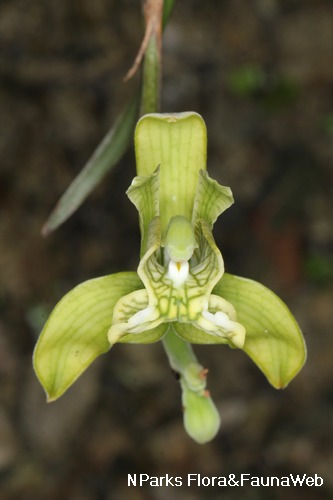
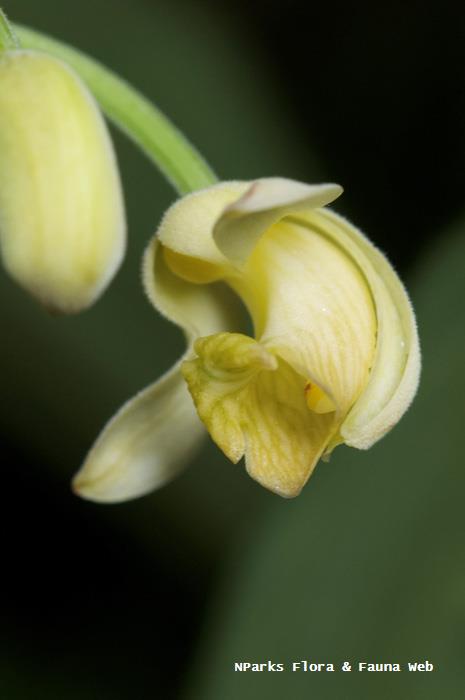
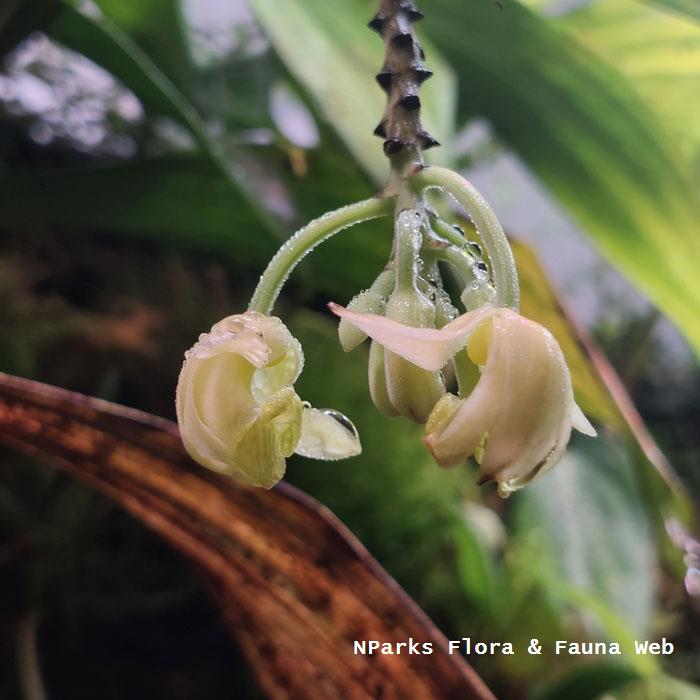
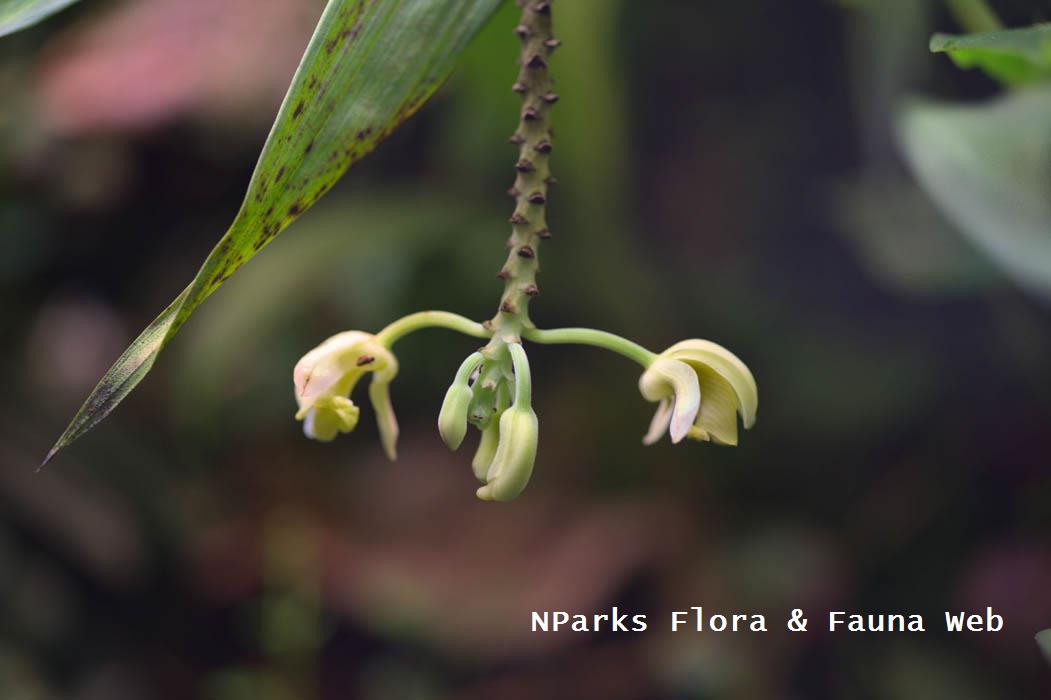
Claderia leontocampus has small, cream-yellow flowers on long pendulous clusters and large, bright yellow-green pleated leaves. First collected from Singapore, it was found growing in secondary lowland forest, on well-drained soil where it grows best under partial sunlight and moderate watering.
Name
Classifications and Characteristics
| Plant Division | Angiosperms (Flowering Seed Plants) (Monocotyledon) |
|---|---|
| Plant Growth Form | Herbaceous Plant, Climber |
| Lifespan (in Singapore) | Perennial |
| Mode of Nutrition | Autotrophic |
| Maximum Height | 25 cm to 35 cm |
Biogeography
| Native Distribution | Peninsular Malaysia (Perlis), Singapore, Sumatra. |
|---|---|
| Native Habitat | Terrestrial |
| Preferred Climate Zone | Tropical |
| Local Conservation Status | Native to Singapore (Critically Endangered (CR)) |
Description and Ethnobotany
| Growth Form | An erect orchid that grows up to 35 cm tall. In the beginning, it grows as a terrestrial before becoming climbing in habit, up to a height of 2 m on small tree trunks. |
|---|---|
| Roots | The adventitious roots (lateral roots) emerge from the nodes with short hairs of about 1 mm long. |
| Foliage | Plant has 3 to 5 narrowly elliptic leaves which are arching to one side, the sheaths are up to 4 cm long, clasping the stem. The leaves are pleated with 4 to 5 distinct veins. Leaves are glossy, bright yellow-green on both sides, leaf blade measures up to 32 cm long and 5 cm wide, with entire (smooth) margin, and acuminate (tapering to a long tip). |
| Stems | Rhizome (underground stem) is bright green, about 20 - 30 cm long, with transparent pale green sheath which turns papery and light brown as it dries. Each rhizome can have at least 10 nodes (stem part where leaf is attached). The stem measures from 2 to 6 cm long, and covered with 1 or 2 sheaths or small leaves. |
| Flowers | Pale cream-yellow pendulous flowers borne on long inflorescence (15 - 20 cm long) located at the terminal, with up have up to 160 flowers. Each flower is about 1.3 cm long and 2.5 cm wide, open to about 3 days and has no fragrance. |
| Fruit | Capsule is spindle-shaped, measuring about 5 cm long and 1.5 cm wide. |
| Habitat | In its native habitat, it is found growing in secondary lowland forest on well-drained soil. |
| Similar | C. leontocampus is similar to C. viridiflora but differs in having narrower flowers (2.5 cm) and is cream-yellow compared to C. viridiflora which is 5 cm wide and is bright green. The inflorescence of C. leontocampus mostly have two flowers which open simultaneously together with many developing buds, unlike C. viridiflora which has one flower developing and open at a time. |
| Etymology | The specific epithet leontocampus is the Greek translation of Merlion, a symbol of Singapore, which refers to the type locality of the species found. |
Plant Care and Propagation
| Light Preference | Semi-Shade |
|---|---|
| Water Preference | Moderate Water |
| Plant Growth Rate | Moderate |
| Rootzone Tolerance | Well-Drained Soils |
| Fertilizing | The plant is likely to be self-infertile, requiring both individual plants to be flowering simultaneously in cultivation, and then cross-pollinated to produce seeds. |
| Propagation Method | Division, Seed, Storage Organ (Rhizome) |
Foliar
| Foliage Retention | Evergreen |
|---|---|
| Mature Foliage Colour(s) | Green, Yellow / Golden |
| Mature Foliage Texture(s) | Glossy / Shiny, Leathery |
| Prominent Young Flush Colour(s) | Green, Yellow / Golden |
| Young Flush Texture(s) | Glossy / Shiny, Leathery |
| Foliar Type | Simple / Unifoliate |
| Foliar Arrangement Along Stem | Opposite |
| Foliar Attachment to Stem | Sessile |
| Foliar Shape(s) | Non-Palm Foliage (Elliptical) |
| Foliar Venation | Parallel |
| Foliar Margin | Entire |
| Foliar Apex - Tip | Acuminate |
| Foliar Base | Clasping |
| Typical Foliar Size | 12 cm to 32 cm |
Non - Foliar and Storage
| Root Type | Aboveground (Aerial Root) |
|---|
Floral (Angiosperm)
| Flower & Plant Sexuality | Bisexual Flowers |
| Flower Colour(s) | Cream / Off-White, Yellow / Golden |
|---|---|
| Flower Grouping | Cluster / Inflorescence |
| Flower Location | Terminal |
| Flower Symmetry | Bilateral |
| Individual Flower Shape | Labiate / Lipped |
| Inflorescence Type | Raceme |
| Flower Lifespan on Plant | 3 days |
| Flower Size | 1.3 cm x 2.5 cm |
Fruit, Seed and Spore
| Fruit Type | Fleshy Fruit , Capsule |
References
| References | <1> Niissalo, M.A., Leong, P.K.F., Tay, F.E.L., Choo, L.M., Kurzweil, H. & Khew, G.S. (2023). A new species of Claderia (Orchidaceae). Gardens' Bulletin Singapore 75(1): 21-41. |
|---|
Image Repository
Others
| Master ID | 34564 |
|---|---|
| Species ID | 8977 |
| Flora Disclaimer | The information in this website has been compiled from reliable sources, such as reference works on medicinal plants. It is not a substitute for medical advice or treatment and NParks does not purport to provide any medical advice. Readers should always consult his/her physician before using or consuming a plant for medicinal purposes. |