










Back
Carex 'ET CRX01'
| Family Name: | Cyperaceae |
| Common Name: | Carex Feather Falls™, Feather Falls™ Sedge, Variegated Sedge |
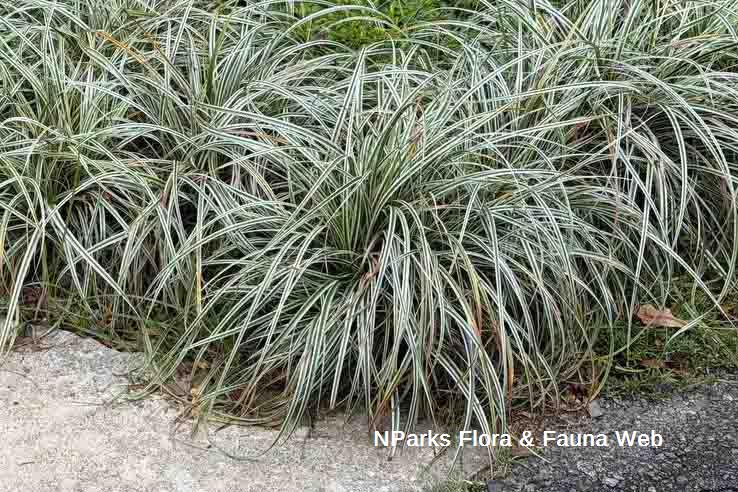
Carex Feather Falls™ is a compact ornamental sedge. Eye-catching long, slender variegated leaves are marked with white marginal bands and a central green band. It grows in full sun or semi-shade and requires little to moderate watering, making it suitable for parks, gardens and rooftop planting.

Name
Classifications and Characteristics
| Plant Division | Angiosperms (Flowering Seed Plants) (Monocotyledon) |
|---|---|
| Plant Growth Form | Grass or Grass-like Plant (Sedge (Cyperaceae)) |
| Lifespan (in Singapore) | Perennial |
| Mode of Nutrition | Autotrophic |
| Plant Shape | Grassy |
| Maximum Height | 0.3 m |
| Maximum Plant Spread / Crown Width | 0.8 m |
Biogeography
| Preferred Climate Zone | Sub-Tropical / Monsoonal, Temperate |
|---|---|
| Local Conservation Status | Non-native (Horticultural / Cultivated Only) |
Description and Ethnobotany
| Growth Form | It is a compact, perennial herbaceous plant, growing up to 0.3 m tall and about 0.8 m wide. It produces offshoots at the base of the plant, creating a crowded appearance. |
|---|---|
| Roots | The fibrous roots are fleshy. |
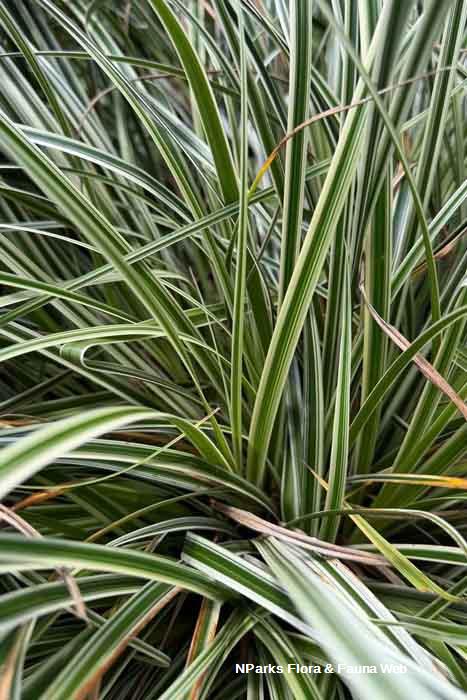
| Foliage | The leaves are long, narrow (about 74 cm long × 1.2 cm wide), narrowly lanceolate, arching and variegated with a thick white marginal band and a central green band. The variegation at the base of the leaves is greener than that on leaves exposed to the sun. The leaves are arranged spirally in a rosette. The leaf margins and underside of the midribs are armed with numerous, minute hooked prickles. |
| Flowers | Flowers have not been observed in Singapore. |
| Taxonomy | This hybrid was selected by Bart Noordhuis and Elisabeth Bisschop of External Plants in Bojil, the Netherlands, and often marketed in the horticulture trade as Carex Feather Falls™ or Carex 'Feather Falls'. |
| Cultivation | It grows best in fertile, moist, well-draining soil, in full sun or semi-shade, with little to moderate watering. It is tolerant of temporary waterlogging; prolonged waterlogging can lead to root rot. Established plants are drought-tolerant. It can be propagated by division. |
| Etymology | The genus Carex is derived from the classical Latin name for a sedge. |
Landscaping Features
| Desirable Plant Features | Ornamental Foliage, Ornamental Form |
|---|---|
| Landscape Uses | Parks & Gardens, Small Gardens, Groundcover, Container Planting, Suitable for Hanging Baskets, Suitable for Rooftops |
| Thematic Landscaping | Silver Garden |
Plant Care and Propagation
| Light Preference | Full Sun, Semi-Shade |
|---|---|
| Water Preference | Moderate Water, Little Water |
| Plant Growth Rate | Moderate |
| Rootzone Tolerance | Drought Tolerant, Moist Soils, Waterlogged Soils (Drains Site), Well-Drained Soils |
| Maintenance Requirements | Low |
| Propagation Method | Division |
Foliar
| Foliage Retention | Evergreen |
|---|---|
| Mature Foliage Colour(s) | Green, White |
| Mature Foliage Texture(s) | Spiny / Bristly / Stinging, Glossy / Shiny, Smooth |
| Foliar Type | Simple / Unifoliate |
| Foliar Arrangement Along Stem | Rosulate / Rosette |
| Foliar Attachment to Stem | Sessile |
| Foliar Shape(s) | Non-Palm Foliage (Lanceolate) |
| Foliar Venation | Parallel |
| Foliar Margin | Spiny, Serrate / Toothed |
| Foliar Apex - Tip | Acuminate |
| Foliar Base | Clasping |
| Leaf Area Index (LAI) for Green Plot Ratio | 3.5 (Shrub & Groundcover - Monocot) |
Non - Foliar and Storage
| Root Type | Underground (Fibrous Root) |
|---|
References
| References | Noordhui, B. & Bisschop, (2015). Carex plant named ‘ET CRX01’ (U.S. Patent No. USPP26199P2), U.S. Patent and Trademark Office. https://patents.google.com/patent/USPP26199P2/en (Accessed on 13 March 2026) |
|---|
Image Repository
Others
| Master ID | 34586 |
|---|---|
| Species ID | 8999 |
| Flora Disclaimer | The information in this website has been compiled from reliable sources, such as reference works on medicinal plants. It is not a substitute for medical advice or treatment and NParks does not purport to provide any medical advice. Readers should always consult his/her physician before using or consuming a plant for medicinal purposes. |