









Back
Muhlenbergia capillaris (Lam.) Trin.
| Family Name: | Poaceae (Gramineae) |
| Common Name: | Pink Muhly Grass, Gulf Muhly, Hairawn Muhly |
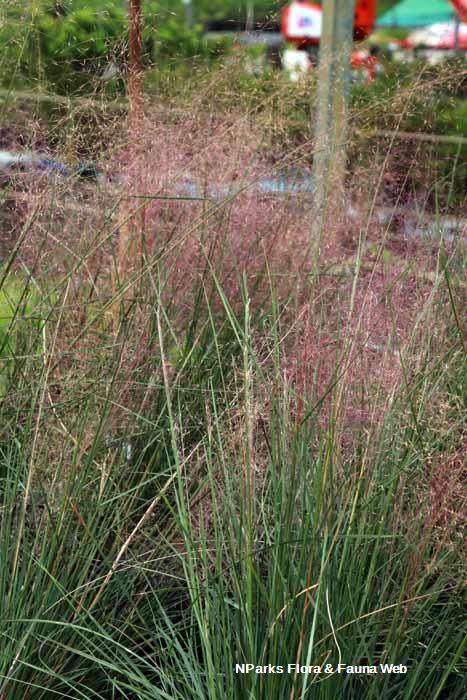
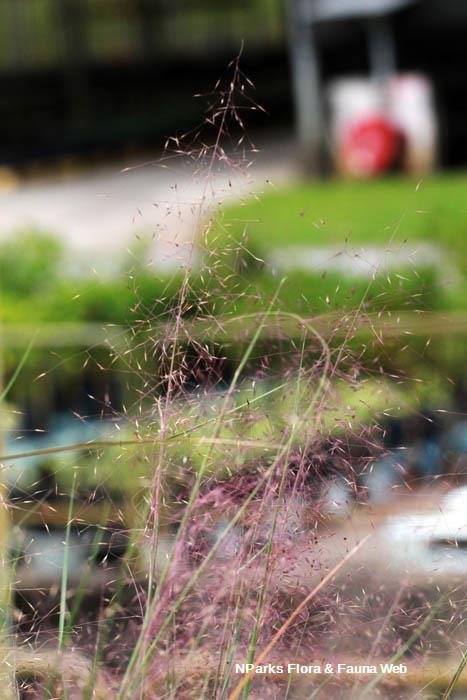
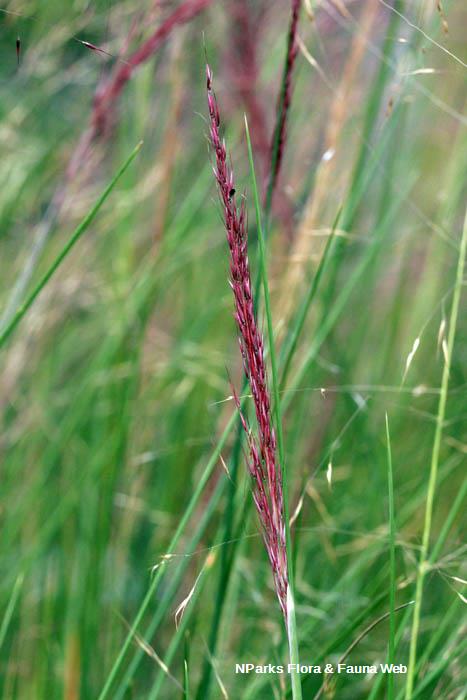
Muhlenbergia capillaris, also known as Pink Muhly Grass, is a slow-growing, clumping grass that can reach 0.6–1 m tall. It produces long, glossy, thin leaves and ornamental plumes of pink to purple flowers. It grows well under full sun, requires minimal watering and is drought tolerant, making it suitable for dry areas and traffic islands.
Name
Classifications and Characteristics
| Plant Division | Angiosperms (Flowering Seed Plants) (Monocotyledon) |
|---|---|
| Plant Growth Form | Grass or Grass-like Plant (Tall Grass (Poaceae)) |
| Lifespan (in Singapore) | Perennial |
| Mode of Nutrition | Autotrophic |
| Plant Shape | Grassy |
| Maximum Height | 0.6 to 1 |
Biogeography
| Native Distribution | Southeastern U.S.A, Mexico, Guatemala, Bahamas, Cuba, & Puerto Rico |
|---|---|
| Native Habitat | Terrestrial (Temperate Forest, Grassland / Savannah/ Scrubland, Disturbed Area / Open Ground) |
| Preferred Climate Zone | Temperate, Sub-Tropical / Monsoonal |
| Local Conservation Status | Non-native (Horticultural / Cultivated Only) |
Description and Ethnobotany
| Growth Form | It is a perennial grass, growing in dense tufts up to 0.6–1 m tall. |
|---|---|
| Foliage | The leaves are smooth or slightly rough to the touch. The leaf blades are glossy, dark green, needle-like, curving and reach 20–50 cm long × 1–2 mm wide. The leaf sheaths are smooth or slightly rough to the touch. The ligule (projection at the top of the leaf sheath) is present, being minute (2–5(–8) mm long), hairless membrane. The leaves are arranged alternately in two ranks. |
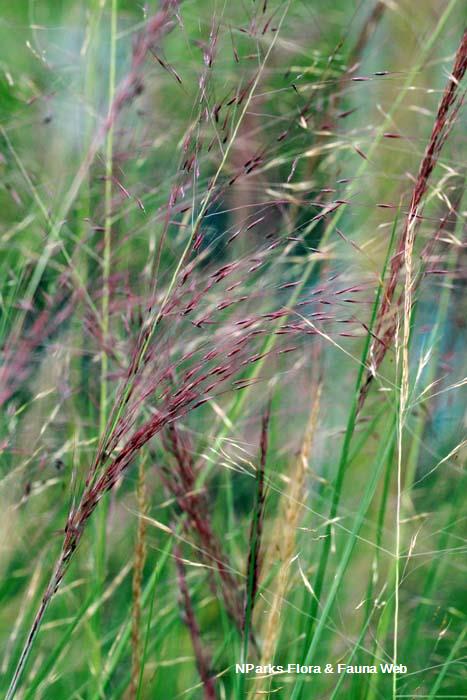
| Stems | The culms (aboveground stems of grasses and grass-like monocots) are erect, and slender, growing up to 0.6–1.0 m tall. The nodes are covered in fine hairs. |
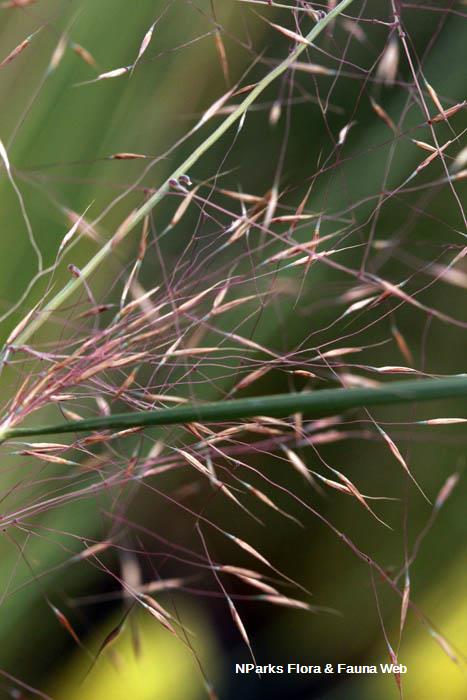
| Flowers | The inflorescence is a bright pink to pink-red open, plume-like panicle with spikelets. Each spikelet comprises a single fertile floret, each consisting of heavily reduced petals and sepals, purple anthers, and stigmas. |
| Fruit | The fruit is a caryopsis (a type of dry, indehiscent fruit, commonly known as a grain). |
| Habitat | It can be found in sandy or rocky soils, in prairies, pine barrens, sandhill, open woodlands, and moist coastal grasslands. |
| Cultivation | It grows best in moist, well-draining soil and bright, direct sunlight or light shade. It is drought tolerant and should not be planted in waterlogged soil. It can be propagated by seeds and division. |
| Etymology | The genus Muhlenbergia is named in honour of Henri Ludwig Muhlenberg, a 18th Century American clergyman and botanist. The specific epithet capillaris means "hair-like", referring to the fine-tetured leaves, stems and plume-like inflorescences. |
Landscaping Features
| Landscaping | It can be planted single as a focal plant but is especially dramatic in groups and sweeps. It is drought tolerant and hardy enough in challenging settings, such as traffic islands. |
|---|---|
| Desirable Plant Features | Ornamental Foliage, Ornamental Flowers, Ornamental Form |
| Landscape Uses | Suitable for Roadsides |
Plant Care and Propagation
| Light Preference | Full Sun |
|---|---|
| Water Preference | Moderate Water, Little Water |
| Plant Growth Rate | Slow |
| Rootzone Tolerance | Drought Tolerant, Well-Drained Soils |
| Propagation Method | Division, Seed |
Foliar
| Foliage Retention | Evergreen |
|---|---|
| Mature Foliage Colour(s) | Green |
| Mature Foliage Texture(s) | Glossy / Shiny, Smooth |
| Foliar Type | Simple / Unifoliate |
| Foliar Arrangement Along Stem | Alternate |
| Foliar Attachment to Stem | Sessile |
| Foliar Shape(s) | Non-Palm Foliage (Linear) |
| Foliar Venation | Parallel |
| Leaf Area Index (LAI) for Green Plot Ratio | 3.5 (Shrub & Groundcover - Monocot) |
Non - Foliar and Storage
| Stem Type & Modification | Culm |
|---|---|
| Root Type | Underground (Fibrous Root) |
Floral (Angiosperm)
| Flower Colour(s) | Pink |
|---|---|
| Flower Grouping | Cluster / Inflorescence |
| Flower Location | Terminal |
| Inflorescence Type | Spikelet / Pseudospikelet / Compound Spike |
Fruit, Seed and Spore
| Mature Fruit Colour(s) | Brown |
|---|---|
| Seed Quantity Per Fruit | Few (1-5) |
References
| References |
|
|---|
Image Repository
Others
| Master ID | 34587 |
|---|---|
| Species ID | 9000 |
| Flora Disclaimer | The information in this website has been compiled from reliable sources, such as reference works on medicinal plants. It is not a substitute for medical advice or treatment and NParks does not purport to provide any medical advice. Readers should always consult his/her physician before using or consuming a plant for medicinal purposes. |