




Back
Oxera sulfurea Dubard
| Family Name: | Lamiaceae (Labiatae) |
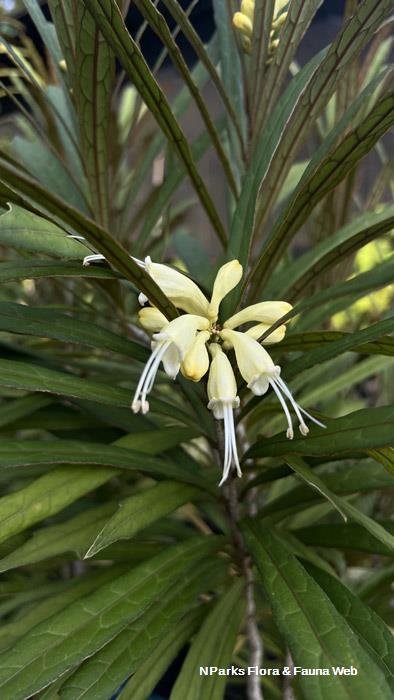
Oxera sulfurea is a tree or shrub, occasionally a climber, endemic to New Caledonia. It grows up to 10 m tall and produces yellow flowers, with fruits that turn yellow at maturity.

Name
Classifications and Characteristics
| Plant Division | Angiosperms (Flowering Seed Plants) |
|---|---|
| Plant Growth Form | Shrub, Tree |
| Lifespan (in Singapore) | Perennial |
| Mode of Nutrition | Autotrophic |
| Maximum Height | 10 m |
Biogeography
| Native Distribution | New Caledonia |
|---|---|
| Native Habitat | Terrestrial |
| Preferred Climate Zone | Tropical |
| Local Conservation Status | Non-native |
Description and Ethnobotany
| Growth Form | It is a tree, scrambling shrub or sometimes a woody climber, up to 10 m tall. The bark is smooth and dark brown. |
|---|---|
| Foliage | The leaves are oblong to lanceolate to linear, measuring 6 – 20 cm long and 1.1 – 7 cm wide, and have a leathery texture (coriaceous). They are arranged in opposite pairs (decussate) or in whorls. Each leaf has 6 – 12 pairs of lateral veins. The leaf tip is rounded to acute while the leaf base is narrow (attenuate) to wedged-shaped (cuneate). The leaf margin is entire when mature but wavy (undulate) when young. The leaf stalk (petiole) is 6 – 19 mm long. |
| Flowers | The flowers occur in branched clusters (thyrse) both in the leaf axils and on the stem (cauline). They are yellow, salver-shaped with four lobes, and measure about 19–42 mm long and 4.5–14 mm wide at the mouth. |
| Fruit | The fruit turns yellow when mature and consists of 1–4 mericarps. Each mericarp is covered with granular warts and contains a single seed. |
| Habitat | It is found in dry forests (sclerophyll forest) and shrubland (maquis vegetation), up to 300m altitude. |
| Associated Fauna | In New Caledonia, flowers are observed to be visited by New Caledonian Myzomela (Myzomela dibapha caledonica) and Grey-eared Honeyeater (Lichmera incana incana), bees while the glands on the calyx are observed to be visited by Eggfly butterfly (Hypolimnas bolina) and Little Fire Ant (Wasmannia auropunctata) |
| Cultivation | It can be propagated by seed. |
| Etymology | The genus Oxera, in Greek, means bulky or swollen, referring to the corolla tube of Oxera pulchella, the first species described in the genus. The specific epithet sulferea, in Latin, means yellow. |
Landscaping Features
| Desirable Plant Features | Ornamental Flowers, Ornamental Foliage |
|---|---|
| Landscape Uses | Parks & Gardens |
Fauna, Pollination and Dispersal
| Pollination Method(s) | Biotic (Fauna) |
|---|
Plant Care and Propagation
| Light Preference | Full Sun |
|---|---|
| Water Preference | Moderate Water |
| Plant Growth Rate | Moderate |
Foliar
| Mature Foliage Colour(s) | Green |
|---|---|
| Mature Foliage Texture(s) | Leathery |
| Foliar Type | Simple / Unifoliate |
| Foliar Arrangement Along Stem | Whorled, Opposite |
| Foliar Attachment to Stem | Petiolate |
| Foliar Venation | Reticulate |
| Foliar Margin | Entire, Entire - Wavy / Undulate |
| Foliar Apex - Tip | Rounded, Acute |
| Foliar Base | Attenuate, Cuneate |
Non - Foliar and Storage
| Trunk Type (Non Palm) | Non Woody |
|---|---|
| Mature Bark Texture | Smooth |
| Root Type | Underground |
Floral (Angiosperm)
| Flower & Plant Sexuality | Bisexual Flowers |
| Flower Colour(s) | Yellow / Golden |
|---|---|
| Flower Grouping | Cluster / Inflorescence |
| Flower Location | Axillary |
| Individual Flower Shape | Salverform |
| Inflorescence Type | Thyrse |
Fruit, Seed and Spore
| Mature Fruit Colour(s) | Yellow / Golden |
|---|
References
| References | Mabberley, D. & de Kok, R. 2004. Labiatae in the Flora of New Caledonia (English text) In book: Flore de la Nouvelle-Calédonie et Dépendances, vol. 25, pp.20–141. Paris: Muséum National D'Histoire Naturelle |
|---|
Image Repository
Others
| Master ID | 34589 |
|---|---|
| Species ID | 9002 |
| Flora Disclaimer | The information in this website has been compiled from reliable sources, such as reference works on medicinal plants. It is not a substitute for medical advice or treatment and NParks does not purport to provide any medical advice. Readers should always consult his/her physician before using or consuming a plant for medicinal purposes. |