











Back
Ophioglossum pendulum L.
| Family Name: | Ophioglossaceae |
| Common Name: | Ribbon Fern, Adder's Tongue Fern |
Name
Classifications and Characteristics
| Plant Division | Ferns & Lycophytes (Non-Seed Vascular Plants) (Fern) |
|---|---|
| Plant Growth Form | Epiphyte, Herbaceous Plant |
| Lifespan (in Singapore) | Perennial |
| Mode of Nutrition | Autotrophic |
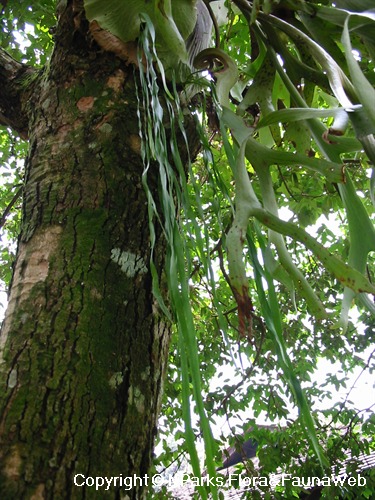
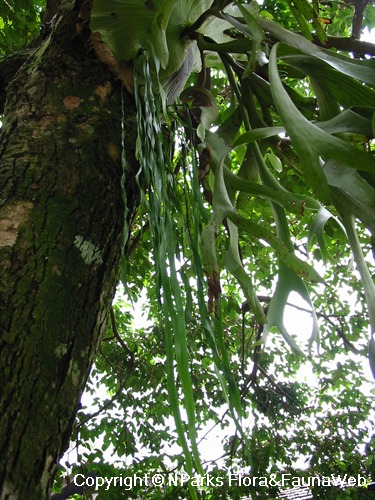
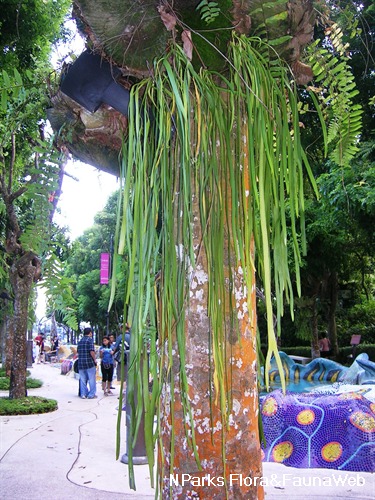
| Plant Shape | Weeping / Pendulous |
| Maximum Height | 0.4 m to 1.2 m |
Biogeography
| Native Distribution | Western Indian Ocean (Comoros, Mauritius, Madagascar, Réunion, Seychelles), China (South-Central China, Hainan), Japan, Korea, Taiwan, India, East and West Himalayas, Sri Lanka, Nicobar Islands, Cambodia, Thailand, Laos, Vietnam, Peninsular Malaysia, Sumatra, Borneo, Java, Lesser Sunda Islands, Maluku, Philippines, Sulawesi, Christmas Islands, Bismarck Archipelago, New Guinea, Solomon Islands, Australia (Norfolk Islands, New South Wales, Queensland), Pacific Islands (Fiji, Niue, New Caledonia, Samoa, Santa Cruz Islands, Tonga, Vanuatu, Wallis-Futuna Islands, Cook Islands, Marquesas, Society Islands, Tuamotu, Tubuai Islands, Caroline Islands, Marshall Islands, Hawaii. |
|---|---|
| Native Habitat | Terrestrial (Primary Rainforest, Secondary Rainforest) |
| Preferred Climate Zone | Tropical, Sub-Tropical / Monsoonal |
| Local Conservation Status | Native to Singapore (Critically Endangered (CR)) |
Description and Ethnobotany
| Growth Form | It is an epiphytic fern with pendulous fronds, growing on palms, tree-ferns, trees, sometimes on rocks; in the lowlands and hills. |
|---|---|
| Foliage | Fronds light to mid green, pendent, tape or ribbon-like, 0.4m to 1.2m in length and 1cm to 4cm wide, often to 1.5m or more in cultivation. Fronds simple, or branching dichotomously. |
| Reproductive Parts - non-flowering plant | The spike produces numerous creamy white spores that are dispersed by wind. |
| Habitat | Grows in association with Platycerium species (Staghorn ferns) and Asplenium nidus (Bird's nest ferns); spores of the Adder's tongue fern rely on a fungus (mycorrhiza) to germinate that is found in the 'nest' of these ferns. In cultivation, the fern can be detached and grown separately from the Staghorn/ birdnest fern, |
| Cultivation | It can be propagated by spores. |
| Etymology | Greek Ophis, a snake; Greek glossa, tongue, referring to the slender fertile spike bearing the sporangia in this genus; Latin pendulum, hanging, pendulous, referring to the pendulous fronds. |
| Ethnobotanical Uses | Others: Its long, narrow leaves are shredded into coconut oil by the Moluccas, to be applied to the head for the improvement of the hair. |
Landscaping Features
| Desirable Plant Features | Ornamental Foliage, Ornamental Form |
|---|---|
| Landscape Uses | Parks & Gardens, Small Gardens, Indoor Plant, Container Planting, Suitable for Hanging Baskets |
Fauna, Pollination and Dispersal
| Seed or Spore Dispersal | Abiotic |
|---|
Plant Care and Propagation
| Light Preference | Semi-Shade |
|---|---|
| Water Preference | Moderate Water, Lots of Water, Occasional Misting |
| Plant Growth Rate | Fast to Moderate |
| Rootzone Tolerance | Shallow Media |
| Propagation Method | Spore |
Foliar
| Foliage Retention | Evergreen |
|---|---|
| Mature Foliage Colour(s) | Green |
Image Repository
Others
| Master ID | 263 |
|---|---|
| Species ID | 1559 |
| Flora Disclaimer | The information in this website has been compiled from reliable sources, such as reference works on medicinal plants. It is not a substitute for medical advice or treatment and NParks does not purport to provide any medical advice. Readers should always consult his/her physician before using or consuming a plant for medicinal purposes. |